Home
+

Published : 23 Oct 2024, 02:47 AM
The demand for the removal of the president, appointed during Sheikh Hasina's tenure, has intensified amid the push for state reform and the expulsion of fascism.
Anti-discrimination Student Movement, which led the ousting of Hasina, along with several other organisations, has set a deadline for the president to resign.
Protests and high drama continued late into the night outside the Bangabhaban.
Coordinators of the movement began voicing the demand in early October, especially following a statement from President Mohammed Shahabuddin regarding Hasina's resignation.
Now, even the advisors to the interim government are echoing similar sentiments.
However, the question remains: can the interim administration remove President Shahabuddin from office?
According to constitutional law experts, since the parliament is not functional, it is not possible for the interim government to remove the president under the current constitutional framework.
However, it is not impossible to remove him. If deemed necessary, the government could ask the president to leave.
The president may also choose to step down voluntarily. The government could then appoint a new president.
Yet, such actions are not possible under the current constitution.
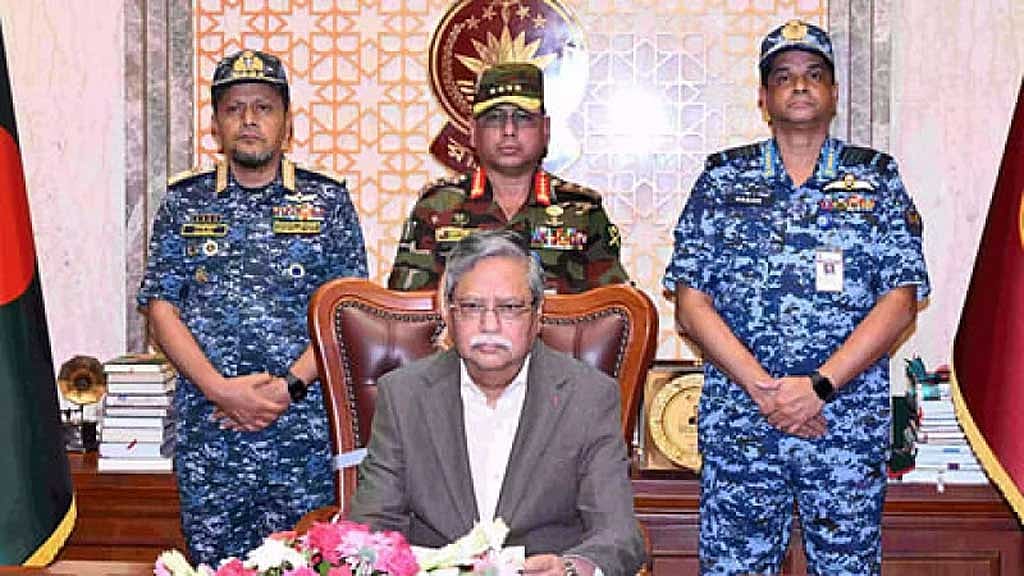
Despite the change in top administrative positions following the end of the Awami League's 15-year rule, Shahabuddin has remained in the presidential role due to 'inevitable' reasons.
On Oct 3, Hasnat Abdullah, a coordinator of the movement, raised the demand for the president's removal in a Facebook post.
Later, another coordinator Sarjis Alam echoed the same call on the platform.
Amid the cacophony, renewed discussions have emerged surrounding the demand. The debate about whether the ousted prime minister submitted her resignation before flying to India has resurfaced after two and a half months, triggered by a statement from the president.
In Bangladesh's history, there has been only one instance of an impeachment effort against a president.
In November 2001, then BNP-elected president late AQM Badruddoza Chowdhury faced removal attempts by the government, but he resigned on Jun 21, 2002, before the process could proceed.
On the night of Hasina’s departure from the country, President Shahabuddin addressed the nation, confirming he had received the former prime minister's resignation letter.
WHAT DOES THE CONSTITUTION SAY?
According to Article 48 of the Bangladesh Constitution, Bangladesh shall have a president, who will be elected by the members of parliament in accordance with the law.
Article 50 says the President shall hold office for five years from the date of assuming duties.
Article 52 provides for the impeachment of the president on charges of constitutional violation or grave misconduct, but specific procedures must be followed, requiring the support of at least two-thirds of the members of parliament.
Article 53 says the president can be removed due to physical or mental incapacity, also requiring the backing of two-thirds of parliament.
Following Hasina’s resignation, the president dissolved parliament on Aug 6, leaving no opportunity for impeachment, according to law experts.
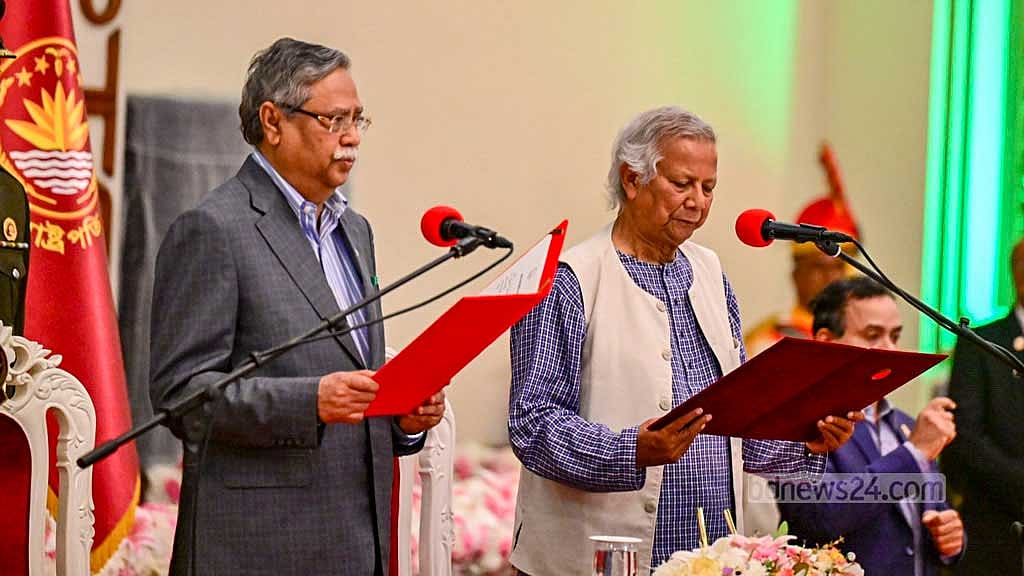
After the fall of the Awami League government, President Shahabuddin administered the oath to the members of the transitional government in the Darbar Hall of Bangabhaban on Aug 8.
WHERE ARE THE OPPORTUNITIES FOR REMOVAL?
Senior Supreme Court lawyer Shahdeen Malik told bdnews24.com that the president cannot be removed without a voluntary resignation at this time.
He said, “In a state of war, the president could reinstate parliament. But we are not in a state of war now.”
Another lawyer Monjil Morshed said, “There is no legal way left for the removal or impeachment of the president at this time. If the president resigns, then it can happen. There are no other options now.”
He said there is no point in seeking the court's opinion on the president's removal at this moment.
“The matter of consulting the court is mentioned in Article 106 of the Constitution. It says if there is a need for deviation or interpretation regarding any law, then only the president can seek the court's opinion,” he added.
DOES ADVISORY COUNCIL HAVE ANY POWER IN THIS MATTER?
Lawyer Monjil said, “They can consider it. However, the advisory council has already taken the oath under the president. They have accepted the president. They can think about whether they want the President or not—anyone can think about this. Those in power can think, but there is nothing they can do.”
“The president can either be impeached or resign. These are the only two options,” he added.
With parliament not in place, how can the president be removed in this situation?
In response to the question, Sharif Bhuiyan, a member of the Constitution Reform Commission and a Supreme Court lawyer, told bdnews24.com: “He [president] must resign.”
WHAT IF HE DOES NOT RESIGN
He said, "Someone needs to ask the president to resign."
When asked who would take that initiative, Sharif said: "One of the advisors will say it. The advisory council will propose to him [president] that he should resign. Then, another person will be appointed as the president, and the chief advisor will administer the oath."
But the authority to elect the president lies with parliament. Since there is no parliament now, how will a new president be appointed?
In response, he said: "There is no constitutional government right now; this is a revolutionary government. Not everything will follow the Constitution. Some things will, some things won’t. The work must be done in the spirit of the Constitution, reflecting the aspirations of the people."

However, Lawyer Monjil believes that as long as the constitution remains in effect, discussing non-legal matters serves no purpose.
On Aug 8, the interim government led by Muhammad Yunus took the oath, promising to abide by the constitution.
President Shahabuddin moved into Bangabhaban with his family after taking the oath on Apr 24, 2023.
WHAT HAPPENS IF THE PRESIDENT RESIGNS
If the president resigns or is unable to perform their duties due to illness or other reasons, the Constitution outlines the next steps.
Until a new president is elected or the current president resumes their responsibilities, the speaker will assume the role.
However, on Sept 2, Speaker Shirin Sharmin Chaudhury resigned from her position. In her absence, Deputy Speaker Shamsul Haque Tuku, who could have taken over, was arrested on Aug 15.
According to Article 74 of the Constitution, the speaker or deputy speaker remains in office until their successor takes over.
When asked what would happen if the president resigns, ZI Khan Panna, Supreme Court lawyer and human rights activist, said: "Why, the students will elect a new president. The chief advisor to the interim government has already said that it was the students who brought him to power, and they will also elect the president.”
Panna believes that since Speaker Shirin has already resigned, there is no opportunity for anyone to assume the role of acting president following the resignation of the incumbent.
WHAT IS THE CONTROVERSY ABOUT?
A few hours after Hasina fled to India on Aug 5, Army chief Gen Waker-Uz-Zaman held a meeting with the leaders of the BNP, the then-banned Jamaat-e-Islami, Hifazat-e Islam and several other party heads and declared that Hasina had resigned before leaving the country.
President Shahabuddin also addressed the nation that evening, confirming the former premier had submitted her resignation letter, which he had accepted.
Following this, a caretaker government, led by Muhammad Yunus, was formed with the Supreme Court's consultation.
A few days later, Hasina’s son Sajeeb Wazed Joy said that his mother did not get a chance to resign while speaking at an interview with a foreign media.
Later, Hasina was heard reiterating the same in a leaked phone call conversation.
On Oct 17, the ICT issued arrest warrants against Hasina and 45 others for two counts of genocide aimed at quelling the Anti-discrimination Student Movement. It also ordered them to appear in court by Nov 18.
The order came at the start of trials relating to the 'genocide' during the student-led mass uprising in July and August that overthrew the Awami League government.
On Oct 19, the daily Manab Zamin Chief Editor Matiur Rahman Chowdhury in its political magazine ‘Janatar Chokh’ wrote: “The question is, if the prime minister had resigned, then where did it [the resignation letter] go? No one has the answer to this question. I have been searching for three weeks. I even looked into the Cabinet Division where the resignation letters of presidents, prime ministers and ministers are supposed to be. It is nowhere to be found.”
Later, Matiur asked the question to the president himself at the Bangabhaban.
To which, Shahabuddin reportedly replied: “I have heard she resigned. But I do not have any documentary evidence. I have failed [to get it] despite trying. Maybe she did not have the time [to resign].”
Before the publication of Matiur's article, coordinator Hasnat had already been calling for the president's removal.
Law Advisor Asif Nazrul said: “In his speech on the 5th of August, the president repeatedly confirmed that the prime minister had resigned. If, after nearly two and a half months, he now claims no resignation letter was submitted, this is a direct contradiction and a breach of his oath. Questions arise about his eligibility to remain in office.”
The advisor added, “If a person is physically or mentally unfit or engages in gross misconduct, there are constitutional provisions to remove them from the presidency.”
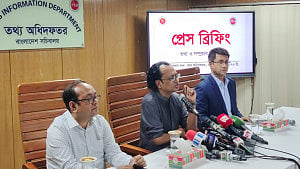
On Tuesday, during a press conference, the Deputy Press Secretary to the Chief Advisor Apurba Jahangir said the interim government agrees with Nazrul’s comments regarding the president.
Accompanied by ICT Advisor Nahid Islam, the law advisor met Chief Justice Syed Refaat Ahmed at the Supreme Court that day.
The Anti-discrimination Student Movement held a rally at the Central Shaheed Minar, presenting a five-point list of demands, which includes the president’s resignation and the abolishment of the constitution, to be fulfilled ‘within this week’.
Several factions of the movement, including Roktim July 24, Swadhin Sharbobhoumotto Rokkha Committee, and Inquilab Mancha, issued the ultimatum from a Bangabhaban siege programme, demanding the president’s resignation within 24 hours.
Demonstrators continued their protest late into the night.
At one point, protesters attempted to storm Bangabhaban after announcing their intentions via loudspeakers, but police blocked their entry.
Following this, army personnel took over security around Bangabhaban.
Two coordinators went to Bangabhaban late at night, requesting two additional days to withdraw the protesters.
However, a faction of the Gana Odhikar Parishad refused to back down and continued their demand for the president’s resignation. High drama outside Bangabhaban persisted until midnight.
Rumours also surfaced regarding the president’s health, but a Bangabhaban official informed bdnews24.com that no such information was available.
CONSTITUTIONAL PROCESSES FOR PRESIDENT’S REMOVAL
The constitutional process for the impeachment of the president is clearly outlined in Article 52 of the Constitution, which details the procedures for accusations of constitutional violations or serious misconduct.
A written notice of the proposal, signed by a majority of the members of parliament, must be submitted to the speaker.
The proposal can only be discussed between 14 and 30 days after the notice is issued. If the parliament is not in session, the speaker will call a session.
As per Article 52 (2), the parliament may refer the conduct of the president to a court, tribunal, or authority for investigation.
Article 52(3) grants the president the right to be present and to send a representative during the consideration of charges.
According to Article 52(4), if the proposal is passed by a two-thirds majority of the total members of parliament after considering the charges, the president's position will be declared vacant.
Removal due to incapacity:
Article 53(1) allows for the president's removal on the grounds of physical or mental incapacity. In such cases, a written proposal must also be submitted to the speaker.
The speaker will call a parliamentary session if needed and propose the formation of a medical board. If the proposal is accepted, the speaker will send a copy of the notice to the president, requesting their presence for an examination within 10 days.
The proposal can only be voted on between 14 and 30 days after the speaker has received the notice.
Additional provisions:
If the president refuses to appear before the medical board, the proposal can be voted on without an examination. If two-thirds of the parliament members vote in favour, the president's position will be declared vacant.
If the president does appear before the medical board, the proposal cannot be voted on until the board's report has been reviewed by parliament. If the proposal is passed by a two-thirds majority, the president’s position will become vacant.
Temporary assumption of duties:
According to Article 54, during the speaker’s temporary assumption of the president’s responsibilities, any reference to the speaker will be deemed to refer to the deputy speaker. If the proposal to remove the speaker is passed, the speaker must cease performing the the president's duties.
[Writing in English by Sheikh Fariha Bristy]