Published : 07 Dec 2025, 07:08 PM
Updated : 28 Aug 2026, 01:30 AM


Farmer Md Sujan of Cumilla Sadar Upazila cultivates radishes as an early winter crop. But when he harvested his yield, he found that all the radishes had turned black and had cracks on them. When he sought guidance from the agricultural officers, they said the soil of his farming land has too much acid in it.
The farmer from Amtali Gomti Char in Sadar Upazila said, "Due to demand, I sold radishes worth Tk 650,000 before they were harvested. Afterwards, I had to return the money to the buyer. I faced a financial loss of Tk 650,000 from just one field."
It isn’t just Sujan's land. The acidity level is increasing like a “silent killer” in the agricultural lands of Chandpur and Brahmanbaria and Cumilla. Harmful levels of acid have increased in about 50 percent of the land in Cumilla. One hundred percent of the land in four Upazilas is affected by the acid disease, said Md Mizanur Rahman, deputy director of the Cumilla Department of Agricultural Extension.
He said that the amount of acid in almost 100 percent of the land in the Sadar Upazila, Laksam, Barura and Lalmai Upazilas of Cumilla, an agriculturally rich area, has increased to a dangerous level.
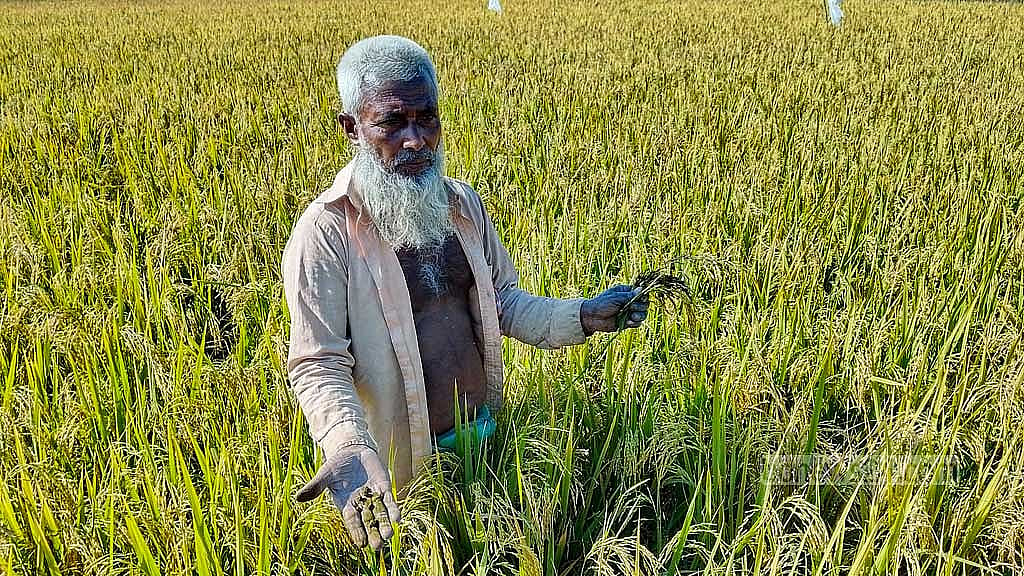
About 50 percent of the land in the entire district is affected by the acid. Therefore, farmers are not getting the expected yield despite cultivating crops at a high cost.
However, agriculture department officers are blaming farmers' ignorance for the increasing acidity caused by the decrease in organic matter in the soil.
They say that the situation has been created by the use of chemical fertilisers while cultivating multiple crops on the same land without using organic fertilisers.
Soil and fertiliser researchers say that a drop in the pH or potential hydrogen value of arable land below 5.5 is a concern for expected yield and production.
They say that if the acidity level increases, plants cannot absorb nutrients from the soil even if fertilisers are applied. This problem is increasing day by day.
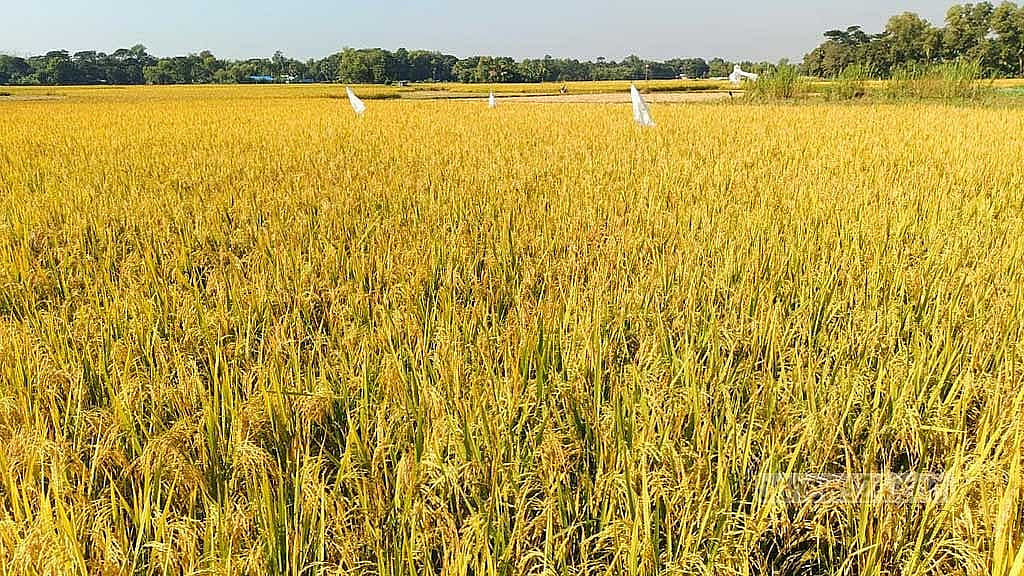
Last season, 483,895 tonnes of Aman paddy and 56,247 tonnes of vegetables were produced on 194,122 hectares of land in Cumilla. Experts fear that production will decrease this year if the soil quality does not remain good.
Abu Md Shahadat Hossain, senior scientific officer of the Soil Research Centre of Cumilla, said: "Ninety-three percent of the soil in Comilla, Chandpur, and Brahmanbaria regions is deficient in organic matter. In addition, at least 47 percent of the soil in this region has increased acidity. In this region, 97 percent of the soil is deficient in nitrogen, 86 percent in phosphorus, 89 percent in potassium, and 66 percent in sulphur.”
He said, "A very strong presence of acid has been observed on 18,805 hectares of land in these three districts. In addition, the pH value has reached 4.5 across 276,286 hectares of land. This means that it is very difficult to get the expected yield in these lands."
Aminul Islam, a farmer from Amtali Gomti Char in Sadar Upazila, said: "We really don't understand. Why don't we get a crop even after applying so much fertiliser and taking so much care? Our lands produce more than one crop in a year. If the crop production drops suddenly, we have to face a lot of financial losses."
Laila Arjuman, agricultural officer of Lalmai Upazila in Cumilla, said, "We are asking farmers to test their soil and we have also sent the soil sample to the Soil Research Centre for testing. We advise farmers to apply fertiliser according to the rules after testing the soil."
Sadar South Upazila Agriculture Officer Junaid Kabir Khan said, "The amount of acid can increase due to continuous use of chemical fertilisers in agricultural land for a long time. That's why we suggest a simple alternative to farmers: use dolochun or dolomite before cultivating the land.”
Deputy Director Mizanur Rahman said, "If farmers do not get the expected yield, they will suffer personal financial losses. But it will also have a huge impact on our food reserves."
“If we cannot achieve our food production targets, it will not be possible to meet the local needs.”
Mizanur Rahman said, "It is better to use dolo lime or quicklime once in three years. This will also increase the quality of the fertiliser and the soil quality."
"Also, if the amount of sulphur-containing fertilisers increases, the amount of sulphur ions and magnesium ions also increases. As a result, the acidity will decrease."
However, emphasising the use of organic fertilisers, he said, "Organic fertilisers are the lifeline of the soil. If organic fertilisers are not available, if there are no beneficial microorganisms in the soil, it is difficult for the soil to return to its normal quality."
"On the other hand, we also need to save the topsoil or surface of the soil. Then the farmer will survive. Otherwise, the yield will decrease - we will face losses nationally."