Published : 08 Nov 2024, 08:54 AM
Updated : 21 Aug 2026, 12:03 PM


“Students of seven colleges protest again” is a title which is a bit too familiar with the average news readers of Bangladesh. This specific headline, or ones similar to it, have made the front pages more than a couple of times in the past seven years, begging the question – where is the actual crisis?
Dhaka College is one of the seven colleges affiliated to Dhaka University.
Abdur Rahman, a student of Dhaka College told bdnews24.com: “The students of the seven colleges are suffering due to the lack of an independent institutional identity. We face a bunch of issues while identifying ourselves.”
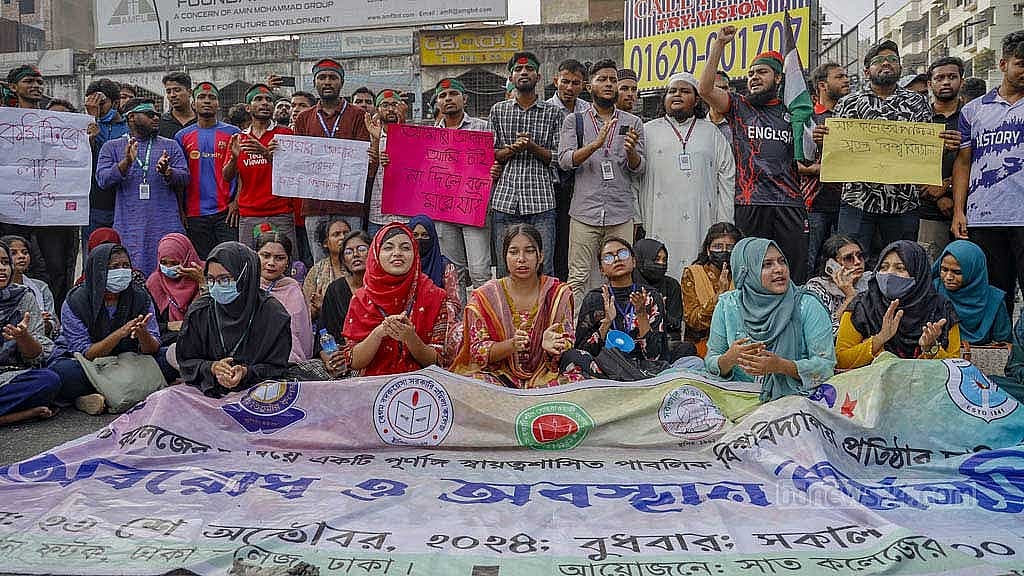
Students from seven colleges in Dhaka have taken to the streets once again to press for the formation of an independent university after the change of power in the government.
Rahman is one of the key coordinators of the protests.
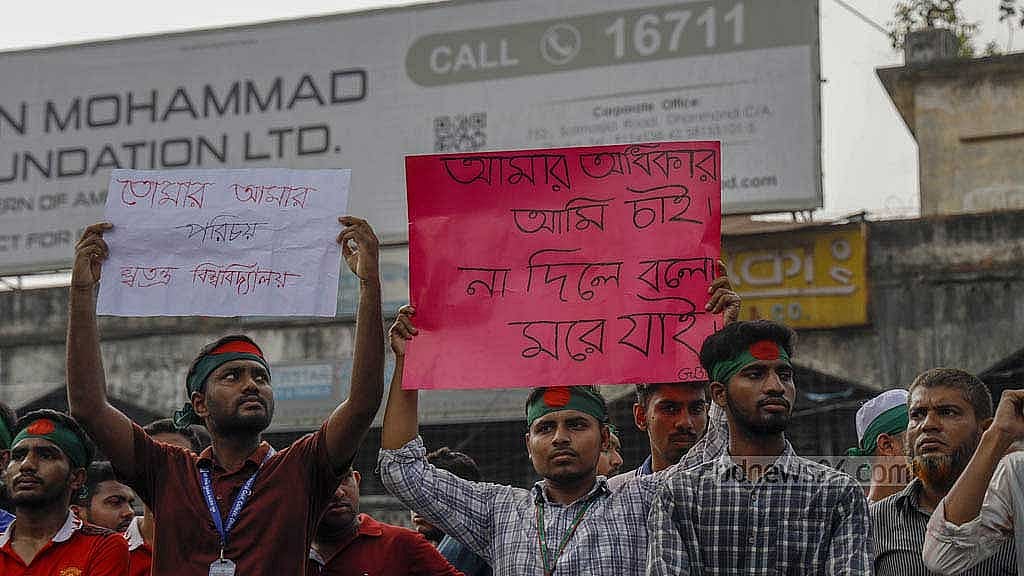
According to him, the formation of an independent university is the ‘only way’ of solving the problems of the students of the seven colleges.
In addition to protesting on the streets, the students have also created a platform called the ‘Central University of Bangladesh’ on social media.
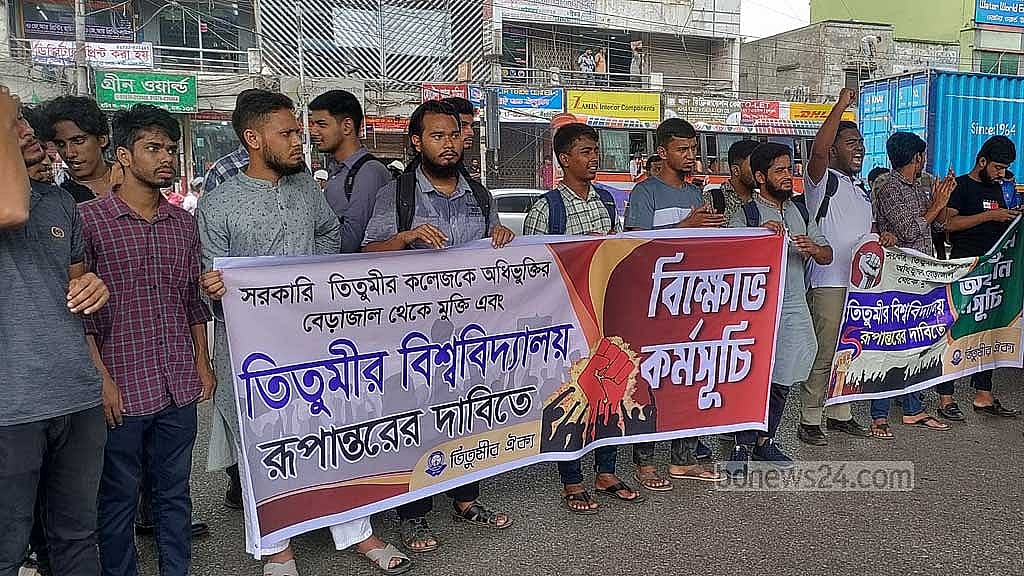
Meanwhile, several students of Titumir College are demanding for a separate university to be built for their institution only.
On the other hand, the students of Dhaka University have also called for the cancellation of the affiliation of the public university with these colleges.
Education Advisor Wahiduddin Mahmud has blamed the issue on the ousted Awami League government as it was due to their decision that the seven colleges are now affiliated with Dhaka University.
According to the advisor, both Dhaka University and the seven colleges are now suffering because of the ‘reckless decision’ of the Awami League government.
However, the interim government is not on the same page with the students pressing for the formation of an independent university.
The government has set up a committee of experts to solve the issue at hand.
WHY THIS AFFILIATION?
Once upon a time, all degree colleges were regulated by Dhaka, Rajshahi Chattogram and Agricultural Universities. But in 1992, the BNP government linked all government colleges which were affiliated with public universities to National University.
However, National University was soon overwhelmed with the task of having to handle all of the colleges at once. Due to delayed exams and results, students were unable to graduate within the stipulated time. Some even questioned the quality of the certificate handed out to the students. To speak up against job discrimination, the students then took to the streets to protest.
Then, in 2014, former premier Sheikh Hasina directed the education ministry to affiliate the 279 government colleges to old public universities at the departmental level.
The following year, she urged the government to speed up the process of bringing the government colleges under public universities during a meeting with the University Grants Commission.
As a result of this, seven government colleges in Dhaka were affiliated with Dhaka University on Feb 16, 2017.
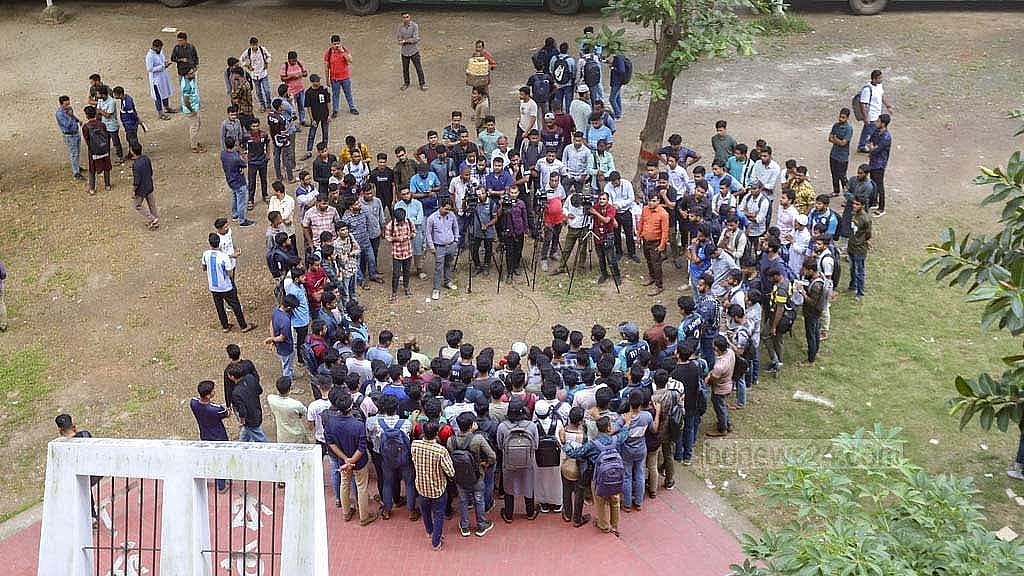
The colleges include Dhaka College, Eden Women’s College, Government Shaheed Suhrawardy College, Kabi Nazrul College, Begum Badrunnessa Government Girls College, Mirpur Government Bangla College and Government Titumir College.
At that time, it was decided that the admission test, syllabus, and examination of these colleges will be conducted from Dhaka University.
Under the National University, there were 2,154 colleges in total and there were more than 2 million students attending them.
In the seven colleges linked to Dhaka University, there were around 167,236 students and 1,149 teachers appointed at undergraduate and postgraduate levels.
Later, although there were talks about affiliating other government colleges of Bangladesh with public universities, the discussion never saw light of the day.
WHAT WAS THE OUTCOME?
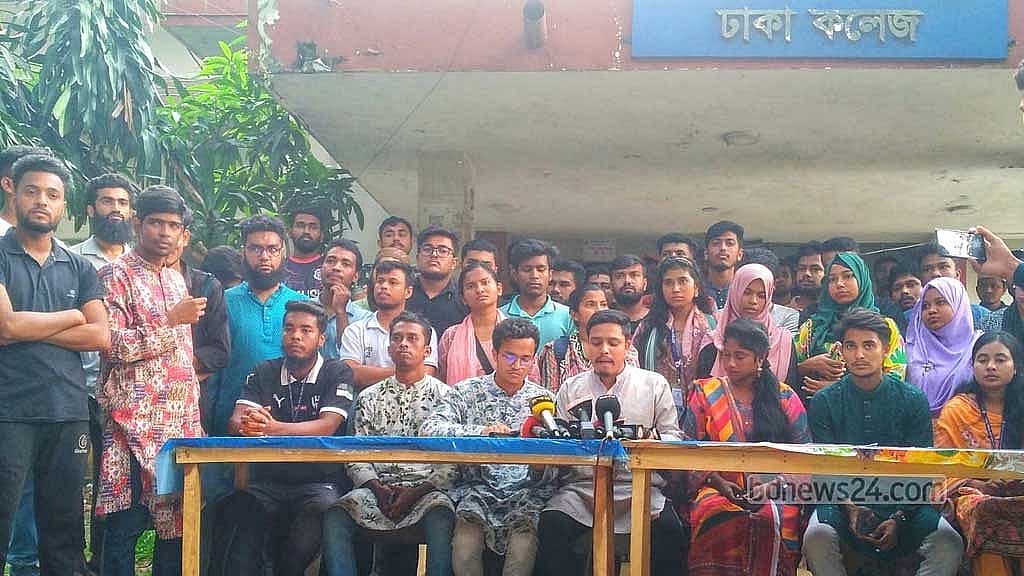
Initially, students were excited about the affiliation of the seven colleges with Dhaka University. But after a couple of days, students began speaking up about various issues and started protesting on the streets for a solution.
As the seven colleges were being regulated by Dhaka University without any long-term plan, several administrative and academic issues began to rise.
Students began to protest on the streets over cases of ‘harassment’ at the university’s registrar building, the non-publication of the academic calendars, session jams, delay in results, faulty results, record number of students failing and several other problems.
Although several measures were announced at various times to bring the students back to class, some of the problems grew more complex over time that even after seven years of affiliation, the colleges were unable to settle under Dhaka University.
Hence, after the fall of the Awami League government, students have been protesting again to cancel the affiliation of the seven colleges with Dhaka University.
Abdur Rahman, a representative for the protest movement, gave a list titled– ‘Discrimination of the students of seven colleges with DU’ to bdnews24.com.
In the list, it has been alleged that there is a shortage of department teachers for research at the undergraduate and postgraduate levels in the colleges.
The protesters also allege that there is no accountability for the amount of money taken for admission, registration, quality improvement, non-collegiate, and how it is spent for the development of the colleges.
Riya Karmakar, a student of Kabi Nazrul Government College, told bdnews24.com: Dhaka University authorities have been treating us like a business institution for a very long time. They only take the money. But they don’t oversee our classes or examinations.”
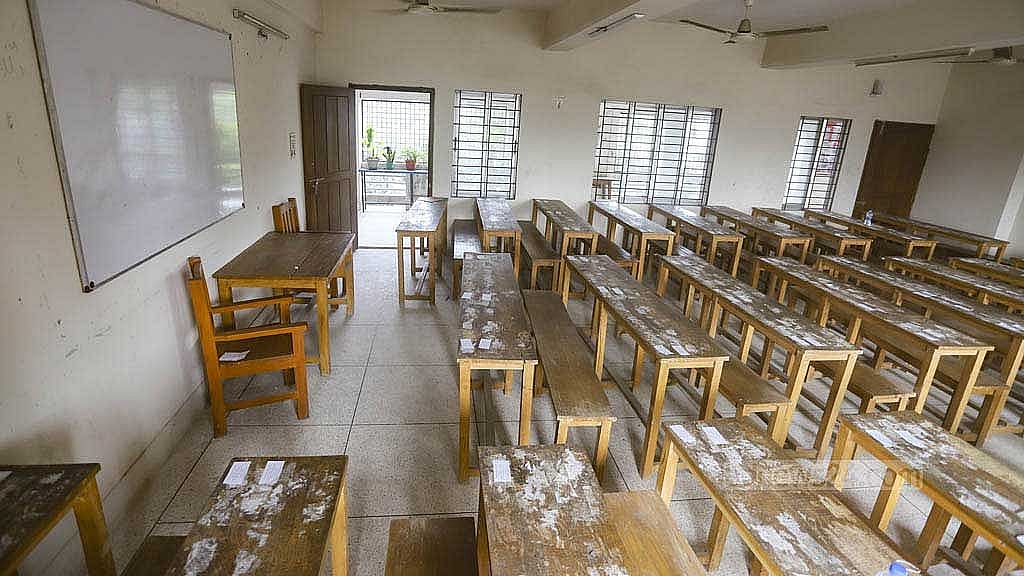
The colleges are operating with a shortage of teachers and classrooms, long admission process, lack of equipment in labs, lack of quality libraries, insufficient allocation of co-curricular activities, and lack of a semester system.
In their list of complaints, the students have described their convocation system as ‘disgusting’. They are deeming ‘online convocations’ under Dhaka University as discriminatory as well.
Kaif Islam, a student of Dhaka College told bdnews24.com: “This method of convocation is disrespectful. To get rid of these problems, we have to free ourselves from affiliation. If we have our own public university, there will be no more discrimination. “
Abdur told bdnews24.com: “They are admitting more than 350 students, even though they do not have the capacity to teach 100 students.”
Zakaria Bari Sagar, another representative for the protest movement, told bdnews24.com: “Our classes are taken by BCS general education cadre teachers. While questions are made and exam scripts are checked by Dhaka University’s PhD holder teachers. These teachers do not take our classes or know of our syllabus.”
“Dhaka University considers the creation of a routine as its only duty. But they admit students beyond its capacity to make more money from the admission process,” he added.
According to the students, many have to face difficulties while applying for higher education or giving job interviews as they are disadvantaged by the word ‘affiliated’.
Furthermore, the students have stated that the seven colleges have to pay more than Tk 2,000 for the exam standardisation fee, which is only Tk 500 to Tk 700 in Dhaka University.
A few days back, Dhaka University authorities doubled the readmission penalty fee of the seven colleges. The students have also complained that the university has failed a massive number of students deliberately for the readmission fees.
In 2017, Dhaka University’s Vice-Chancellor Prof AMS Arefin Siddique had said that this was being done to enhance the quality of higher education.
He was contacted on his mobile phone several times to know if his views have changed regarding the situation. But he did not respond to any calls.
WHAT IS THE GOVERNMENT DOING?
A 13-member committee was formed under the chairmanship of the additional secretary of the education ministry to ‘resolve the academic and administrative problems of the seven colleges affiliated to Dhaka University’ on Oct 24, after the students began their movement.
The students then rejected that committee, demanding the formation of a ‘University Transformation Commission’ and took to the streets and blocked the Science Laboratory intersection on Oct 29.
Later, on Oct 31, a notification issued by Shahinur Islam, the deputy secretary of the education ministry’s public general university branch, stated that the committee’s name had been changed to a ‘Committee for the review and recommendation of the demands of the students of seven colleges’.
Meanwhile, efforts are being made to find a solution by speaking with the students who are protesting.
Mohammad Khaled Rahim, chairman of the committee and additional secretary of the education ministry’s college division, told bdnews24.com: “We will add more members to our committee. We will also include student representatives. We will have a meeting this week. It will be decided whether the committee will remain or a commission will be formed.”
However, the government has not yet ‘agreed’ to the main demand of the students, which is the establishment of an independent university.
On Oct 31, Press Secretary Shafiqul Alam said: “The seven colleges will remain under DU. A separate place will be arranged for them in DU, where all administrative activities will be carried out. They will have separate registrars as well as officers. This will be done after discussing with DU authorities and the University Grants Commission.”
On Nov 1, the authorities of Dhaka University issued a statement saying that they need to have more discussions with important stakeholders and the students to solve the problem.
CENTRAL UNIVERSITY OF BANGLADESH
Zakaria told bdnews24.com: We are thinking of the formation of an independent public university, where we want to keep each department in a separate college. For example, some departments will be in Dhaka College, some in Eden College, and others in Kabi Nazrul College. Similarly, the campus of the independent university will be expanded to other colleges. Which can be named Central University of Bangladesh.”
According to the protestors, if the affiliation is not annulled and if an independent university is not established, then the problems of the seven colleges won’t go away.
After meeting with the advisors on Oct 31, Abdur told bdnews24.com: “We discussed potential solutions to various problems in the meeting. A lot of models have been proposed. We will take the decision after consulting with the students.
Meanwhile students have already taken to the streets to push for an independent university.
Aminul islam, a student participating in the protests, told bdnews24.com: “There are no significant public universities in Dhaka North City. Under the circumstances, considering the position and merit of Titumir College, it will be good for the people if it was converted to Titumir University.”
However, students from other colleges believe that the 'correct solution' is to establish a university by merging the seven colleges.
Abdur told bdnews24.com: “Some students of Titumir College are making this demand. But the students are with us and protesting with us.”
Sadia Afrin, a student of Eden Women’s College, said: “The seven colleges have everything to establish a university. A few things may need to be reformed. We demand that a reform commission should be formed with the students and teachers to move things quickly.”
Prof Kamrul Hasan Mamun of Dhaka University's Department of Physics, also a member of the University Teachers' Network, believes that the formation of an 'independent university' is the key solution for the students of the seven colleges.
"There is only one solution to the seven colleges issue. The colleges should be united under a single institution, which can be achieved by establishing an independent university," he told bdnews24.com