Published : 02 Nov 2025, 06:15 AM
Updated : 21 Aug 2026, 02:39 PM


Chief Advisor Muhammad Yunus has congratulated the National Consensus Commission for what he called a “success” in formulating the July National Charter and setting the course for its implementation through months of dialogue with all political parties.
Yunus extended his congratulations in an official statement on Saturday, thanking the members of the commission for their role in achieving the consensus.
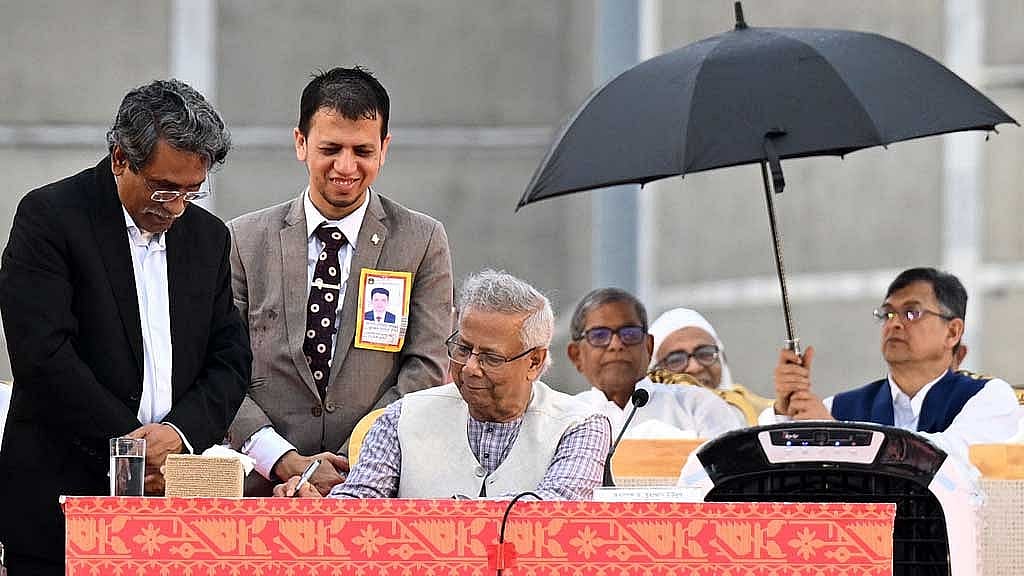
“The July National Charter is our historic achievement,” he said.
“This Charter is a valuable document for our nation. It will not only pave the way for the next general election but also guide the future of national politics and strengthen our democracy.”
Following the fall of the Awami League government, the interim administration led by Yunus initiated a series of reforms to establish a permanent and accountable system of governance, in line with the aspirations of the July Uprising.
To that end, the Consensus Commission, chaired by Yunus, was formed on Feb 12 this year with a mandate to propose necessary structural reforms. Its term ended on Oct 31.
During this period, the commission held discussions with all political parties, drafting the July Charter, which was signed by a majority of parties despite differences.
Days before its term ended, the commission also prepared and submitted to the government a draft constitutional order for implementing the charter.
“People are now eager to see changes in national life -- changes that will nurture democratic culture in Bangladesh, prevent the return of autocracy, and uphold citizens’ rights and dignity,” Yunus said.
He added that the most hopeful part of the process was that “we ourselves worked on these reforms and reached consensus -- no one imposed any decision on us.”
“In the past, Bangladesh saw foreign mediators, including friendly states and UN representatives, attempt to bring political parties to the table. But after the July Uprising, our political forces agreed that we must resolve our own crises. That is why all parties stood together, engaged in dialogue, and found a way forward.
“Instead of inviting the world to solve our political crisis, we have presented our national unity before the world.”
Yunus thanked all political parties and their leaders who “worked tirelessly to make the impossible possible”.
He said the Charter would stand as “a unique example for the world”.
“Nowhere else in the world has such an event occurred. It will remain a shining example in global political history. Other nations in crisis will look to Bangladesh’s Consensus Commission model as an inspiration.”
Yunus also expressed gratitude to commission Vice-Chair Ali Riaz, and members Badiul Alam Majumdar, Iftekharuzzaman, Safar Raj Hossain, Justice Emdadul Haque, Mohammad Aiyub Miah, and Special Assistant Monir Haidar for their contributions.
He also expressed appreciation to journalists for “communicating months of complex discussions to the public in simple language”.
“We must preserve the unprecedented unity that now binds us,” Yunus said.
“‘Fascist elements’ have tried with all their might to divide this nation. Over the past 15 months, we have resisted their conspiracies together. To defeat fascism and save the country, we have no alternative but to maintain this unity.”
Acknowledging the challenges ahead, Yunus added: “Building the future of this nation is a great challenge. No single individual, organisation, institution, or government can do it alone. Every political party and stakeholder must remain united, no matter the obstacles.”