Published : 16 Dec 2025, 07:37 AM
Updated : 21 Aug 2026, 02:53 PM


On a winter morning in 1971, the Pakistani forces surrendered, and the red and green flag of Bangladesh soared over a liberated land.
The nation’s independence was won at the cost of millions of lives, yet it marked the dawn of freedom, democracy, and hope. 54 years on, the memory of that sacrifice guides celebrations across the country, as citizens honour the martyrs and reflect on the path that brought Bangladesh to sovereignty.
To mark the occasion, a comprehensive schedule of celebrations has been adopted. The national flag will fly across all government and private buildings, Shaheed Minars nationwide -- including Savar’s National Memorial -- will be adorned with floral tributes, and the streets will resonate with the march of victory.
Among the day’s key events, a joint initiative by the Army, Navy, and Air Force will see 54 paratroopers descend with the national flag in a skydiving display. According to the chief advisor’s press office, this will set a new Guinness World Record for the most flags carried during a parachute jump.
In 1947, the creation of Pakistan under the two-nation theory placed Bengali-speaking East Pakistan alongside culturally and linguistically distinct West Pakistan, despite a shared faith. Analysts had long predicted that such divisions would render the union unstable.
Exploitation, neglect, and systemic discrimination by West Pakistani rulers fanned the flames of Bengali resentment. The attempt to impose Urdu as the state language sparked the first acts of defiance, laying the groundwork for a broader struggle for rights and recognition.
West Pakistan’s response was force, culminating in the horrific night of Mar 25, 1971, when an unparalleled massacre unfolded.
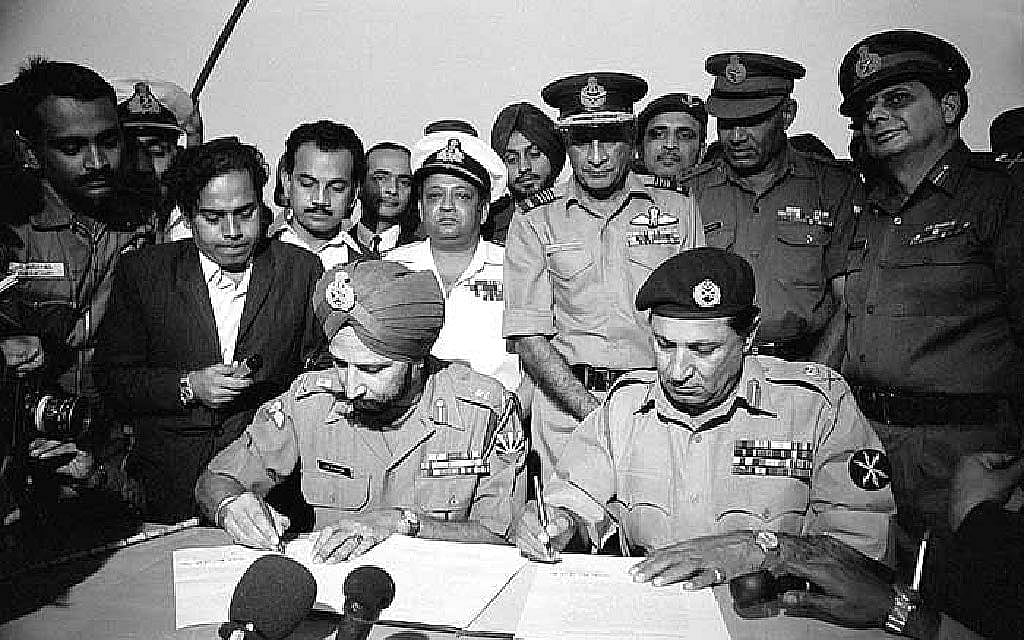
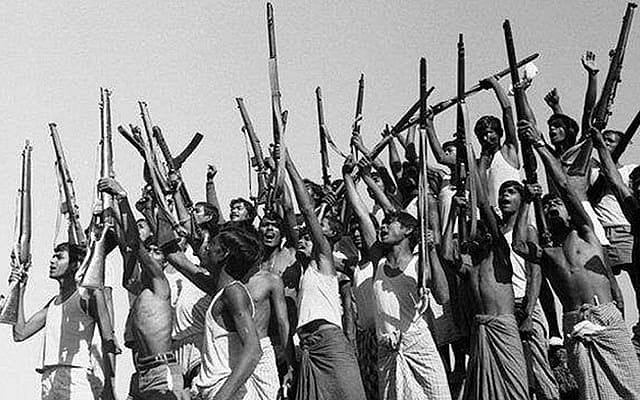
Answering the call of Bangabandhu Sheikh Mujibur Rahman, the people of Bengal rose in resistance. After nine months of relentless struggle, Pakistani forces surrendered on Dec 16 at Dhaka’s Racecourse -- now Suhrawardy Udyan -- to the combined command of the Mukti Bahini and India’s Eastern Command.
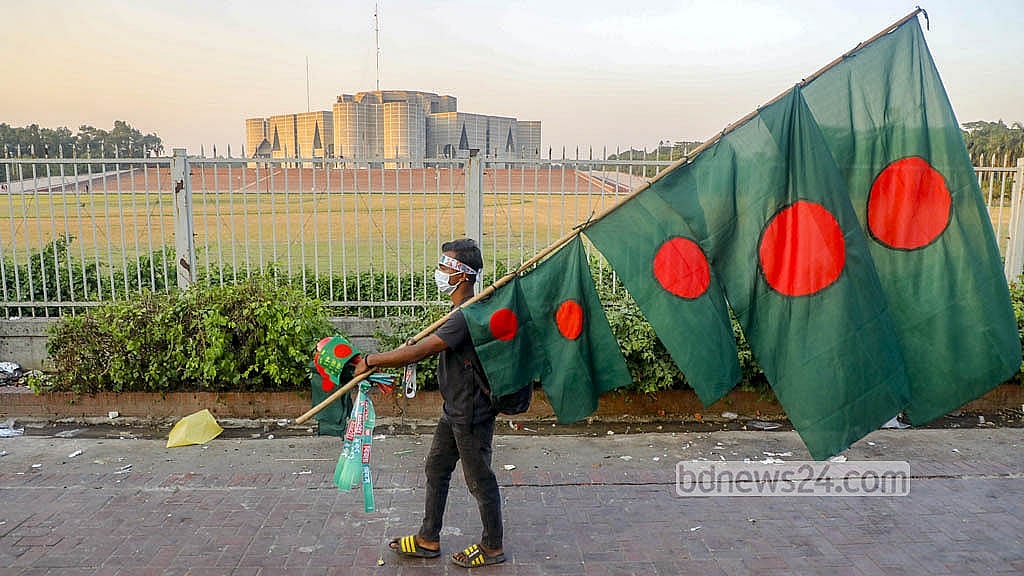
The red and green flag of Bangladesh was raised, signalling the birth of a liberated nation.
A NEW REALITY
This year’s Victory Day unfolds amid a transformed political landscape. The upheavals of 2024 have reshaped governance, and the nation now awaits the parliamentary elections in February, which will chart Bangladesh’s next course.
Tensions surfaced when Sharif Osman bin Hadi, convenor of Inqilab Moncho and prospective election candidate, survived an assassination attempt shortly after the election schedule was announced.
Security concerns have intensified, yet Hadi remains prominent in Victory Day events. During the government’s world-record parachuting display, BIDA Executive Chairman Ashik Chowdhury will leap wearing a helmet bearing Hadi’s image.
The end of the Awami League’s 15-year rule and Sheikh Hasina’s exit have ushered in 16 months of political flux, exposing deep divisions in history, culture, and ideology.
Dr Sarwar Ali, trustee of the Liberation War Museum and a decorated veteran, stressed the sanctity of historical truth.
“We must acknowledge that the history of the Liberation War and the sacrifices made post-independence have left gaps in achievement. Like other nations, people have struggled to fill these gaps. That is reality and cannot be denied,” he told bdnews24.com.
“But in doing so, we must never erase or obscure the history of the Liberation War. That would dishonour the martyrs.”
He urged recognition that history cannot be rewritten for convenience: “After independence, people have pointed out the incompleteness of different reforms. Yet those who sacrificed their lives for the Liberation War and the country remain owed respect.
“Changing governments may attempt to present selective versions, but history itself is immutable. There can be differences in interpretation, but history cannot be erased or altered. This truth must be universally acknowledged.”
He reiterated the historical reality: “Historically, Pakistan, created in 1947, never experienced a transfer of power through direct elections during its 23-year existence. No nationwide elections were held.
“Against this backdrop, and the social, economic, and political inequalities, the people of this land fought and realised that liberation was the only path to freedom.”
THE CRUX OF LIBERATION
Sarwar emphasised, “The central character of this aspiration of the people, and the preparatory phase of the Liberation War, is the people of Bangladesh themselves. This is true, and equally true is that from their forefront, certain political leaders, intellectuals, and student communities inspired them in this struggle for freedom.
“Yet at the crucial moment, decisive action -- especially through the Six Point Movement of 1966 and the speech of Mar 7 -- highlighted the paramount role of Bangabandhu.”
He also recalled that a small fraction of the country had sided with Pakistan during the war, a truth that must not be forgotten.
“Those who took up arms in the Liberation War were the common people. It was a people’s war, and the general populace also suffered mass killings. Through this, we achieved independence. One may interpret it differently, but this truth, this just history, is immutable.
“And those who acted to preserve Pakistan’s territorial integrity were collaborators of the Pakistan government during the Liberation War. It is also true that they assisted Pakistan in its efforts to maintain that unity.”
PRESERVING SECULAR IDEAS
As attempts grow to diminish or politicise the Liberation War, Mofidul Hoque, a trustee of the Liberation War Museum, once again underscored the centrality of secular ideals to Bangladesh’s birth.
“Celebrating Victory Day is also a moment to look back. But the primary aim is to chart a course forward. Today, there are many efforts to belittle or politicise the Liberation War.
“Yet history is on our side. Knowing and understanding it is critical.”
Placing Bangladesh’s emergence within its 20th-century context, Mofidul said the country’s creation marked a defining historical rupture.
“The birth of Bangladesh was a significant historical event. Significant, because the subcontinent was engulfed in communal conflicts. We ourselves bore the cost during Pakistan’s rule.
“Our linguistic, economic, and social rights were undermined, and we were oppressed. There was a mix of military rule and theocracy. That was the country we endured.”
Against that experience, he said, a national consciousness took shape around the vision of a secular, egalitarian society.
“There is no inherent conflict between national identity and religious identity. People of one faith coexist with various ethnic identities, even within a single country.
“The convergence of religion, society, and national identity -- Bangladesh showcased that first in the subcontinent.”
Mofidul noted that the region has continued to suffer from communalism: “Today, the subcontinent remains afflicted by religious strife -- this is true in India, Pakistan, Myanmar, and even Sri Lanka, where Buddhism has been politicised.
“In 1971, Bangladesh laid a path for peaceful coexistence, guided by secular principles. We have not fully followed that path, but the sacrifices and foundations laid then cannot be erased. That is our legacy and the direction for the future.”
Reflecting on the global significance of the Liberation War, he added: “Bangladesh’s struggle in 1971 drew worldwide attention. Another aspect is that it was fought on the basis of democratic rights. It was never a separatist struggle.
“Bangabandhu organised the people and guided the movement through popular mandate, which is why, when Pakistan struck, we received support and solidarity from across the world.”
Mofidul expressed hope for the country’s future: “The younger generation must remember the fusion of religion, ethnicity, and social harmony as they chart the path ahead.
“All that Bangladesh has achieved cannot be easily destroyed or sacrificed. Today’s youth must study history objectively. Among its core elements is secularism, and the humanistic and unifying values inherent in religion. We must move forward with these principles, ensuring religion is never exploited politically as it was in 1971.
“The next generation should build a society where faith, nationality, identity, and harmony coexist -- that is our aspiration.”
‘ECONOMIC FREEDOM AND SOCIAL JUSTICE’
President Mohammed Sahabuddin conveyed warm greetings and heartfelt congratulations to Bangladeshis at home and abroad on Victory Day.
“Independence is our greatest achievement, borne of a long history of oppression, deprivation, and struggle,” he said.
Recalling the sacrifices that made that freedom possible, he said: “We remember the valour of all martyrs, the injured freedom fighters, the bereaved mothers and sisters, the families of the fallen, and all those who contributed to the independence movement.
“The Liberation War was not solely about political freedom; its objectives also encompassed economic emancipation and the establishment of social justice. Over the past five decades, full political and socio-economic freedom for the people has yet to be realised. In this context, the 2024 student and people’s [July Uprising] have rekindled hope for a corruption-free, equitable Bangladesh.”
The president stressed that the true dividends of independence can reach the people only through stronger democratic institutions.
“We must cultivate a culture of tolerance, mutual respect, and unity across individual, societal, and state life. Inspired by the ideals of the Liberation War, we will collectively work to build a Bangladesh free from exploitation, inequality, and poverty.
“Let this be our pledge on this great Victory Day,” he said.
A PLEDGE FOR THE NATION
Chief Advisor Muhammad Yunus also conveyed warm Victory Day greetings to Bangladeshis worldwide.
“Through the triumph of the Liberation War, a new sun of independence rose. Yet over the years, it has often dimmed under authoritarianism and misrule. The July mass uprising has now opened the opportunity to establish a democratic state free from inequality, corruption, and despotism.
“The interim government has launched a wide-ranging reform initiative to lay the foundation of a prosperous, well-governed Bangladesh. With the participation of the nation’s people, we are progressing successfully toward the completion of this mission.”
He added: “I hope that this will eradicate autocracy, ensure justice, transparency, and accountability across all state affairs, and secure people-oriented, sustainable development.
“Let this Victory Day be a day to renew our unity in national life. Inspired by the Liberation War’s spirit, we must advance toward genuine empowerment of the people, safeguarding the democratic path.
“Together, let us build a safe, happy, and prosperous Bangladesh for future generations, irrespective of religion, race, or community, hand in hand, on the path of peace and progress,” he said.
COMMEMORATION AND CELEBRATION
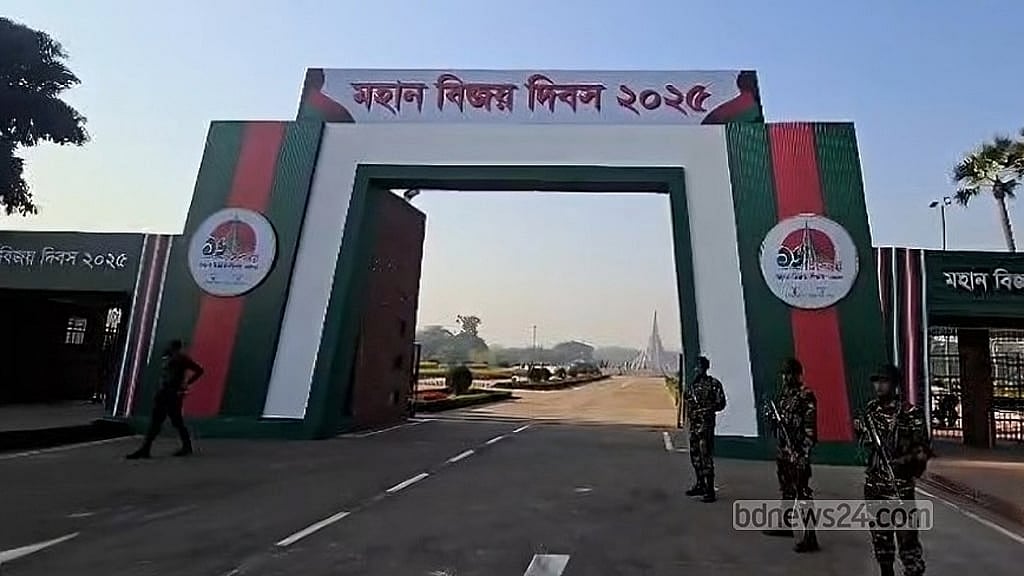
Victory Day celebrations in Dhaka will begin at dawn with 31 gun salutes. The president and chief advisor will lay wreaths at the Savar National Memorial.
Following this, under the leadership of the Liberation War affairs advisor, families of Bir Sreshtho recipients, injured freedom fighters, and other veterans will pay tribute. Diplomats, political and social organisations, and citizens from all walks of life will also lay wreaths to honour the martyred heroes.
All government, semi-government, autonomous, and private buildings, along with Bangladeshi embassies and missions abroad, will hoist the national flag and illuminate significant structures.
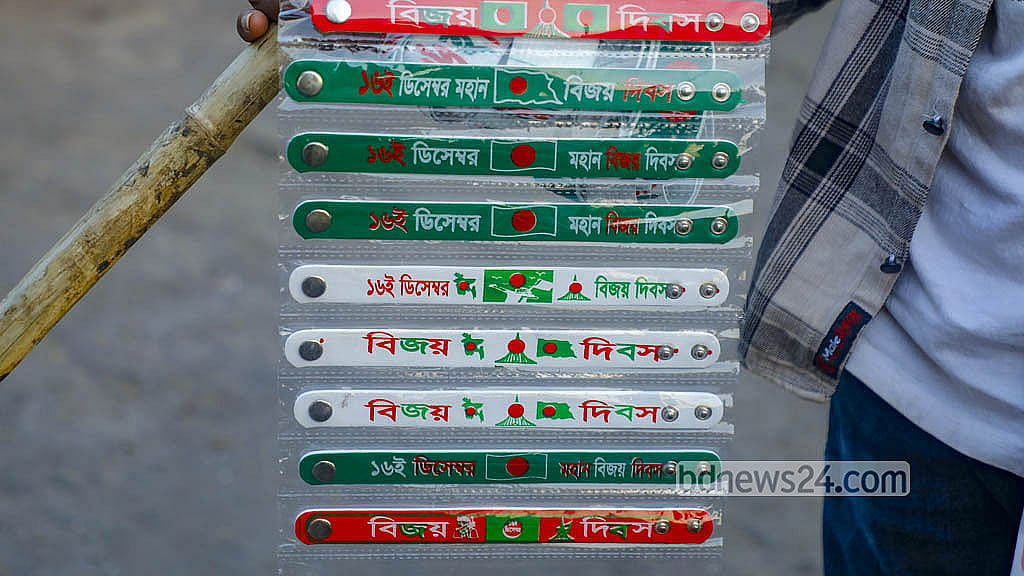
Major roads and intersections in Dhaka and across the country are decorated with national flags, banners, and colourful insignia.
For the first time, Bangladesh aims to set a world record for parachuting with the highest number of flags held.
At 11am, the Army, Navy, and Air Force will conduct separate fly-pasts over Tejgaon Old Airport, complemented by special Victory Day band shows nationwide. Police, BGB, Ansar, and BNCC bands will perform alongside Armed Forces across the country.
Three-day victory fairs will take place in districts and Upazilas. Schools will host student assemblies, flag-raising ceremonies, national anthem performances, parades, and displays.
At 3pm, Suhrawardy Udyan will host Victory Day songs, while artists across 64 districts will simultaneously perform via the Swadhin Bangla Betar.
Cultural and social organisations -- including Bangladesh Shilpakala Academy, Bangla Academy, National Museum, Liberation War Museum, and Bangladesh Shishu Academy -- will organise discussions, cultural programmes, art and essay competitions, sports events, and documentary screenings based on the Liberation War.
Bangladeshi embassies abroad will also conduct commemorative programmes.
In the afternoon, Bir Sreshtho families will be honoured at Bangabhaban by the president, alongside veterans and martyr families at the local, district, and Upazila levels. The Directorate of Posts will issue commemorative stamps.
Hospitals, prisons, old age homes, orphanages, street children rehabilitation centres, welfare centres for the disabled, daycare and child development centres, and homeless institutions will host celebratory feasts.
All children’s parks and museums will remain free for the public, while cinemas across Dhaka and the country will screen Liberation War-based films for students without charge.
Ports, including Chattogram, Khulna, Mongla, and Payra, as well as Dhaka’s Sadarghat, Pagla, and Barishal, and BIWTC jetties, will have naval and Coast Guard ships open for public viewing from 9am until sunset.