Published : 20 Aug 2025, 08:51 PM
Updated : 21 Aug 2026, 01:41 PM


Chief Advisor Muhammad Yunus has called for collective efforts to prevent non-communicable diseases (NCDs), noting that 69 percent of personal healthcare expenses in Bangladesh relate to NCDs.
He said that the active participation of all segments of society, including public and private sectors, civil society, national and international organisations, and development partners, is essential to prevent and control NCDs.
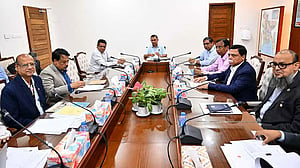
He made these remarks at the “joint declaration” signing ceremony, which was organised to increase inter-ministerial cooperation for adopting and implementing integrated initiatives to prevent and control diseases.
At the event on Wednesday, 35 ministries signed the joint declaration on the prevention and control of NCDs.
Yunus said, "When a person contracts a non-communicable disease, they are forced to face high medical costs. If a person gets cancer, their family has to spend the maximum of their financial resources and often becomes helpless and destitute.
“In some cases, treatment needs to be sought from abroad at a very high cost. A significant amount of our money goes abroad to meet the treatment costs for these diseases."
The chief advisor said intensive monitoring and evaluation are essential for the implementation of any action plan and these require appropriate and skilled manpower and financial allocation too.
He underscored the need for giving special priority to the implementation of the joint declaration and ensuring the necessary allocation and manpower to this end.
Earlier, he handed over the joint declaration to the senior secretaries.
The advisor said the NCDs are spreading worldwide day by day, while this situation is even more critical in Bangladesh in the context of its socioeconomic, geographical location, and the larger population living in a small territory.
"So, it is perhaps the most important aspect of national health management, which is closely related not only to the health sector, but also to our overall economy, social security and sustainable development," he said.
Citing the World Health Organization's 2022 report, he said about 71 percent of all deaths occur in Bangladesh due to NCDs, and 51 percent of these deaths take place before the age of 70, which are considered as premature deaths.
He stressed creating public awareness on the NCDs and taking prevention and control measures, apart from improving the treatment management of NCDs.
It is not possible for the Health Services Division alone, the chief advisor said, adding that cooperation from all ministries is required to this end.
"Each sector such as food, agriculture, education, sports, local government, public works has an important role to play. Specific action plans and intensive initiatives are needed from each sector," he said.
All these ministries have been identified and their tasks have been determined, he added.
Stressing the need for making the country's people aware of public health, Yunus said if the young people are not made aware of tobacco today, the future of the next generation will be uncertain.
In addition, he said the people should be made conscious about sugar intake on an urgent basis.
He said the national policies must be formulated in such a way that they are health-friendly and helpful in preventing and controlling NCDs, while children's, adolescents', and women's health must be given special priority.
The chief advisor said widespread public awareness and adoption of health-friendly policies and strategies at all levels can be a great tool in preventing and controlling NCDs.
He suggested taking initiatives to establish healthy lifestyles and responsible civic behaviour, and turning it into a social movement.
Yunus said the implementation of the joint declaration requires private initiatives along with the government and regional and global technical cooperation.
The chief advisor said he believes that through its implementation, public health protection programmes in Bangladesh will be more dynamic and this will be a new milestone of progress.
"It will be helpful in achieving the health-related Sustainable Development Goals and post-SDG agendas more efficiently," he added.