Published : 12 Oct 2025, 07:47 AM
Updated : 21 Aug 2026, 02:34 PM


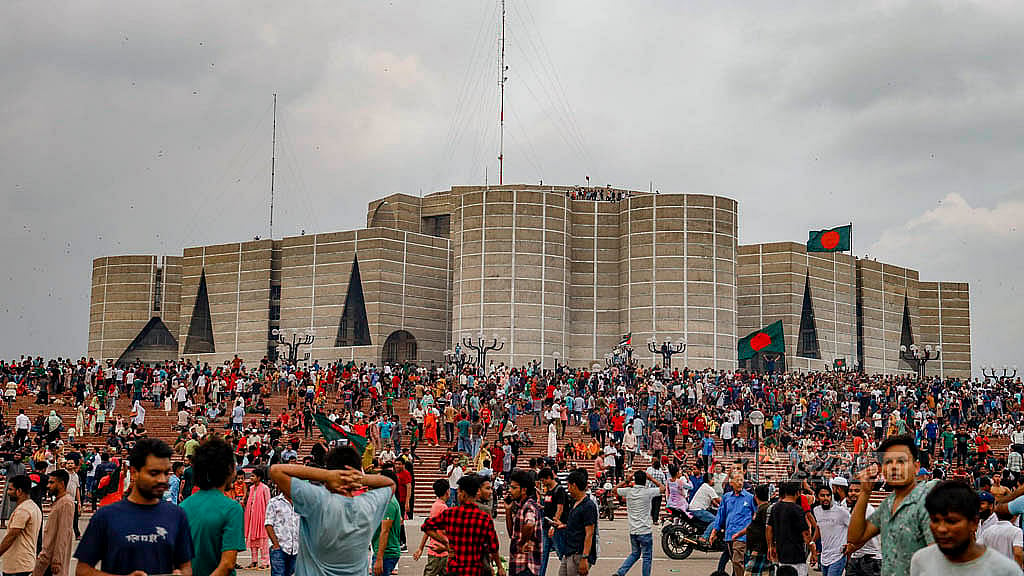
As discussions over the implementation of the July Charter unfolded at the National Consensus Commission, six political parties, including the Jamaat-e-Islami, took to the streets with coordinated protests.
Their joint campaign demands that the July Charter be implemented ahead of the national election in February, that proportional representation (PR) be introduced in both parliamentary chambers, and that the activities of the “allies of the Awami League” be banned.
The movement, framed around five uniform demands, is described by the parties as both a strategy to pressure the government and a tool to build public opinion.
Yet, with an interim government in place that has said it will honour decisions based on political consensus, questions have arisen over whether the protests primarily serve to pressure the Bangladesh Nationalist Party, the country’s largest active political party.
Political analyst Sayeed Iftekhar Ahmed said the six-party movement appears deliberately structured with this objective.
“If the elections are delayed or their campaigns succeed in postponing them, it will politically benefit them,” he says.
A BNP Standing Committee member, however, maintains that such protests are unlikely to affect the BNP’s politics, negating any perceived pressure.
SIX PARTIES, 5-POINT AGENDA
Since mid-September, Jamaat, Islami Andolan Bangladesh, Bangladesh Khelafat Majlis, Nezam-e-Islam Party, Khilafat Andolan, and the Jatiya Ganotantrik Party (JAGPA) have held marches, rallies, and leaflet campaigns nationwide.
Their five-point agenda includes:
• Holding the national election in February based on the July Charter
• Implementing the PR system in both parliamentary chambers
• Ensuring a level playing field for a free, fair, and credible election
• Visible justice for all atrocities, massacres, and corruption under the “fascist government”
• Banning the activities of “allies of the autocracy”, namely the Jatiya Party and the 14-party coalition
With the exception of the PR system demand, none of these positions conflict publicly with BNP’s stance. Even calls to prosecute the so-called “allies of fascism” have not elicited opposition from the BNP.
MOVEMENT TIMELINE
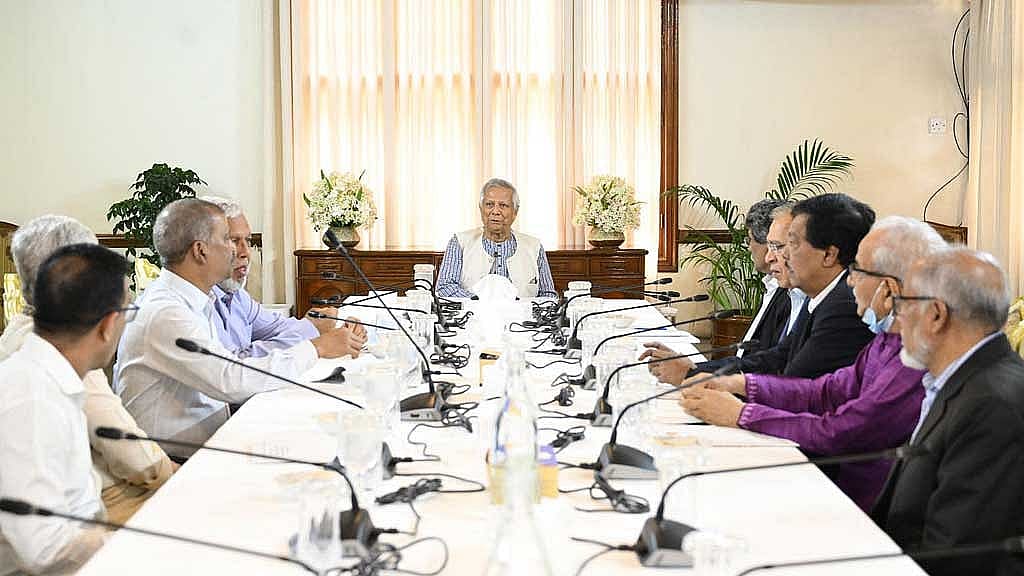
The National Consensus Commission concluded dialogue with the parties on Wednesday night, agreeing on a public referendum for the July Charter before the national polls. Despite this consensus, the six parties have continued their coordinated street campaigns.
The movement has intensified calls for proportional representation. Initial demonstrations were held on Sept 18 in Dhaka, Sept 19 in divisional towns, and Sept 26 across districts and sub-districts.
From Oct 1-9, the parties conducted nationwide public engagement programmes, followed by mass marches in the capital and all divisional towns on Oct 10.
The Khilafat Andolan and Nezam-e-Islam Party limited their activity to Dhaka. On Oct 12, Jamaat, Islami Andolan, Khelafat Majlis, and JAGPA plan to submit memoranda to district commissioners nationwide.
GOALS BEHIND THE STREET CAMPAIGN
JAGPA Vice-President Rashed Prodhan told bdnews24.com, “We are mobilising public opinion in support of our party’s programme. We want the PR system included in the referendum on the national election. Our campaign is not directed against any party or faction.”
Explaining the rationale for simultaneous dialogue and street campaigns, Jamaat-e-Islami deputy chief Syed Abdullah Muhammad Taher said: “Protests alongside dialogue are not new in Bangladesh. They occurred during the British and Pakistan eras and in 2006. We are participating in dialogue and continuing our street programmes simultaneously.”
Asked about the efficacy of the movement, he added: “The protests are productive and will become more so. More campaigns are planned, and additional programmes may be announced.”
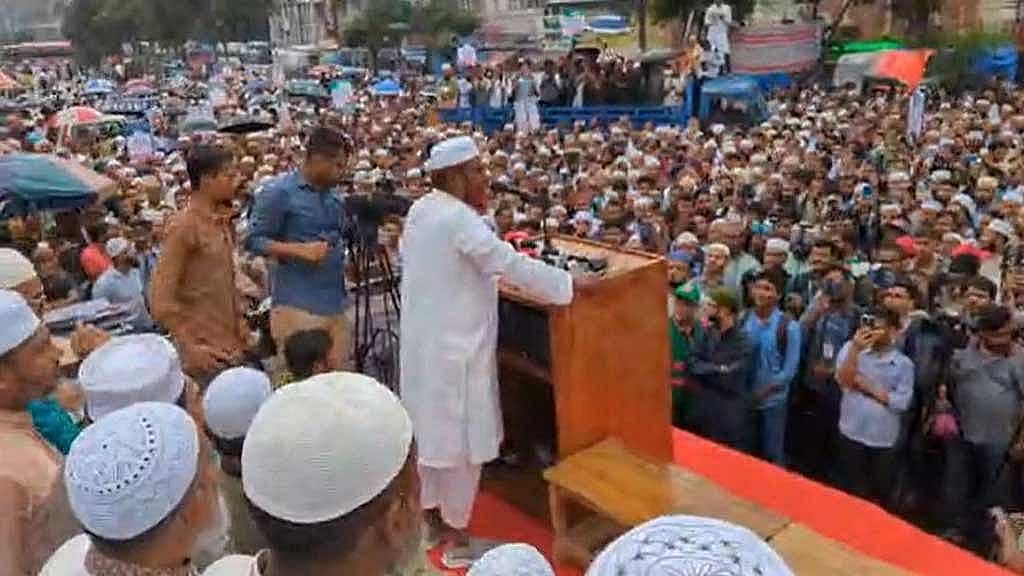
Khelafat Majlish Secretary General Ahmad Abdul Kader told bdnews24.com, “We have mobilised public opinion in favour of reforms. Our programmes now create both pressure on the authorities and shape public sentiment regarding our demands.”
HOW OTHER PARTIES VIEW IT
The Consensus Commission finalised the draft of the July Charter, also known as the July National Charter, after consolidating reform proposals discussed with political parties and embedding pledges for implementation. Yet, differences emerged over how the charter would be executed.
Jamaat, the NCP, and several smaller parties had consistently demanded that the Charter be implemented through a nationwide referendum. Meanwhile, the BNP and some other parties opposed the move.
The commission has now indicated that agreement has been reached on holding a referendum, though the commission has not provided a timeline or detailed procedure. Separately, it initially announced that the July Charter will be formally signed on Oct 15, later deferring the signing to Oct 17 on Saturday.
Earlier, in September, media reports noted that eight parties, including Jamaat and the NCP, were embarking on simultaneous protests demanding the “five-point agenda”.
Later, the NCP clarified it would not join the coordinated demonstrations, saying it only seeks the PR system in the upper house, not both parliamentary chambers.
Of the 30 parties present at the Consensus Commission, six are now actively on the streets, while the remainder continue to support election transitions through dialogue.
This has raised questions among political observers: against whom and for what objectives are these protests being conducted?
Salahuddin Ahmed, a Standing Committee member of the BNP, told bdnews24.com: “I do not see the Islamist parties’ protests as an attempt to pressure the BNP. Demonstrating is their democratic right. The BNP believes problems can be resolved at the dialogue table. But those who are protesting have every right to do so.”
Mahmudur Rahman Manna, convenor of the Nagorik Oikya, said: “I asked them directly. They said the programmes are not meant to apply pressure, but to publicise their demands. The reasoning seems weak to me.
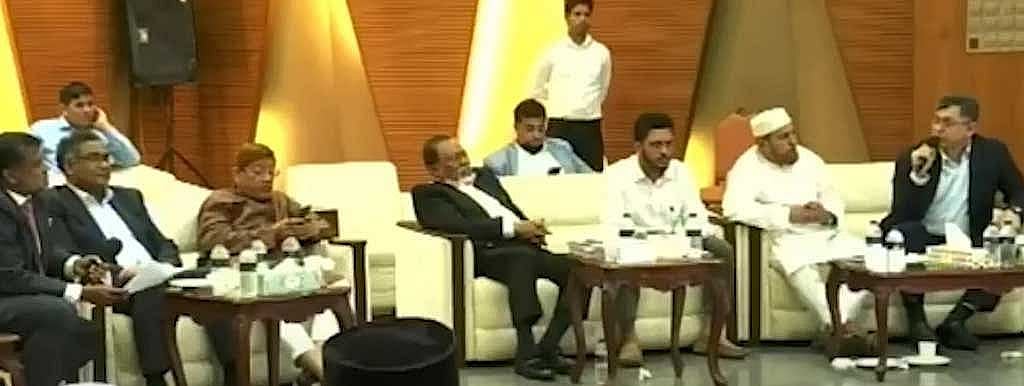
“The hopeful part is they assured me the protests won’t be amplified. Their PR demand is no longer contested. The July Charter itself does not include PR provisions, but we all agreed on holding a referendum to validate it.”
Mushtuq Husain, a permanent committee member of JaSaD, said it remains unclear to the public exactly whom the street actions are targeting.
“If it’s for public opinion-building, that is fine. Mobilising support through media or public engagement can be effective. Traditional protest methods at this stage, however, could complicate the situation.”
A veteran student leader active in anti-dictatorship movements of the 1990s, Muhstuq added: “We are not participating in such protests. If the government departs from a neutral stance and favours a particular party, we will object. A prompt national election is essential for reaching a stable solution.”
Abdullah Kafi Ratan, general secretary of the Communist Party of Bangladesh (CPB), criticised the Islamist parties for dual tracks.
“On one hand, they participate in consensus meetings; on the other, they stage public demonstrations. How ethically justifiable is this?
“We, too, have registered notes of dissent within the Consensus Commission, rejecting some points while agreeing on others. But we are not taking to the streets. Their activism is unacceptable.”
Ratan added that leftist parties will soon announce their own programmes.
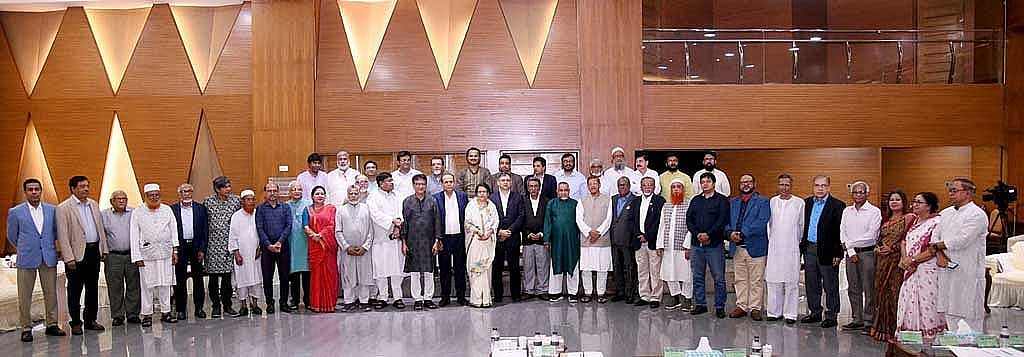
“We have positions on the four fundamental principles of the Constitution, which cannot be altered under any circumstance. New provisions can be added if necessary. We will hold a press conference in the coming days to outline our plans.”
POLITICS AND ELECTORAL IMPACT
Since the announcement of the February polls and the scheduling of the Charter’s signing, public discourse has focused on the trajectory of the protests led by Jamaat and five other parties.
According to Jamaat leader Taher, their demonstrations are far from over, with more programmes in the pipeline.
Political analyst Iftekhar told bdnews24.com that while the Islamist parties’ mobilisations appear as straightforward democratic campaigns for their demands, they are being conducted with broader objectives.
He said, “The protesters speak of pressuring the government. There is a public perception that some elements within the interim administration tacitly support this movement. Though the demonstrations focus on specific demands, it is reasonable to interpret their apparent objective as delaying the election and putting BNP under political pressure.”
Iftekhar, a faculty member of the American Public University System’s School of Security and Global Studies, specialising in international relations, distinguishes between devoted Muslims and those who pursue Islam-based politics.
“Merely following Islam makes one an adherent,” he said. “But those engaged in Islamic politics -- whether Jamaat, Islami Andolon, Khelafat Majlish, or others -- are Islamists.”
He said the current protests unite ideologically divergent Islamist groups.
“Jamaat, influenced by Maududi’s thought, is taking to the streets alongside the Qawmi-stream Islami Andolon and Khelafat Majlish under a common agenda. Such coordinated demands could evolve into electoral compromises.”
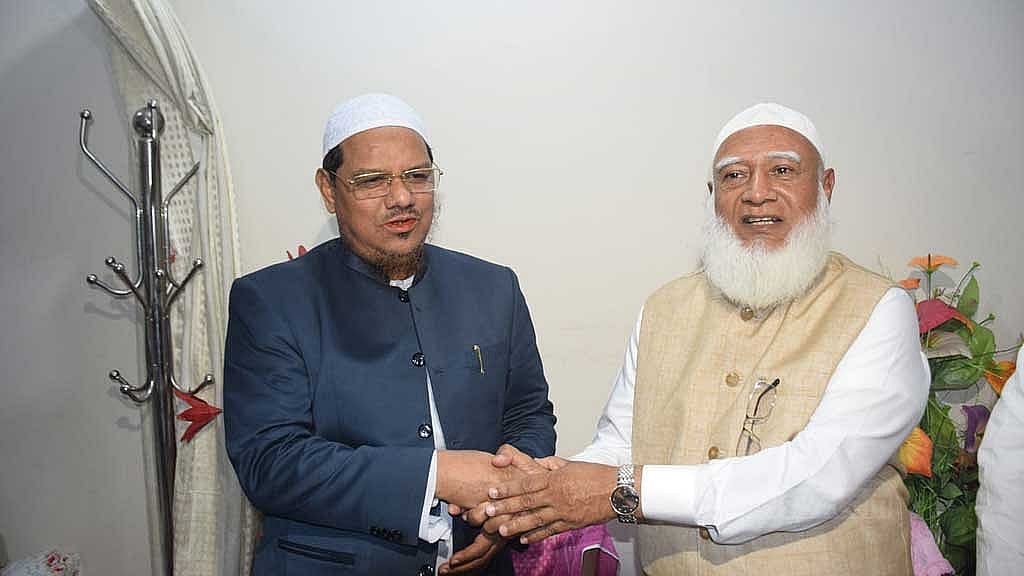
But Iftekhar cautioned that if the election is delayed or manipulated through these protests, it would give the Islamists a political advantage. “This unity accelerates their efforts toward broader goals.”
He also observed that the six parties’ insistence on the PR system in both parliamentary chambers contrasts with the BNP’s position.
“The NCC advocates PR for the upper house only. Some demonstrators demand it in the lower chamber too, increasing pressure on the BNP.”
The analyst added that demands to postpone elections until trials are held for arrested Awami League affiliates could place the BNP in an especially vulnerable position.
“Opposing this publicly would be difficult. If the announced February elections proceed while Jamaat and allies claim unmet demands and boycott the polls, BNP could face a severe political crisis.”
Political analyst Kazi Mohammad Mahbobor Rahman said, in parliamentary affairs, no party can remain outside a binary coalition.
“Bangladesh politics has long revolved around two dominant streams: the Awami League and the BNP. With the interim government in place, Islamist parties are developing as an alternative stream, seeking to establish themselves as a credible political option outside the BNP’s orbit.”
He added, “Against the BNP, another ideological stream is emerging, rooted in Islamic principles and Sharia law advocacy. If they carry this understanding through the election, we may witness the crystallisation of a new political current outside the BNP.
“These Islamist parties are positioning themselves for the upcoming election, aiming to secure votes independent of the BNP -- that is their strategic goal.”