Published : 26 Mar 2026, 04:18 AM
Updated : 21 Aug 2026, 03:31 PM


For the last few years, Shakib Khan, or better known as the King of Dhaliwood, has been consistently giving the audience smash hits.
Although some of his ultra masculine roles have some resemblance to characters in Tamil movies, in the end, Shakib added his own panache to his characters, giving them the extra edge.
Add to that some intelligent film direction, punchy dialogue and thrilling twists.
I am talking about both Toofan and Tandob, two movies that have not only added to the allure of Shakib but have also carved a new dimension for action-based masala films in Bangladesh.
Over the top plots, dialogue laced with bravado, opulent sets, sumptuous item numbers and audience rousing twists are the key features of such commercial productions and both Toofan and Tandob ruled the film releases during past Eid holidays.
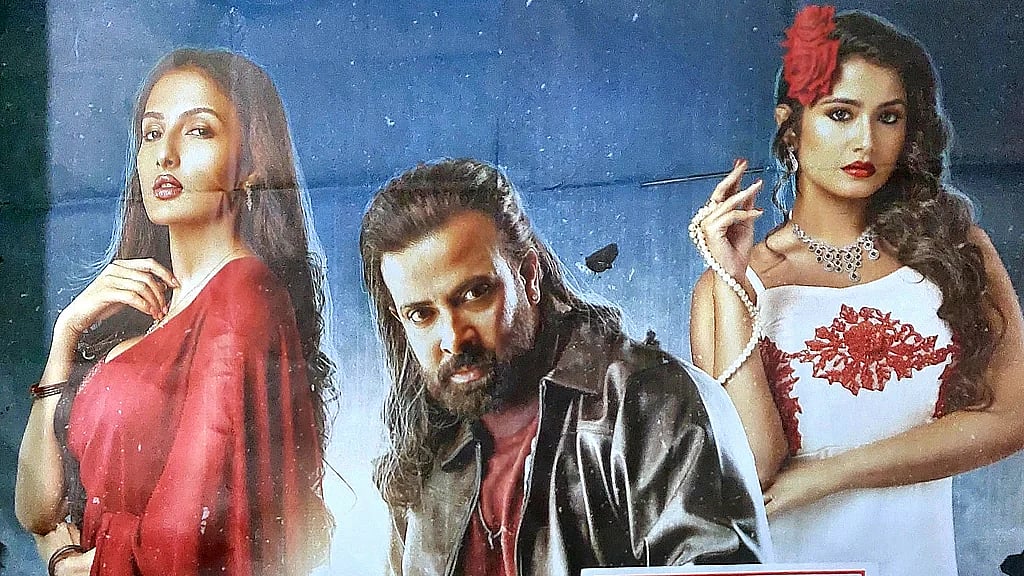
Naturally, when Prince: Once Upon a Time in Dhaka was announced, there was considerable enthusiasm.
We’ve seen Once Upon a Time in Hollywood and Once Upon a Time in Mumbaai -- both unique and thoroughly engrossing in their own right.
The first captures the height of the swinging sixties in Hollywood, marked by a hedonism layered with a glamorous lifestyle, while the latter dived deep into the glitzy world of Bollywood of the 70s when bling blended with bang as celluloid and underworld crime formed a heady mixture.
Alas! There’s no Dhaka
So, what did we expect from Prince: Once Upon a Time in Dhaka?
For starters, certainly not a film which has minimum representation of Dhaka.
Forget about the rest, the movie commits sacrilege by showing Old Dhaka through areas in West Bengal, mainly Kolkata.
Why?
Is there any plausible answer to this!
If Old Dhaka needs to be shown then at the top of one’s head, Lalbagh Fort, Christian cemetery, Armenian Church, Tiger House, Chawkbazaar, Ahsan Manzil and even parts of Dhaka University come to mind.
To present the core ethos of Old Dhaka, the gastronomic joie de vivre cannot be left out and, therefore, one needs to show Hajir biriyani, Nanna’s polao, Beauty Lassi, Beauty Boarding and so on.
Unfortunately, none of these are showcased in the film.
As a Bangladeshi and a film lover, this is demeaning and difficult to accept.
It’s not that the film is showing a distant place and therefore, shooting has to be done in a different country.
What is the point if Old Dhaka’s historic enchantment and gastronomic charm is missing in a film supposed to portray the most bustling part of this city?
Some strategic shooting plans along with recreating an Old Dhaka set somewhere in Bangladesh could have worked.
To make matters worse, in one scene, one of the actresses is taken to a modern restaurant which hardly captures Old Dhaka’s rich culinary heritage.
The faults of this film then comes like a flood: Tasnia Farin drives what looks like a Padmini Fiat car, a vehicle which was never used in Dhaka.
Most other cars shown are of Indian make, again creating a major cinematic anachronism.
In the 70s and even in the 80s, no Bangladeshi law-enforcing agency used Indian made vehicles.
But even if we accept the vehicles, there is a problem because the film seems to show the 70s and 80s while many of the car models are of the late 90s.
What Time Period Are We Looking At Here?
This is yet another question that continues to assail the mind.
At one point, it seems the film tries to show the 70s because people are seen in bell bottoms, then suddenly, mobile phones appear, more bizarrely, TV set models indicate the 90s while the uniform of the law enforcers have no similarity whatsoever with any government law-enforcing agency which operated in independent Bangladesh.
The incongruities pile up -- the protagonist is shown killing hundreds with what appears to be a copy of a gatling machine gun, seen in earlier movies.
This time, however, the special effects are so primitive that unless one has downed six or seven shots of Vodka, the rational side will protest.
Vehemently!
The Prince goes on a killing spree while in the background, for some inexplicable reason, there are fighter jets.
What is he doing in an air force base? Someone in the audience asked.
The answer never came…
“I am thoroughly dismayed because many parts of this film seem like blatant copies of earlier movies, from the clothes to the demeanour to the delivery of braggadocio while casually swirling a whisky tumbler,” said Zahirul Islam, a journalist.
Endorsing his views, Mazhar Mithun, another journalist, deplores: “There is a dearth of originality here; worse still, some of the shots of actors have been amateurishly superimposed against scenes within Dhaka University.”
Actors playing underworld figures are speaking not the Dhakaiya dialect, which is actually a blend of Urdu and Bangla, and neither are they speaking in the common Dhakaiya Bangla, laments Mazhar.
Referring to the conflicting time periods, Md Yeasin, an ardent Shakibian or Shakib fan, says: “it’s very confusing, while the clothes indicate the 70s, the cars and other instruments are from the 90s and later periods.”
A young underground operative kills indiscriminately, falls in love with two people, does some steamy item numbers, helps a political party to win elections and then appears to be killed, only to re-appear in some desert.
That’s the plot -- to be honest, it’s more like a mix of several films we have seen before, contends Sohag Hossain, a film enthusiast.
Tasnia is a seasoned actor but here, it seems her main-task is to add the vamp allure.
Actors like her should never be given 10 layers of make-up, they are naturally attractive and that’s how people like them, remarked Mazhar.
Why Did Shakib Make This Movie?
During the interval, the most common question heard from young film lovers: Did Shakib read the script and get a thorough idea of the filming before he signed?
The disappointment among many of the viewers was palpable.
One cannot have a movie on Dhaka and then shoot it elsewhere, because that fails to capture the actual spirit and the kaleidoscopic nature of this city, remarked one viewer.
In the end, we see Shakib delivering a line in what appears to be Tamil!
Why do we have such an ending???
The questions are many, answers still not forthcoming.
Coming out of the hall, we felt lost, confused and puzzled!
Once upon a time in confusion, someone quipped while the line of the night from one viewer: Can I get a refund on that ticket?
[Towheed Feroze is a former journalist!]