Published : 05 Feb 2026, 05:13 AM
Updated : 21 Aug 2026, 03:06 PM


In all the hubbub over the massive protests against the Islamist regime in Iran, and possibility of strikes on the regime by the US and its allies, it would be easy to miss the significance of a video that made the rounds on X (formerly Twitter) that collects dozens of Bangladeshi social media influencers kissing digital images of Iranian Supreme Leader Ayatollah Khamenei.
This unambiguous sign of support by some young Bangladeshis for one of the most violent theocrats in the world, who, in recent weeks, has systematically killed thousands of his own people (estimates range between about 5,000 and over 30,000) for the crime of protesting, is both chilling, and ironic.
Chilling, for the celebration of a mass murderer. Ironic, since what is happening in Bangladesh right now, and even more the response to it from the US and its allies, echoes the Islamic Republic’s history.
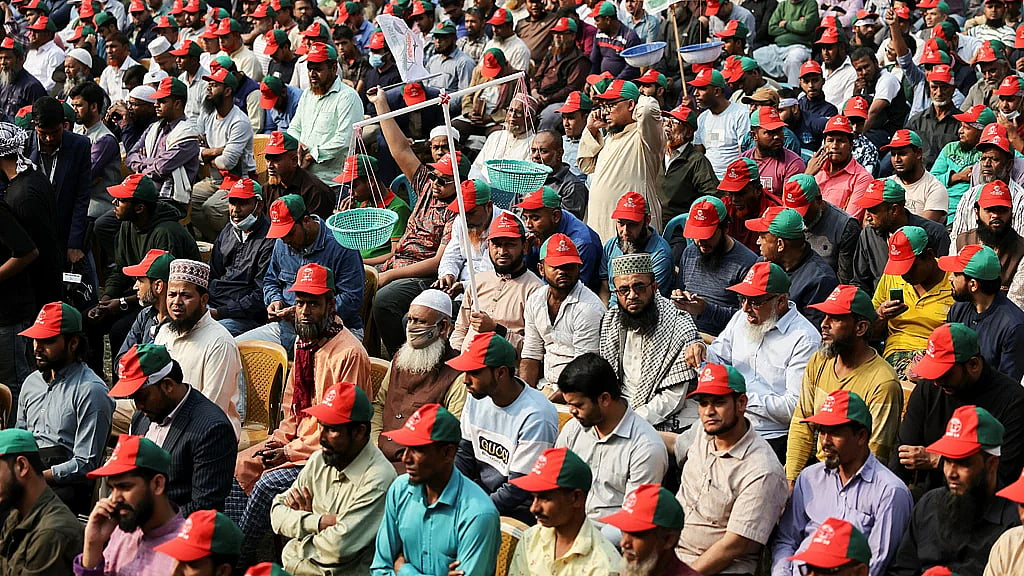
Put more plainly: in the election coming up in less than two weeks, a bloc of 11 primarily Islamist parties, led by South Asia’s premier Islamist movement, Jamaat-e-Islami, is the only significant competitor to the Bangladesh Nationalist Party (BNP).
And the United States, and indeed much of the world, is asleep at the wheel as to what the rise of political Islam in Bangladesh could mean.
The 1979 Islamic Revolution in Iran caught much of the world by surprise.
First, because it happened, and second, because it proved to be one of the most toxic and dangerous global developments of the second half of the 20th century.
Ayatollah Ruhollah Khomeini, far from the Gandhi-like “holy man” much of the Western media portrayed him as, proved to be one of the most brutal and repressive dictators in the world.
Mistaking Khomeini for the leader of an innocuous social movement was arguably the biggest mistake of President Jimmy Carter’s term in office, and the ensuing hostage crisis sunk his chances at a second term.
The entire world has had to deal with the repercussions of the Iranian revolution since.
A similar dynamic may be playing out with regard to Bangladesh.
The distortions in Western media about what is going on in Bangladesh became clear shortly after the fall of Sheikh Hasina.
A podcast featuring Karishma Mehrotra, the South Asia Correspondent of The Washington Post, DC’s most influential paper, portrayed what was happening in Bangladesh as a revolt of everyday Bangladeshis against a corrupt elite.
Mehrotra’s portrait of the situation was not entirely fictional.
Hasina had extremely sharp elbows and her party had been accused of systematic voter suppression for years, something I know was widely believed in the US State Department.
It had certainly engaged in some level of repression and few doubt that her government had grown sclerotic, having been in power for an excessive 15 years.
However, the podcast explained her ouster in terms so naïveté and incomplete it was difficult to fathom.
Repeated references to the “student” revolt, sans any discussion of who those students were, and its impact on what was going on in the ground in Bangladesh, would lead one to think these students were just like civil rights activists in the American South circa 1964.
There was no mention of the fact that, in the the run-up to Bangladesh’s 2014 election, Islami Chhatra Shibir, the student wing of the Jamaat movement, was named the third most violent non-state armed group in the world, and is widely believed to have been at the forefront of the protests that led to Hasina’s fall.
Nor was there any mention that their parent organisation, Jamaat, was deeply involved with the Bengali genocide of 1971.
Nor was there any mention of Islamist movements at all, other than to say that Hasina was their opponent.
This kind of naiveté was not unique to the Washington Post.
A CNN story, published just days before Hasina’s fall, painted Islami Chatra Shibir as innocent victims of a repressive government, full stop.
This lack of attention to this potential threat in American media is perhaps best exemplified by the fact that, a quick search of The Washington Post’s website, shows that Jamaat was not mentioned once between February of 2024, and Jan 22 of 2026, just three weeks before the Bangladesh election.
Occasional mild concerns raised in outlets like the New York Times, or occasional examples of think-tank experts raising alarms in less influential media outlets, do not change the overall trend in US media, which is very similar to the portrayal of the Iranian revolution of 1979.
US diplomats are publicly apathetic.
“We want them to be our friends,” said one anonymous diplomat to The Washington Post, and urged reporters to engage Islami Chhatra Shibir when doing their reporting.
“I simply do not believe that Jamaat can impose sharia,” the diplomat said, even though it is something the islamist party has long advocated, and some members have continued to openly promote.
Instead, the diplomat suggests that if party leaders made moves in this direction, the United States “would have 100 percent tariffs put on them the next day”.
It’s impossible to know if US media portrayals of the situation is the cause of the diplomat’s stance, or if its western diplomats views that are instrumental in shaping US media coverage, but both are reading from the same playbook.
Nor were these diplomats views an aberration.
The US had been courting Jamaat for months, as have many US allied countries.
Shafi Mohammad Mostofa, a professor of world religions and culture at Dhaka University, correctly observed that “Jamaat is now desperate to move into the mainstream and keen to project itself as inclusive and tolerant in order to fit Western democratic narratives”.
The joint incredulousness of Western media and diplomats to the possibility that the Jamaat bloc could gain power and impose a theocratic vision, is evidence that their makeover campaign is working.
A recent controversy illuminates the problem.
An X account belonging to Jamaat chief Shafiqur Rahman in Bangladesh, recently posted that “We believe that when women are pushed out of the house”, i.e. women working outside the home, “This is actually another form of prostitution”.
This statement stands in contrast to recent speeches praising the role of women in Bangladesh, and caused a backlash.
Rahman claimed that his account was hacked.
It seems more likely that he committed a gaffe.
In other words, he accidentally told the truth about what he believes.
It is worth remembering that Khomeini made many pro-women statements before he took power in Iran.
Those stances didn’t last.
Jamaat’s role in the 1971 Bengali genocide is another issue.
One expert points out that while Jamaat has offered vague, broad apologies for past acts, as part of their rebranding efforts, they have never admitted to the crimes involved, or been explicit about what they are apologising for.
Such half-measures are not credible, yet they seem to have been sufficient to convince the Western foreign policy elite that there is nothing to see here.
It is not my claim that Bangladesh will be the next Iran.
Bangladesh has a different history, a different role in the geopolitical order, and Muhammad Yunus, the interim government’s leader, is hardly Khomeini.
Also, a wide variety of secular forces still maintain considerable power.
This is a drama whose end is not known.
But it is remarkable that Western diplomatic and media establishment figures barely seem to notice that the Awami League, traditionally one of the two largest parties in Bangladesh, is banned from participating in the coming election for alleged perpetration of relatively mild political repression, while a party that was clearly instrumental in a genocide within living memory leads the only bloc that challenges the BNP.
Recent history shows why this is a problem: the Muslim brotherhood was never popular in Egypt, but it did win an election when it was seen as the only alternative to what was perceived as a corrupt and out of touch elite.
One can hope that a relatively free and fair election will occur in Bangladesh, and that Bangladeshis will choose a more tolerant force than Jamaat and their ilk.
That result may still come to pass.
But a failure to take the possibility of an Islamist led government in Bangladesh seriously is a significant indictment of Western media and policymakers.
It seems far too many didn’t learn the lessons of 1979.
[Clifford Smith is a former congressional staffer. He lives in Washington, DC, where he works on national security issues, with a focus on radical Islamist movements. He is also a writing fellow with Usanas Foundation, India-based security and foreign policy think tank. Clifford.vernon.smith@gmail.com]