Published : 01 Jul 2025, 07:20 AM
Updated : 21 Aug 2026, 01:28 PM


Researcher Mamun Or Rashid has changed his position amid criticism after disseminating misinformation in the media and later disclosing its withdrawal.
While previously labelling the missing or removed links as “fake news”, he is now saying that not all of those may actually be fake news or misinformation.
Moreover, Mamun—who is a consultant for the ICT Division’s project titled Enhancement of Bangla Language in ICT through Research & Development (EBLICT)– said even some reports that have not been retracted are included in the list as “misinformation”.
“The research is still ongoing. A preliminary report will be published soon, and a long-term study on the subject is also under way,” he added.
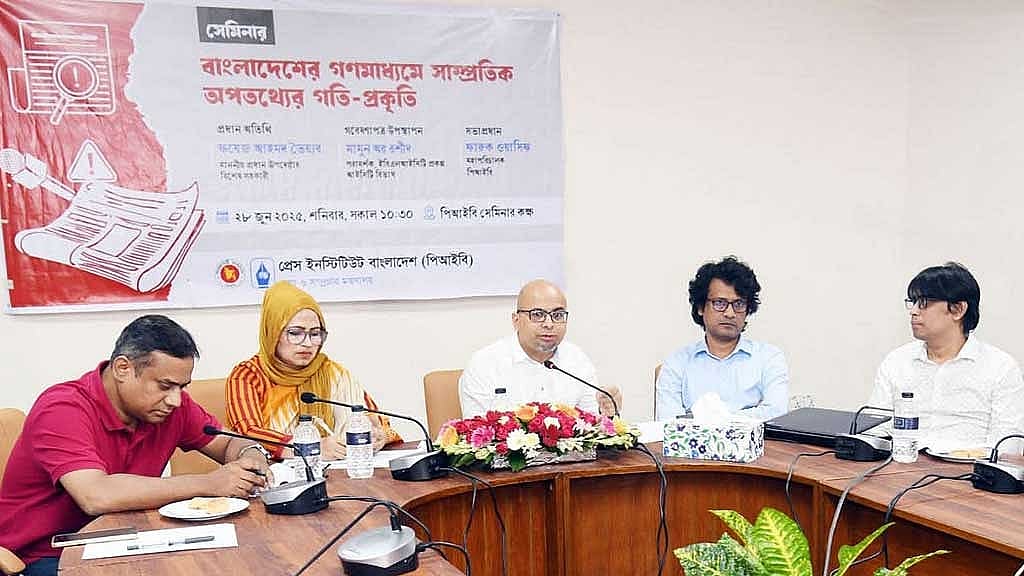
Mamun, the assistant professor at Jahangirnagar University’s Bangla Department, presented findings from the ongoing research at a seminar titled “Recent trends in misinformation in Bangladeshi media”, held Saturday at the auditorium of the Press Institute of Bangladesh (PIB).
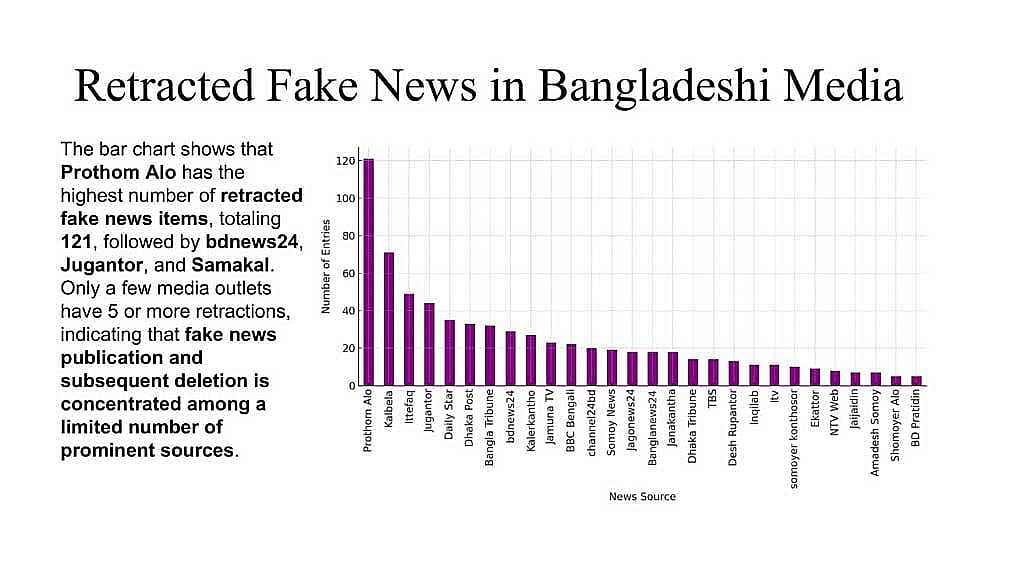
In a presentation titled “Mis-Dis-Mal Information in Mainstream Media”, a slide read: “The graph shows that Prothom Alo tops the list with 121 fake news articles that were later retracted. Next in line are bdnews24.com, Jugantor, and Samakal.”
However, the chart on the same slide showed Kalbela in second position, Ittefaq third, and Jugantor fourth—creating a discrepancy that sparked criticism about the credibility of the research once reports were published based on it. In response, PIB issued a detailed explanation on Sunday.
PIB explained that the research analysed how the “404 Page Not Found” messages on newspaper websites could indicate content that had been retracted—and how this may suggest potential misinformation.
“To this end, a dataset was prepared by collecting 404 links using a web crawling method. The study then examined how the structure of the permalinks of those retracted articles with 404 messages does not necessarily reveal whether the content was misinformation.”
The agency added, “Big data analytics was used for this observation, and the seminar featured a sample of the dataset. The numbers presented in the slide refer to retracted reports, which also include misinformation.
“Not all data are necessarily misinformation, but they are statistical samples of retracted news. Although this was stated verbally during the presentation, the slides did not mention it, which left room for some confusion.”
According to PIB, the observation was based on examining retracted (or modified) links among 377,410 articles from a leading newspaper.
One of the slides presented at the seminar showed that nearly 30 reports dubbed as "fake news" had been retracted by bdnews24.com. When researcher Mamun was asked for those links on Monday, he explained that they fell into three separate categories.
He said, “The research is still in progress, and the data shown in the 404-related slide should be seen as the sum of both retracted articles and misinformation. The dataset is not constrained by publication dates either.”
“A 404 error can result from technical issues, factual reasons, or archival policy. Once the ongoing research is published, we hope the confusion will be cleared.”
Showcasing a link (http://bdnews24.com/bangla/details.php?id=141544&cid=3) which shows a 404 Not Found error (nginx/1.25.4), he said: “This link does not match bdnews24.com’s usual permalink structure but was found through crawling.”
This report, labelled as "misinformation" due to a nonexistent link, was originally published on Nov 13, 2010. The current link to the report titled "Cantonment is no more Khaleda’s residence" is: https://bangla.bdnews24.com/politics/article451282.bdnews.
A spokesperson from bdnews24.com said, “Since that time, our website has undergone three-fold changes, and the server has also been changed at least three times. During this process, the structure of the URLs changed. As a result, a new URL was generated for that report as well. That is by no means misinformation, and the report was never retracted.”
Mamun provided a link to another report by bdnews24.com which is still "live" or active. This clearly shows that the report has not been retracted, nor has the link been removed.
So how is that link being counted among the retracted items?
The researcher said the link has been identified as “misinformation”. However, he did not immediately explain on what basis it is being called “misinformation”.
That report, titled "US behind govt ouster, will return soon: Sheikh Hasina" was published on Aug 11 last year. bdnews24.com published it based on a report from Indian media outlet The Print.
Several other media outlets in the country also published reports based on The Print's article. It is not clear whether those are also included in the researcher’s list of “misinformation”.
The third link from bdnews24.com provided by Mamun leads to an English version report titled "BNP mayor candidate Ishraque to stand trial in ACC case”.
Pointing out that the link of the news (https://bdnews24.com/politics/2020/01/15/bnp-mayor-candidate-ishraque-to-stand-trial-in-corruption-case) now shows a 404 error, the researcher noted that it could be due to “site restructuring or archival reasons”.
“There is the presence of such data here that the segment with the date shows a 404 error, but when removed, the page appears active.”
Following the publication of that report on Jan 15 2020, the URL structure of bdnews24.com changed due to a shift in server and CMS. That report is still available online and accessible via this updated link: https://bdnews24.com/politics/bnp-mayor-candidate-ishraque-to-stand-trial-in-corruption-case.
It has not been retracted, nor is it misinformation or fake news. Anyone can verify its authenticity through a simple Google search.
Although Mamun claimed to have found 30 “retracted” links from bdnews24.com, he provided only three when asked.
bdnews24.com reviewed them and found that all the reports are still available online.
In two cases, the URLs have changed, which in no way constitutes a “retraction”. Nor are those reports “misinformation” or “fake news”.
Even though the event mentioned the removal of 30 “fake news” in over six months, the time span of those three reports covers almost 14 years.
Referring to “confusion” created by the report presented at the seminar, PIB said: “Some media outlets have published reports citing another outlet in such a way that confusion is being created about the newspaper and the research itself. All data used in the research is properly preserved by the researcher.
“Once the research paper is published, detailed information and analysis on the matter will be made available. Until then, we request everyone to publish accurate information only.”