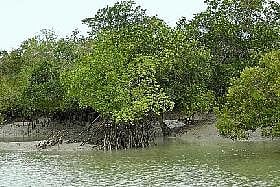
KHULNA, Jan 18 (bdnews24.com/Reuters) – Sundari trees in the country's mangrove forests are dying off, according to forestry officials.
The trees from which the name Sundarbans was derived, are dying of "top-dying" disease, which officials say has intensified following the Nov 15 cyclone.
Cyclone Sidr, striking the coastal regions with winds of 250 kph (155 mph), destroyed a large part of the Sundarbans, a UNESCO World Heritage site and home to the Royal Bengal tiger.
At least 60 percent of the 6,000 sq km (2,320 sq mile) mangrove swamps that are home to more than 400 Royal Bengal tigers was devastated by the cyclone.
Top-dying was already endemic among Sundari trees, but the disease appears to have spread and intensified since the cyclone hit.
Sundari trees constitute 70 percent of trees grown in the swampy forest. The trees grow up to 70 feet in height and are mostly used in boat building and house construction.
Experts have yet to find a cause of the top-dying disease, but they.
"Gradual decreasing of oxygen in the soil of the forest may also be a factor for this (top-dying disease)," said AF Fazlul Haq, a professor in the forestry department of the Khulna University.
Other experts suspect that increased salinity may have something to do with the intensification of the disease, as salinity has been increasing due to decreasing water flow across the forest, which is criss-crossed by a number of rivers and canals.
Water flow has decreased due to urbanisation and the construction of dams further upstream on the rivers, most of which flow in from neighboring India before emptying into the Bay of Bengal.
The Sundarbans stretch 4,000 sq km (1,545 sq miles) into India's eastern state of West Bengal.
bdnews24.com/rah/1352hours