Published : 28 Apr 2026, 04:38 AM
Updated : 21 Aug 2026, 03:39 PM


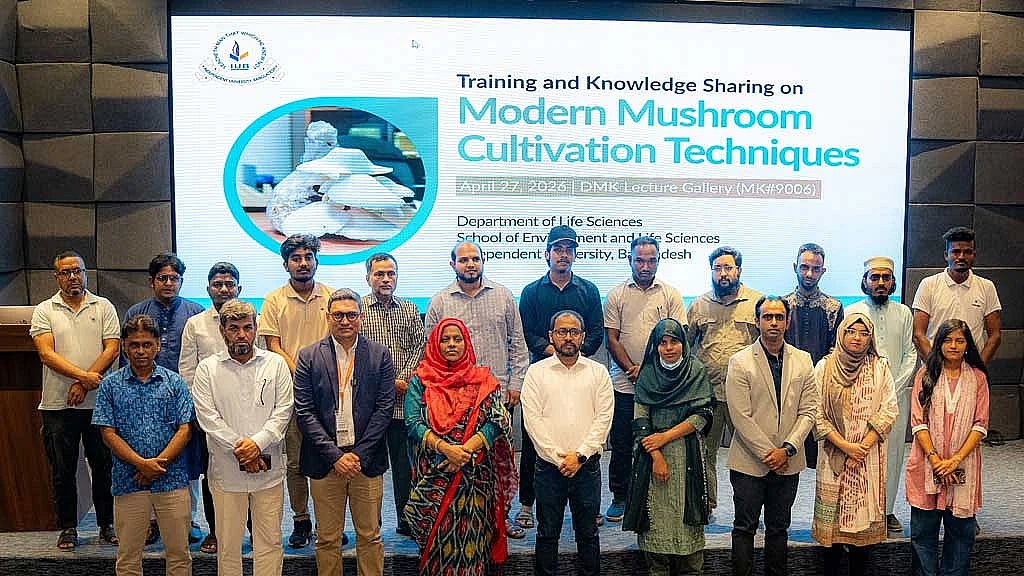
The Department of Life Sciences at Independent University, Bangladesh (IUB) has held a workshop on modern mushroom cultivation methods.
Cultivators and entrepreneurs from across the country attended the event on Monday, sharing their experiences and difficulties, the university said in a statement.
Mushrooms have become a promising crop, contributing both to household nutrition and income for marginal families.
However, fungal contamination continues to be a major issue, often starting in a single spawn bag and quickly spreading across entire farms.
To tackle this, Associate Professor of Life Sciences Jebunnahar Khandakar developed a new technique after nearly three years of research that prevents harmful fungal spread without lowering yield and remains safe for both humans and the environment, the statement said.
The workshop had two key objectives: addressing farmers’ questions about the new method and collecting feedback for further refinement, and helping entrepreneurs better understand the persistent challenge of achieving sustainable market access to improve profitability.
During the opening session, special guest Rezaul Karim Siddique, a renowned media personality and host of the agricultural programme “Maati O Manush”, said mushrooms have not penetrated grassroots levels in Bangladesh over the past 40 years, largely due to public doubts about whether they qualify as proper food, the statement said.
He also noted that quality spawn is not easily accessible, adding that marketing barriers have limited availability in rural areas, keeping consumption mostly within upper and middle-income groups.
According to the statement, Bogura’s Priyozon Mushroom Foundation founder Jamal Uddin Ahmed said the dropout rate among mushroom entrepreneurs reaches as high as 99.9 percent.
From what was once several hundred thousand participants, only a small number remain active today, he said.
He emphasised that consuming mushrooms worth about Tk 5,000 monthly can help reduce the risk of several chronic illnesses, while stressing collective initiative to expand the sector.
Mushroom cultivation is a highly intensive process, requiring a precise chain from tissue culture to marketing, the statement says.
As a "perishable product", it demands careful management across production, processing, packaging and distribution, yet such structured support has not been sufficiently provided by authorities.
IUB Pro Vice Chancellor Prof Daniel W Lund, Dean of the School of Environment and Life Sciences K Ayaz Rabbani, and Head of the Department of Life Sciences Md Mahmodul Hasan Sohel also addressed the opening session
In the technical segment, Prof Jebunnahar presented the newly developed technique, explaining mushroom cultivation as a knowledge-driven business where strong yields depend on continuous learning and gradual refinement of methods.
She also outlined the scientific principles behind the process to help participants gain a deeper and more comprehensive understanding, the university said.
Department of Human Resource Management Head Ikramul Hasan highlighted the role of social media and digital tools in expanding market reach and customer bases.
He encouraged entrepreneurs to build independent brands while fostering collaboration within the sector, stressing that joint efforts are essential given the underdeveloped state of the mushroom market in Bangladesh.