Published : 06 Nov 2025, 07:25 AM
Updated : 28 Aug 2026, 01:29 AM


Following the formal initiation of the process to merge five financially distressed Shariah-based private banks, Bangladesh Bank Governor Ahsan H Mansur has identified several challenges in stabilising the new bank.
Speaking at a press conference on Wednesday in Dhaka, he said the primary challenge is keeping the business running, with each bank required to continue operating properly.
The second challenge is IT system integration, which involves converting the different technologies used by each bank into a single platform and ensuring proper monitoring over it, he added.
“It is very important that we maintain takeover control over the IT systems.”
Several private banks have faced financial fragility for some time due to irregularities and loan scams.
The most troubled banks are those previously controlled by prominent business groups including S Alam Group, NASSA Group, and Sikder Group.
Bangladesh Bank has struggled to manage these banks even with special concessions. Eventually, with no other option, it decided to pursue a merger.
Before being removed from office, the previous Awami League government had identified several banks as “problematic” in April 2024, among the 61 commercial banks in the country.
At that time, steps for a merger were also initiated. A contract was signed under Bangladesh Bank’s direct supervision to merge private Padma Bank (formerly Farmers Bank) into another private bank, Exim Bank.
However, following the fall of the Awami League government in August, the initiative was halted.
After the reshuffle in the financial sector, the merger returned to discussion based on recommendations from a banking taskforce.
The Exim Bank, previously considered “stable” under the Awami League government, has now been classified as “distressed”.
Governor Mansur has taken steps to merge it with four other Sharia-based banks under the interim government.
The other four banks are First Security Islami Bank, Global Islami Bank, Union Bank, and Social Islami Bank.
While there are other distressed banks, the governor said the four under S Alam Group’s control and Exim Bank under NASSA Group’s control are in the weakest positions.
On Wednesday, directors of these banks were sent letters asking them to resign.
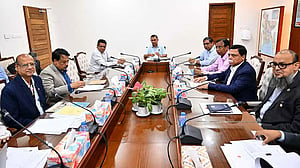
Before the press conference, the governor held separate meetings with the chairmen and managing directors of the five banks.
Together, these five banks operate 750 branches nationwide and employ around 75,000 staff.
Upon merger, branches in the same district, sub-district, or city will be consolidated into one or two locations. Managing the workforce, including selection and retention, will be another challenge, the governor said.
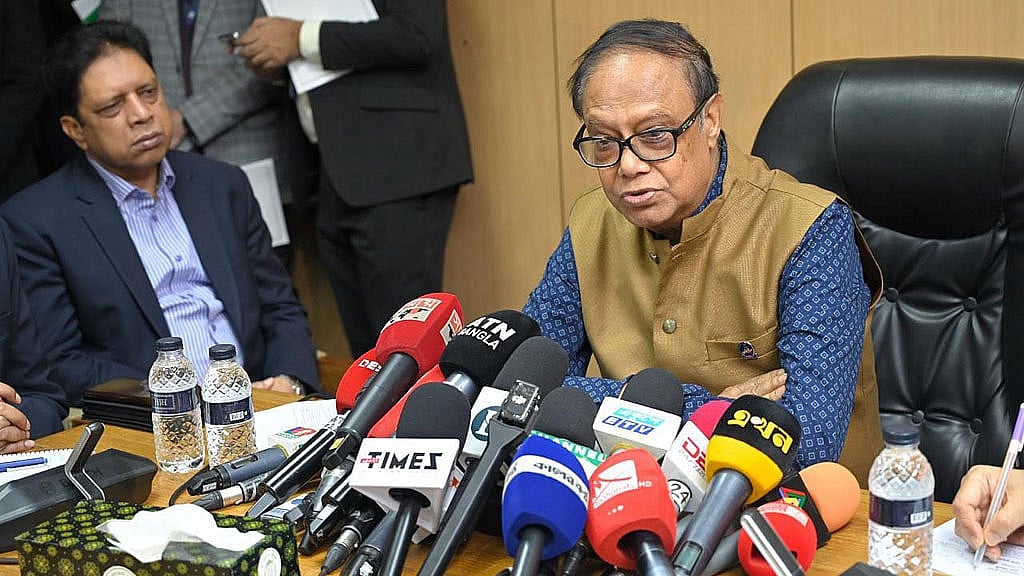
Describing the merger process as “ambitious”, he added that reviewing human resource management and rationalising the branch network nationally are critical.
“Currently, a single street might have five branches. That will no longer happen. There may be one or two branches. A central corresponding team will provide IT support at the individual bank level,” he said.
The fourth challenge, according to Mansur, is financial management. “Ultimately, the bottom line is finance. The banks are in this situation due to financial mismanagement. We have provided the government with a framework detailing the process.
“Bangladesh Bank will monitor each bank’s finances to prevent further deterioration. Any issues must come to our attention.”
He added, “Once the merger is complete, we will be able to provide liquidity support. The government can also extend liquidity, and this will reach the 7.5 million depositors. Management will be an important part of the process.”
At this stage, he noted that there will be no layoffs. A new Shariah bank will be created with authorised capital of Tk 350 billion, funded by the state, to take over all liabilities of the five banks.
An interim office has been set up at the Sena Kalyan Sangstha building in Motijheel. Although state-owned, the bank will not follow the status or privileges of other government banks. Officials will not receive salaries, allowances, or benefits typical of state banks.
Mansur said, “We will bring in professionals, and it will operate like a private bank. Government pay scales will not apply. Current staff will continue with their existing salaries.
“Over time, salary structure nationalisation will be implemented gradually.”
The proposed bank will be named “Sammlito Islami Bank”. Once profitable, the bank will be returned to the private sector within three to five years and listed on the stock market.
Asked whether founders of the liquidated banks could take control of the new bank or face visible consequences, the governor said, “No, those involved will not return to the sector. Many of them are already facing legal proceedings.”