Published : 13 Jun 2026, 06:54 AM
Updated : 08 Sep 2026, 09:15 AM


The BNP government’s first budget has set out an expansive promise - a path towards a trillion-dollar economy, lower inflation, stronger investment and broader prosperity.
But when ministers gathered on Friday for the traditional post-budget press conference, many of the questions that followed Thursday’s budget speech were left looking for answers.
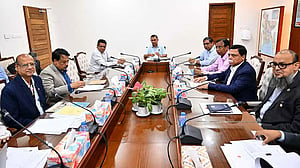
Finance Minister Amir Khosru Mahmud Chowdhury, flanked by senior ministers and officials, defended the Tk 9.38 trillion budget and its ambitious economic targets.
Yet on inflation, jobs, banking reform, energy security and revenue collection, much of what came from the podium sounded familiar.
The government wants to bring inflation down to 7.5 percent, lift economic growth to 6.5 percent and raise revenue collection to a record Tk 6.95 trillion. It also wants to revive investment, restore confidence in banks and create jobs.
The difficulty, critics say, is that the ambition is far clearer than the roadmap.
A Budget Built on Hope
Opening the press conference, Khosru described the budget as an inclusive plan designed to move Bangladesh away from what he called the “patronage economy” of the past.
“For the past one and a half decades, the economy benefited a select group of people,” he said. “We want everyone to be included.”
Economists, business leaders and political opponents, however, have questioned whether the budget’s assumptions are realistic.
The proposed budget is 19 percent larger than the revised outlay for the outgoing fiscal year. It comes at a time when inflation remains stubborn, private investment is subdued, banks remain weak and pressure on foreign exchange reserves has not gone away.
Business groups have broadly welcomed the investment incentives and tax concessions, but analysts are not convinced that incentives alone can overcome the deeper problems holding back the economy.
At a budget discussion on Thursday, Bangladesh Chamber of Industries President Anwar-ul Alam Chowdhury Parvez described the revenue target as extremely difficult to achieve with the National Board of Revenue’s current capacity.
The Centre for Policy Dialogue (CPD) think tank also warned on Friday that the budget projections had been built on fragile ground and questioned whether the implementation targets could realistically be met.
Jamaat-e-Islami, meanwhile, dismissed the budget as overly ambitious, debt-dependent and vulnerable to misuse.
Where Will the Jobs Come From?
Employment was one of the most persistent questions at the briefing.
The government has repeatedly argued that tax incentives and investment-friendly policies will encourage businesses to expand, and that expansion will create jobs.
But when journalists asked how many jobs would be created, which sectors would generate them and over what timeframe, ministers offered few specifics.
Khosru acknowledged that precise employment projections were not possible.
Instead, he said job creation would depend on generating demand for investment, both at home and abroad, and improving the skills of the workforce.
“We have to create demand both at home and abroad,” he said.
The finance minister pointed to higher spending on education and skills development, arguing that a better-trained workforce would eventually improve employment prospects.
But the exchange exposed a wider concern among economists: the budget assumes investment will produce jobs, but gives few measurable targets linking one to the other.
In effect, the government is betting that investment incentives will eventually translate into employment, without yet presenting a detailed jobs strategy.
Investment Without Financing?
That assumption raises another question: where will the investment come from?
The budget offers tax breaks, lower compliance burdens and incentives for a range of sectors.
Many businesses, however, continue to complain of high borrowing costs, weak credit growth and liquidity constraints across the banking system.
The government wants investment to drive growth. But concerns remain over whether banks are in a position to provide the financing needed to support that strategy.
That issue was largely left unanswered, both in the budget speech and at the post-budget briefing.
Energy Remains the Missing Link
Energy supply emerged as another major concern.
Tax incentives may encourage investment, but factories cannot run on incentives. Industrial output depends on reliable access to electricity and gas.
With conflict in West Asia continuing to unsettle global energy markets, questions were raised over how Bangladesh would secure the energy supplies needed to meet its growth targets.
Power and Energy Minister Iqbal Hassan Mahmood Tuku blamed previous governments for making Bangladesh too dependent on imported fuel while failing to adequately develop domestic gas resources.
He said the government had already started efforts to expand gas exploration through state-owned BAPEX and was pursuing both onshore and offshore projects.
Bangladesh currently imports around $2.5 billion worth of fuel annually, he said, while assuring reporters that fuel supplies remain stable.
But much of the minister’s answer focused on medium and long-term solutions.
He highlighted plans to generate 5,000 megawatts of solar power by 2030 and pointed to the removal of import duties on solar equipment.
What remained less clear was how industries would secure the energy they need during the coming fiscal year.
Capacity Payments Remain Untouchable
Questions were also raised about capacity charge payments, a longstanding source of controversy in the power sector.
Critics have repeatedly argued that the government could ease subsidy pressure by renegotiating costly capacity payment agreements instead of raising electricity prices.
Tuku acknowledged that contracts signed under previous administrations had largely favoured investors.
Those agreements, he said, were designed to help private operators secure bank financing and left the government with limited room to manoeuvre.
“Almost all those contracts were written in favour of investors,” he said.
The minister said the government had sought legal opinions on whether action could be taken over the agreements.
Yet despite years of criticism over capacity payments, the budget contains no major policy shift on the issue.
One of the country’s largest structural drains on public finances therefore remains unresolved.
Banking Confidence Still Fragile
The banking sector provided another flashpoint.
The government has time and again promised to restore confidence in a sector scarred by loan scandals, governance failures and allegations of large-scale capital flight.
But journalists pointed to continuing reports of depositors struggling to withdraw money from some banks.
Questions were also raised about whether confidence could truly be restored while controversy surrounded senior regulators.
Bangladesh Bank Governor Mostakur Rahman defended his record and rejected suggestions that the sector faced a broader liquidity crisis.
He argued that delays in loan repayment should not be confused with default and said claims about his own borrowing history had been distorted.
“We often repeat something so many times that it eventually starts to sound true,” he said.
The governor insisted there was no systemic liquidity shortage.
Yet the budget speech itself acknowledges the need for recapitalisation, governance reforms and risk-based supervision of weak banks.
That contrast captures the difficult balancing act facing policymakers: projecting confidence while also admitting that the sector has deep weaknesses.
The Black Money Debate Returns
One of the most contentious exchanges concerned the budget’s treatment of undisclosed income invested in property.
NBR Chairman Abdur Rahman Khan rejected suggestions that the measure amounted to a black-money whitening facility.
He said the provision merely addresses the longstanding gap between actual property values and officially declared registration values.
According to him, both property buyers and sellers often face tax complications because transactions are registered at values far below their true market price.
The new measure, he said, was intended to provide relief, not legalise illicit wealth.
Critics remain unconvinced.
Earlier on Friday, CPD Executive Director Fahmida Khatun described the measure as unjustifiable.
Khosru himself stopped short of fully echoing the NBR chairman’s defence.
Instead, he acknowledged that artificially low mouza rates were part of the problem and said the government was reviewing property valuation systems to bring them closer to market prices.
His remarks appeared to recognise, at least implicitly, that the current framework creates room for undeclared wealth to be legitimised.
Betting on Digitalisation
On perhaps the biggest question of all - how the government plans to achieve its record revenue target - Khosru returned to a familiar answer: digitalisation.
The government believes automation, transparency and reduced corruption can significantly improve tax collection.
The minister also pointed to plans to bring retailers and smaller businesses into the tax net through simplified flat-rate mechanisms.
Whether that will be enough remains uncertain.
The NBR has long struggled with administrative weakness, allegations of corruption and low compliance rates.
The government’s revenue target would require roughly 50 percent growth over likely collections in the outgoing fiscal year — a scale of improvement many analysts consider highly ambitious.
Optimism And Execution
The post-budget press conference showed a government eager to project confidence.
Its economic vision is clear enough: encourage investment, revive growth, widen the tax base, repair the financial sector, and eventually ease pressure on households.
What remains less clear is how quickly those objectives can be turned into results. For now, ministers are asking businesses, investors and consumers to trust the process.
The budget offered a compelling account of where the government wants the economy to go.
The post-budget briefing suggested that many investors, economists and ordinary citizens are still waiting to hear exactly how it plans to get there.