Published : 08 Sep 2025, 07:38 PM
Updated : 28 Aug 2026, 01:26 AM


The “final draft” of the July National Charter that is to be sent to political parties for signing will end with the following promise:
“We agree that all the proposals/recommendations of the July National Charter 2025 that are considered immediately implementable will be fully implemented by the government and other relevant authorities before the next national parliamentary elections without any delay.”
Once the parties sign, it will bring an end to the main project of the National Consensus Commission. And yet, many questions linger.
Will all the 30 parties that took part in the commission’s discussions on state reforms sign this charter? If they do not, will it create new questions about the acceptability of the charter?
How will the reform initiatives that parties have promised to implement be implemented? How many of these decisions can be implemented through the issuing of ordinances?
How many of these recommendations can be implemented before the next general election in February? And how many will be implemented by the new parliament after the polls?
If that parliament does not receive the necessary backing, what will be the future of the July Charter?
Even as the charter takes its final form, doubts persist about the extent to which Bangladesh will take advantage of the rare opportunity afforded by the 2024 July Uprising to carry out state reforms.
Several parties, including Jamaat-e-Islami and the National Citizen Party (NCP), are seeking a legal basis for the July Charter to ensure the issues on which consensus has been reached are implemented. Certain analysts have also questioned the joint draft of the charter, which states the document should be given precedence above the Constitution in certain cases.
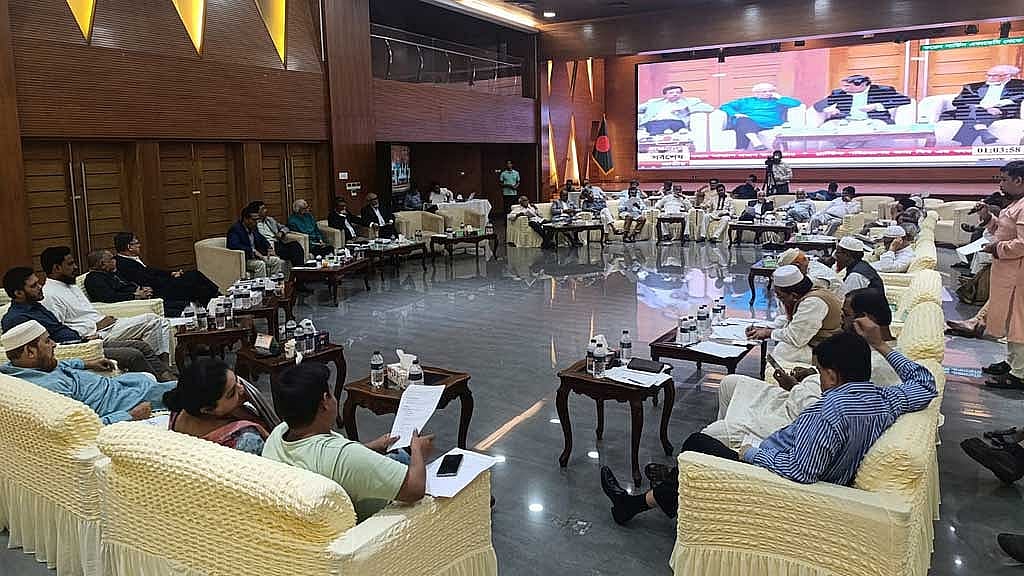
The National Consensus Commission says it will present the suggestions on the implementation process from political parties and experts to the government. The responsibility of implementing the charter thus falls to the government.
It was previously stated that the “final draft” of the July National Charter would be sent to the political parties by Sept 4 for signing. But on Thursday, National Consensus Commission Vice-Chairman Ali Riaz announced that the deadline would be extended by another week.
After discussions on reforms with political parties that lasted six and a half months, a “full, integrated draft” was prepared based on the opinions of parties on the initial draft. The “final draft' has been prepared based on the opinions of the parties on that earlier draft.
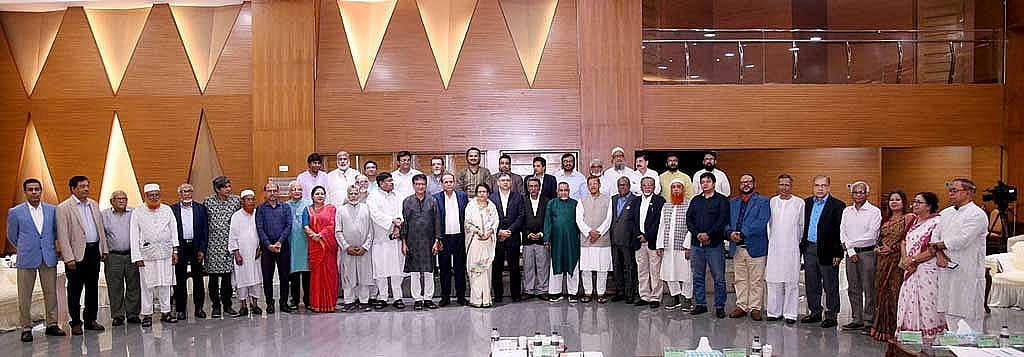
Members of the National Consensus Commission will also sign the much-discussed charter alongside the political parties that took part in the dialogue.
Riaz told bdnews24.com, "The commission will hold discussions with experts this week based on reviewing the opinions of political parties. After that, the final charter as well as the recommendations regarding the implementation process will be sent to the political parties together by Thursday."
HOW MANY RECOMMENDATIONS CAN BE IMPLEMENTED THROUGH ORDINANCES?
One way to implement the July National Charter is to issue ordinances to provide a legal basis for reforms. Some parties have been pushing for these ordinances for a long time.
However, some political and legal experts say the future of the July National Charter is in the hands of the national parliament to be elected in the upcoming general election.
Even if an ordinance is issued on any issue, it has to be passed in the form of a new law within 30 days of the start of the parliamentary session. Otherwise, it loses its effectiveness. Even if a referendum is held, the Constitution must be amended through parliament.
In that case, it is not possible to change the Constitution by issuing an ordinance. The reforms that can be implemented by issuing ordinances now will also be at risk of being nullified if they cannot pass parliament later.
After extensive discussions and debates, the National Consensus Commission has said political parties will reach a consensus on 19 fundamental issues of state reform. Of these, 10 have received objections and notes of dissent from various parties. However, there is “100% consensus” on the remaining nine.
Communist Party of Bangladesh (CPB) General Secretary Sardar Ruhin Hossain Prince told bdnews24.com, "An ordinance cannot provide a legal basis for any issue in the Constitution. Parliament has to intervene."
"The nine issues on which there is 100 percent consensus can be made legal by issuing ordinances."
Asked how many reforms could be implemented through an ordinance, Ali Riaz said: "We will provide a recommendation to the government. From there the government will do whatever it thinks is best.
"Whether the government issues ordinances on nine or ten issues, or it does not, is up to the government. We cannot say for sure."
WILL ALL PARTIES SIGN THE CHARTER?
The commission sought opinions from 30 parties on the charter. Of them, 26 parties submitted their opinions within the stipulated time. The Gono Odhikar Parishad (GOP), the Rastro Songskar Andolon, Jamiat Ulema-e-Islam Bangladesh and the Islamic Oikya Jote did not give their opinions.
In addition to four parties of the Left Democratic Alliance, the Gono Forum and Bangladesh JaSaD have raised objections to several elements in the draft.
The Bangladesh JaSaD said it is in favour of political parties signing the July National Charter based on a commitment to implementing only those issues on which there was "full consensus" during the talks.
The party says that the July National Charter cannot be placed “above the Constitution” and that anyone aggrieved by the charter cannot be deprived of the right to approach the courts for remedy.
The party says it is in favour of adopting the amendments to the Constitution if they are elected to the national parliament and the upper house.
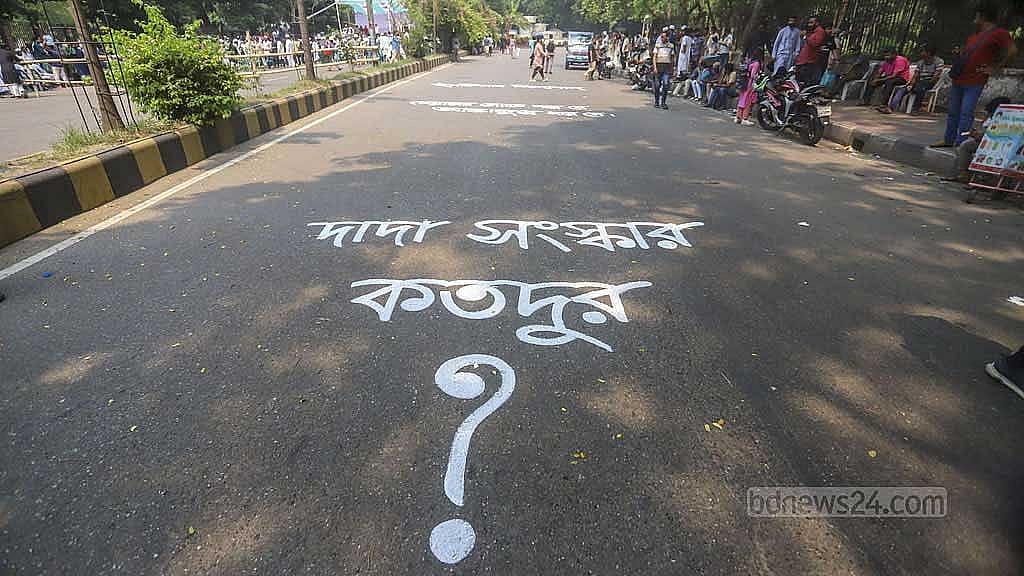
The four parties of the Left Democratic Alliance, including the CPB, have already objected to changing the basic principles of the Constitution. The parties say that they could refuse to sign the charter if there is any scope to amend the Constitution without a parliament.
CPB General Secretary Prince told bdnews24.com, “The charter is one matter, and the other is the implementation of the charter. They will ask us whether we can agree to it or not. And we will answer ‘yes’ or ‘no’.
“If they want to know our written opinion for implementing the charter, we will discuss with others how to implement it, and we will give an opinion. We will be able to tell you whether we can agree to it or sign it after we see the final draft.”
Bazlur Rashid Firoz, general secretary of the Bangladesh Socialist Party (BaSaD), said: “We have said before and we are saying again that if ‘nationalism, socialism, democracy and secularism’ are removed as the basic principles of the state in the current Bangladesh Constitution, we will not accept it in any way.”
Gono Forum General Secretary Mizanur Rahman also commented that if the issues related to the Constitution, especially the four fundamental principles, are changed, “signing [it] is not possible”.
Around 20 parties, including the BNP, Jamaat and NCP, have made promises to sign the charter. There is still uncertainty about the others.
DISPUTE OVER ‘UNANIMOUS CONSENSUS’
Several political parties participating in the six and half a months-long state reform dialogue believe that only the issues upon which all parties are unanimous deserve the label “consensus”.
Conversely, the commission maintains that issues where most parties agree qualify as “consensus”.
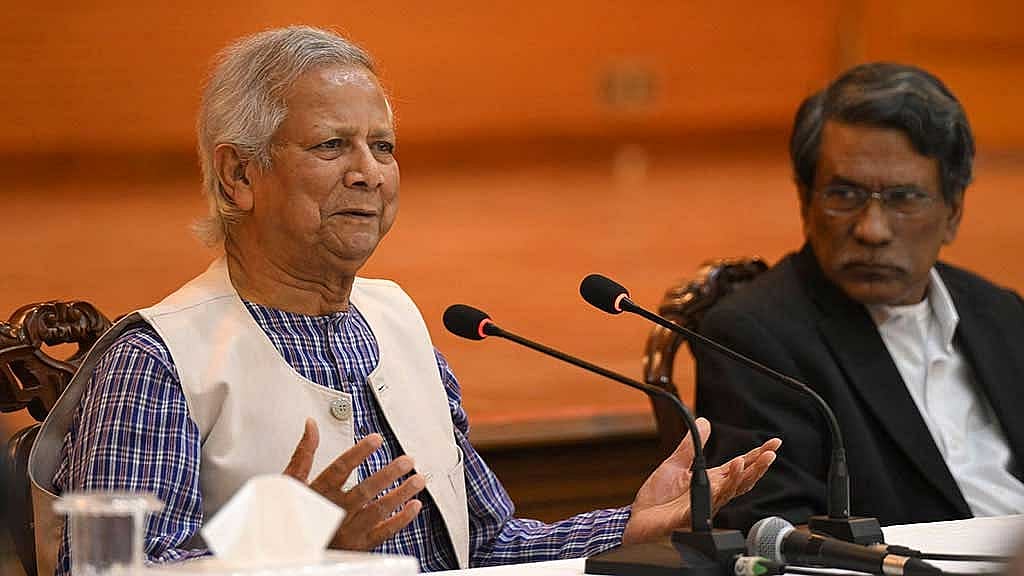
Speaking to bdnews24.com, CPB’s Prince said last year’s Oct 5 meeting with the chief advisor established that only issues with agreement from all parties would be included in the July National Charter.
Now, however, he claims that the draft labels some contested issues -- with “notes of dissent” -- as consensus, which is misleading.
“We disagree over what counts as consensus,” he said. “Only issues with unanimous agreement should be termed consensus. Calling other matters consensus creates unnecessary complications.
“In that case, as we have already said in writing that supporting this consensus may become impossible,” he added.
ISSUES WITH DISSENT NOTES
• Change in state principles: Bangladesh JaSad, CPB, BaSad, BaSad (Marxist) and Gono Forum opposed.
• System of electing the president: Islami Andolan Bangladesh opposed.
• Powers and responsibilities of the president: Partial opposition from BNP, Jamiat Ulama-e-Islam, Labour Party, NDM, LDP, 12-Party alliance.
• Abolishing the option of prime minister holding multiple offices: BNP, NDM, Nationalist Likeminded Alliance and 12-party alliance opposed.
• Caretaker government system: BNP, Labour Party, NDM, Jamiat Ulama-e-Islam, Bangladesh Nizam-e-Islam Party, Nationalist Likeminded Alliance, 12-party alliance opposed in part.
• PR system in upper house elections: BNP and NDM opposed.
• Publication of upper house candidate lists: BNP and NDM opposed.
• Powers and role of the upper house: CPB, Jamiat Ulama-e-Islam, NDM, Bangladesh A-Am Janata Party opposed.
• Provision for women’s seats: CPB, BaSad, A-Am Janata Party opposed.
• Appointments of ombudsman, public service commission, auditor general and Anti-Corruption Commission: BNP, NDM, Nationalist Likeminded Alliance, 12-party alliance opposed.
COMMISSION'S STANCE ON IMPLEMENTATION
Asked about the future and implementation of the July National Charter, Commission Vice-Chairman Riaz said: “We are on the verge of signing the July Charter on the basis of consensus among political parties.
“We have already held discussions with the BNP, Jamaat, and NCP. Political parties were asked to provide written views on how the charter should be implemented since they already have the draft in hand.
He added, “We also held meetings with experts, who gave procedural recommendations. We consulted the attorney general and the law advisor. They too have made recommendations.
“We have asked them to submit these in writing, and we will review them before forwarding one or more proposals to the government.”
Riaz added that not all dissent would necessarily stand in the final draft. “Those who submitted notes of dissent may withdraw them. The belief that unanimity requires agreement from all parties is a misconception.
“With over 30 political parties involved, complete agreement on every issue is unrealistic. Out of 20 issues, only eight face dissent. In most of the 62 earlier proposals, the majority of parties agreed. Consensus cannot be blocked just because one or two parties oppose.”

‘LEGAL FOUNDATION’
The BNP and Jamaat have demanded that the July Charter be given a legal basis, with some provisions placed above the Constitution.
The draft says the charter’s provisions will take precedence over the Constitution or other laws in case of conflict, and its validity cannot be challenged in court.
Jamaat’s deputy chief Syed Abdullah Mohammad Taher said, “We assumed from the beginning that reforms proposed through this process would have legal grounding and be binding. Without legal force, it will remain mere rhetoric that people will neither respect nor accept.
“History shows similar cases in Bangladesh, but legal ways were found to overcome the complications,” he added.
NCP Member Secretary Akhtar Hossain said, “If the July Charter is not given legal standing, it will end up like the three-party outline of 1991 -- just a historical document without effectiveness. We do not want an incomplete, ineffective charter lacking basic reforms.”
The BNP has argued that implementation must take place through the next parliament.
In a three-page opinion submitted to the commission, the party called the proposal to place the July Charter above the Constitution “impossible, illogical, and unacceptable”.
It also argued that if a government formed under the existing Constitution tried to replace it with a new arrangement, it would not be a revolution but rather a “coup”.
ANALYSTS’ VIEWS
Dhaka University political science professor Kazi Mahbobor Rahman said the future of the charter depends on the next elected government.
He told bdnews24.com, “The next government could implement it legally, either by passing a law or directly, which would require a two-thirds majority in parliament. If taken under the current Constitution, we must wait for the next parliament.”
On issuing an ordinance, Mahbobor said: “If an ordinance is issued, it must specify that the charter will be approved by the next parliament.”
He described the charter as a social contract. “Parties sign it, creating a form of social agreement. Even without constitutional basis, it forms a practice that is not insignificant.”
Supreme Court lawyer Shahdeen Malik cautioned that the crisis would remain. “Laws must pass through parliament. Ordinances must also be presented to parliament. If not approved within 30 days, they lapse automatically.
“To give the charter any legal basis, only parliament can do it. If you try to put it above the Constitution, then the Constitution itself ceases to exist.”
He added that referendums are not an option. “To hold a referendum, a dedicated law must first be passed outlining the process, subjects of referendum, and how it would be conducted. Only then could the public vote.”
Shadheen explained that the current Constitution only allows referendums in specific cases.
“The Constitution permits referendums solely on the preamble, and Articles 8, 48, and 56. Beyond those, even referendums are not allowed. Even if a broader referendum were considered, it would still require parliament’s approval.”
Summing up, he said: “In short, the implementation of the July Charter cannot happen without parliament. Its future lies entirely in the legislature.”
Chittagong University political science professor Nizam Uddin Ahmed said the current government took an oath to preserve the Constitution, which limits the scope of implementing the charter outside of parliament.
“Since the government has sworn to uphold the Constitution, there is no way to implement the July Charter without the next parliament,” he told bdnews24.com.
He suggested the parties could pursue a united pledge instead.
“If these 30 parties announce to the nation ‘We’ve signed this and will pass a law to amend the Constitution in the first session of the next parliament’ what greater commitment could there be? If that promise is broken, then your state itself collapses.”
Nizam pointed to a clear constitutional restriction. “The Constitution explicitly says no constitutional amendment can be made through an ordinance.”
Referring to past regimes, he said: “People talk about constitutional amendments under Ziaur Rahman, but at that time there was no Constitution. That government itself wasn’t formed under constitutional rule. There was no functioning legal order -- what existed was jungle law. Invoking that as a precedent for today’s constitutional government makes no sense.”
On the issue of referendums, the professor said it was not viable. “If you want to do something through a referendum, you’d need to educate millions of people.
“Are they going to read and vote on 86 proposals? There is simply no route outside the Constitution to govern.”
“If you intend to operate beyond the Constitution, then why take an oath under it in the first place? You should have formed a revolutionary government -- then many things would be possible. But now, to implement the July Charter, we have no choice but to wait for the next parliament,” he added.