Published : 11 Jan 2013, 11:42 AM
Updated : 23 Apr 2022, 03:54 PM


The day in 2007 saw the nation being thrown to a two-year spell of the state of emergency.
Apparently, to put an end to a spate of violence after the regime of BNP in 2006, then President Iajuddin Ahmed issued the state of emergency.
Simultaneously, the President also resigned from his role as the Chief Advisor of the caretaker government, and the 2007 general elections were dismissed.
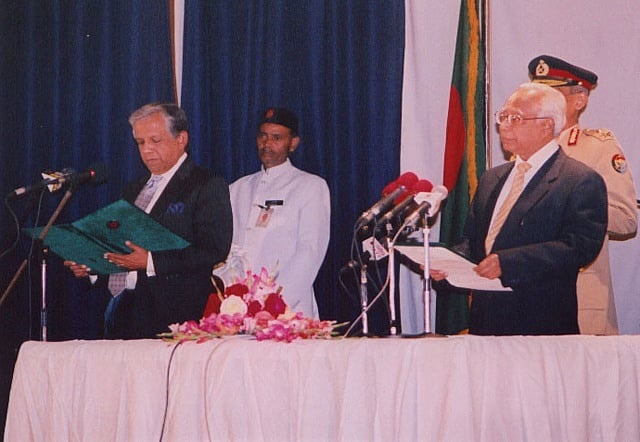
Bangladesh saw a new former Bangladesh Bank Governor Fakhruddin Ahmed-led army-backed ‘caretaker government’ being enthroned.
Democracy resumed much later - on Dec 29, 2008, two years after the Election Commission was reformed under the ‘caretaker government’.
All political activities were banned under the decree of emergency. The army-supported government, though initially gained popularity, later became unpopular.
On the 1/11 evening, a meeting at the Canadian High Commissioner’s residence saw some Awami League and BNP separately sit in discussions with the representatives of the United States, Britain, Australia, Japan and the European Commission amidst countrywide rumours and tense situation.
In the afternoon, President and Chief Advisor Iajuddin Ahmed had himself sat in talks with law enforcers, along with the law and order advisory committee. Chiefs of all law-enforcing bodies including the Detective Branch had participated in the meeting.
Later he sat in talks in the chiefs of the Bangladesh Army, Bangladesh Navy and the Bangladesh Air Force at Bangabhaban.
After this meeting, then army chief Moeen U Ahmed sat in another round of discussions with the chiefs of air force, navy, police DG, Rapid Action Battalion, BDR (now BGB) and all other law enforcing bodies including detective branches.
The President called over other advisors to Bangabhaban. The meeting saw President himself resigning as the Chief Advisor. Other advisors soon followed and stepped down.
Soon after, a notification from the President’s office announced the state of emergency ‘for the sake of country’s economy and security of people’.
The order was put into effect that very evening. A curfew was imposed on all metropolitans and cities in Bangladesh.
In a late-night speech from the President himself, he said he had stepped down as the Chief Advisor to ensure a general election by participation from all political parties.
The next day, Fakhruddin Ahmed declared himself the chief of ‘caretaker government’.
The ‘one eleven’ proved to be uncomfortable for all leading political parties. Over the next two years, Bangladesh witnessed numerous ‘ups and downs’ in the political arena.
Several top leaders and businessmen were arrested over corruption charges. At one point, Sheikh Hasina and Khaeda Zia also were also thrown behind bars on the same charges.
Later, sustained movements forced the ‘caretaker government’ to release them and walk the poll path.
The army-backed government faced the toughest challenge from students. A massive all-out protest spread out through the Dhaka University after a student faced harassment from an army personnel in 2007. Later, the protests spread out through Bangladesh.
Several students and teachers of Dhaka and Rajshahi University were arrested.
After 2009 elections, the incident went under probe by the Parliamentary Committee on Education Ministry of the newly-formed Awami League-led government.
The probe report faulted the then ‘caretaker government’ chief and the army chief. The committee recommended bringing them to justice.
The current Awami League-led government amended the constitution and erased the caretaker government provision.
Now the BNP-led 18-Party Alliance is waging movement for reinstatement of the provision.