Published : 13 Apr 2026, 07:16 AM
Updated : 28 Aug 2026, 01:33 AM


Dhaka’s two city corporations claim they have taken multiple steps to curb mosquito infestation, but residents say the situation on the ground tells a different story.
While officials insist mosquito numbers have declined, many city dwellers say they rarely see mosquito control workers spraying insecticides.
"I couldn't even stand here because of the mosquitoes. You can see for yourself how many there are," Akram Hossain, a resident of Mohakhali's T&T Colony, told bdnews24.com on Thursday.
However, he noted that mosquito density has dropped slightly in recent days due to continuous storms and rain.
A similar observation came from Helal Uddin of Segunbagicha, who said: “It is wrong to say mosquitoes have decreased because of the city corporation. It has gone down somewhat due to two to three days of storms and rain.”
Dhaka South City Corporation’s Chief Health Officer Jahan-e-Ferdous Binte Rahman did not dismiss the residents’ claims.
“Mosquito control workers are spraying insecticides regularly, but the recent storms and rain have also reduced mosquito numbers somewhat,” she said.
The mosquito situation in Dhaka has worsened alarmingly even before the monsoon season.
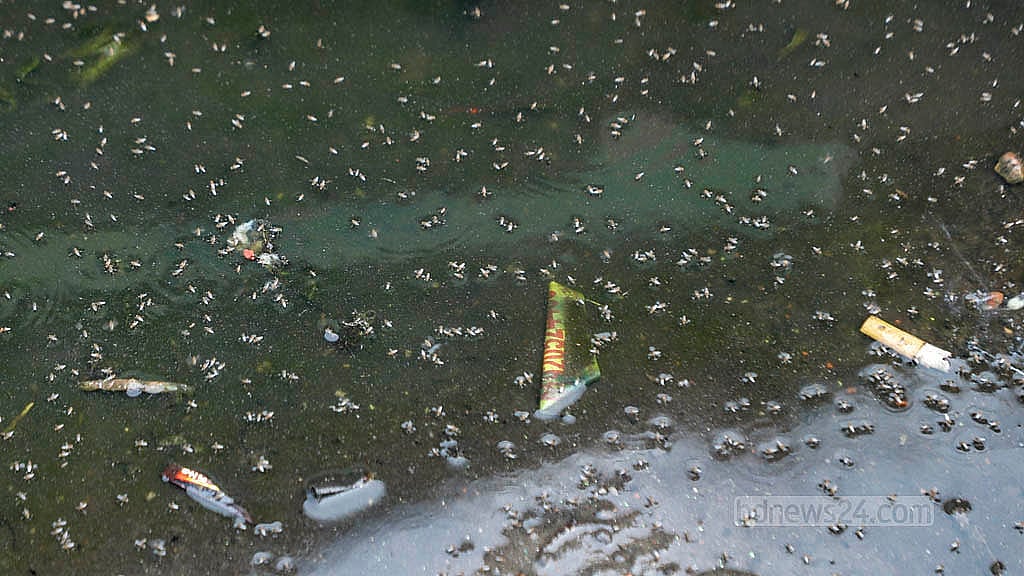
Officials from both city corporations say instead of relying solely on insecticides, greater emphasis is needed on cleanliness and public awareness, as clogged water bodies, open drains and poor waste management contribute significantly to mosquito breeding.
They maintain that fogging and spraying operations are ongoing and claim that mosquito numbers have decreased compared with before.
According to them, cleaning waste, drains and stagnant water bodies would significantly reduce mosquito prevalence, with dengue control now their primary focus.
However, questions remain over whether the situation has improved since February, when alarming data on rising mosquito density emerged.
Media reports citing a study led by Prof Kabirul Bashar of Jahangirnagar University’s zoology department showed that mosquito density in Dhaka rose by more than 40 percent in February compared with January, with around 90 percent being Culex species.
The study also warned that rising temperatures in March could push the situation out of control.
Three main mosquito species are commonly found in Bangladesh -- Culex, Aedes and Anopheles. Among them, Culex is the most widespread and poses risks of diseases such as filariasis and Japanese encephalitis. In recent years, however, the growing prevalence of dengue has become a major public health concern.
Are Mosquito Control Workers in the Field?
Between 3pm and 6pm on Thursday, visits to multiple areas in Dhaka South -- Bakshibazar, Chankharpul, Hosni Dalan, BUET, Palashi, as well as the National Press Club, Segunbagicha, Bijoynagar, Naya Paltan and Kakrail -- found no mosquito control workers on main roads or in nearby alleys.
This comes despite Dhaka South City Corporation (DSCC) forming a committee in mid-February to assess whether insecticides were effective and whether field workers were performing their duties properly.
A DSCC official alleged that some workers were neglecting their responsibilities, using political affiliations as cover.
“Although the administrator has changed, supervision has weakened. In the current political situation, it is difficult to hold them accountable,” the official said.
He added that some workers associated with the previous Awami League administration have gone into hiding, while others are irregular at work.
However, DSCC’s chief health officer Jahan said the workers in the area were undergoing training at the time.
According to DSCC’s health department, 1,030 workers are currently engaged in mosquito control, with seven assigned in the morning and six in the afternoon per ward.
But the reality on the ground appears to differ from official claims.
An official from Dhaka North City Corporation (DNCC) said the city employs 1,114 mosquito control workers, both permanent and temporary.
Residents also voiced frustration.
Shahidul Islam, a security guard in Bakshibazar, said: “They used to come twice daily. I saw them once six or seven days ago; they haven’t come since.”
A resident of Mirpur’s Ahmednagar in DNCC’s Ward 12 said he had not seen any spraying in the past 15 days.
Similar observations were reported in Mohakhali, Amtoli, Titumir College, Wireless Gate and T&T Colony, where no spraying was seen during a two-hour visit on Thursday.
A grocery shop owner near Titumir College said, “They used to spray daily. Now they come every four or five days. I last saw them on Monday; nothing since then.”

What Are the City Corporations Doing?
Dhaka South has 75 wards and Dhaka North 54, with a combined population of about 10.3 million, according to the Jul 27, 2022 census.
However, a 2025 UN World Urbanisation Prospects report, cited by Al Jazeera, estimates Dhaka’s population at 36.6 million.
Regardless of the exact figure, responsibility for mosquito control lies with the two city corporations.
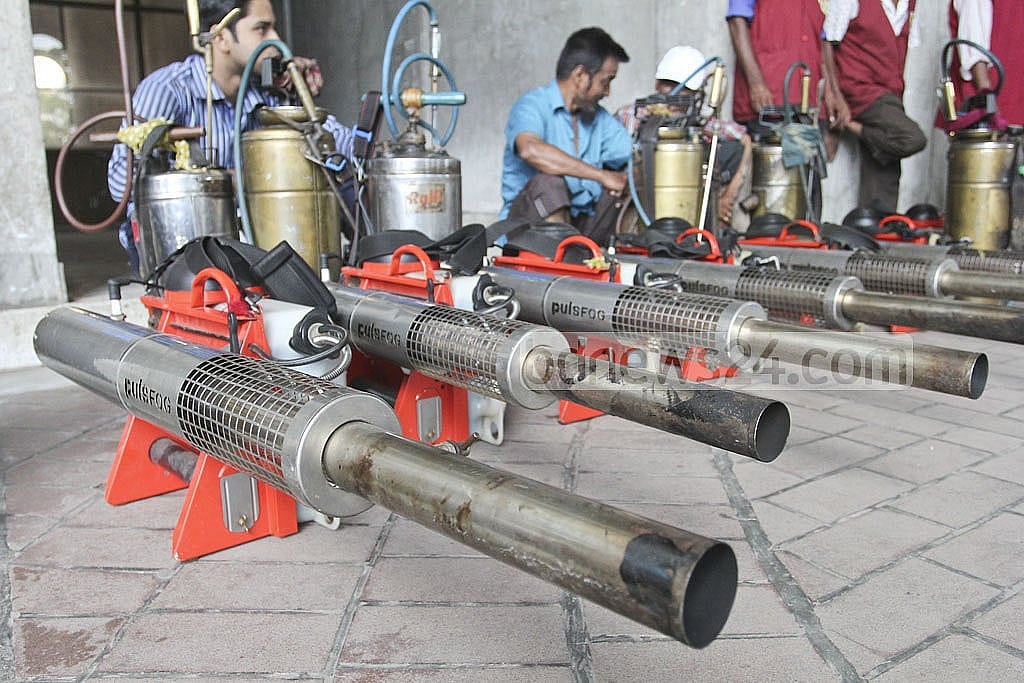
They apply larvicides in drains, canals and water bodies in the morning, and adulticides through fogging in the afternoon.
Both city corporations have formed multiple committees -- technical, taskforce, working and ward-level -- to oversee mosquito control, including evaluating the effectiveness of insecticides.
However, since the 2024 political upheaval, when mayors and councillors who previously supervised field operations went into hiding, accountability at the field level has weakened, leaving residents with little avenue to lodge complaints.
DSCC Chief Executive Officer Md Zahirul Islam said, “Mosquito numbers had increased, but through monitoring by our teams and officials, we have managed to reduce them to a satisfactory level.”
On insecticide effectiveness, he said: “The chemicals are effective; even the health minister has verified this. The issue lies in application -- how they are being used. We are now focusing on improving fogging practices through closer monitoring.”
DNCC health official Mahamuda Ali said, “Our northern areas have more slums, canals, ponds and reservoirs, with widespread water hyacinth. Waste disposal in these areas worsens the situation.”
She added, “We have identified hotspots and are working intensively, including weekly cleaning drives every Saturday. Overall, the situation is under control.”
Effective Chemicals, Poor Results
DSCC health department data shows the authorities use Temephos, imported from India, for morning larviciding, and Chinese-made Malathion for evening fogging to target adult mosquitoes.
However, a health official admitted that while the chemicals pass laboratory efficacy tests, the real-world results are disappointing.
In particular, the evening "fogging" only kills mosquitoes that come into direct contact with the smoke.
"The chemicals work on paper, but the desired outcome is missing on the ground," the official said.
Despite these observations, DSCC CHO Juhan maintained that a dedicated committee recently verified the potency of the pesticides.
Similarly, DNCC Health Officer Mahmuda insisted that both the morning and evening applications remain highly effective.
Focus Shifts to Stagnant Water
DSCC identifies Shyampur, Kadamtali, Demra, Jatrabari, and Khilgaon as the city's worst-affected zones due to the high density of ditches and stagnant drains.
Jahan claimed that Culex mosquito populations have already seen a significant drop, partially aided by recent storms.
"Everything will settle soon. We are currently prioritising dengue control," she said.
She added that mosquito control workers are undergoing five days of intensive, hands-on training to refine their application techniques.
Addressing concerns over supply chains, Jahan confirmed there is no shortage of pesticides.
She also noted that initial fears regarding fuel supplies -- essential for running the fogging machines -- have eased following the de-escalation of the Iran conflict.
Focus Shifts to Dengue
While dengue typically peaks during the monsoon, the Aedes-borne disease now persists year-round.
This year, the outbreak remains subdued.
The Directorate General of Health Services (DGHS) reported four deaths in January and February -- including one in Dhaka South -- with no further fatalities recorded in March or April so far.
In the 24 hours to 8am on Friday, four new patients were hospitalised across both cities.
To date, 246 patients have been admitted in Dhaka North and 314 in Dhaka South.
Since record-keeping began in 2000, 2023 stands as the deadliest year on record, with 321,179 hospitalisations and 1,705 deaths.
"Dengue is our immediate concern," said DSCC CEO Zahirul. "We are training workers to ensure precise pesticide application and fogging, while simultaneously clearing waste from ditches and drains."
Dhaka North Health Officer Mahmuda added that while no dengue cases have been identified in the North recently, the administration is treating it as a top priority.
"We are focused on destroying breeding sources and running public awareness campaigns," she said.
Administrators' Stance
DSCC Administrator Abdus Salam claimed that mosquito populations have already declined significantly under heightened supervision.
"Mosquito control is one of our four top priorities for building a liveable city. We have formed dedicated committees to monitor high-risk areas and ensure field accountability," he said.
DNCC Administrator Shafiqul Islam Khan Milton echoed this priority, noting that while pesticide efficacy has been laboratory-verified, chemicals alone are not the solution.
"We cannot control mosquitoes through medicine alone," he said. "It requires a combination of rigorous monitoring and increased social awareness."