Published : 02 Aug 2025, 09:48 AM
Updated : 28 Aug 2026, 01:24 AM


Lamha, a Grade 1 student at Milestone School and College, spotted her friend Nailat the moment she stepped onto the campus. The two little girls broke into squeals of laughter, their tiny feet racing across the courtyard as their mothers looked on, relieved.
When asked how they were, both children chirped the same simple answer: “We’re fine.”
But at Milestone, that word -- fine -- now carries the weight of something fragile, even defiant.
For the past 10 days, nothing about life at this school has felt normal. According to parents, the children who can now say they’re “fine” are.
In truth, anything but.
Lamha’s mother, Nazneen Neela, recounted that as they entered the school gates on Tuesday afternoon, her daughter asked: “Mum, will we come back to school again?” When Neela replied, “Yes,” Lamha followed up with another question: “Will the plane crash again?”
That single question captures the lasting psychological scar left on Milestone’s children after a military training aircraft crashed into one of the school buildings just over a week ago.
“She holds my hand tightly at night,” Neela said. “She even ties my scarf around her hand and says ‘Mum, don’t leave me’.”
After the crash, videos circulated on Facebook showing severely burned children running in panic. One of them, Lamha’s classmate, was identified by her daughter, Neela said.
“She’s too little to grasp everything fully, but after seeing the video, she recognised the boy and said ‘Mum, he’s from my class’. She keeps saying ‘Mum, my friend was burned, he must be in so much pain’.”
A year ago, Lamha suffered minor burns from hot water. Remembering her own injury, she now tries to imagine her friend’s suffering.
On Monday, she even attempted to draw the image of her burned friend, her mother shared.
“When I asked why she was drawing that,” Neela said, “she replied ‘I think that’s how he must look’.
“We can’t always express their pain in words, but she’s clearly scarred. That particular boy studied with her, it’s shaken her deeply.”
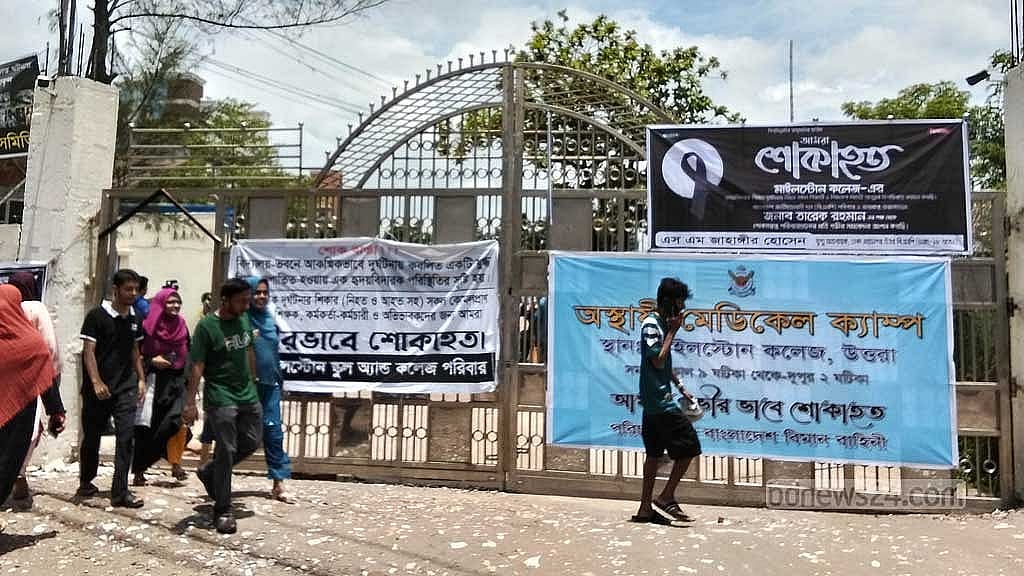
TRAUMA OF JET CRASH GRIPS SCHOOL
On Jul 21, a Bangladesh Air Force fighter jet crashed into the Haidar Ali Building on the Milestone School and College campus in Dhaka’s Diabari. It was the deadliest military aviation accident in the country’s history. Among the 34 people confirmed dead so far, most were children; nearly all of them students at Milestone.
Since the incident, many students, teachers, and parents have been suffering severe psychological trauma. The question now is how and when they can begin to recover.
To address this, the school has launched a dedicated counselling centre, with plans to gradually offer support to all students.
“This is a long-term issue,” said Khadija Akhter, head of the school section at Milestone. “We are prioritising students who need urgent help right now. Gradually, all students, parents, and teachers will be brought into the programme.”
Asked about future plans, she said the matter is being handled at high levels of government. “All relevant government mental health wings have already begun working on this,” she said.
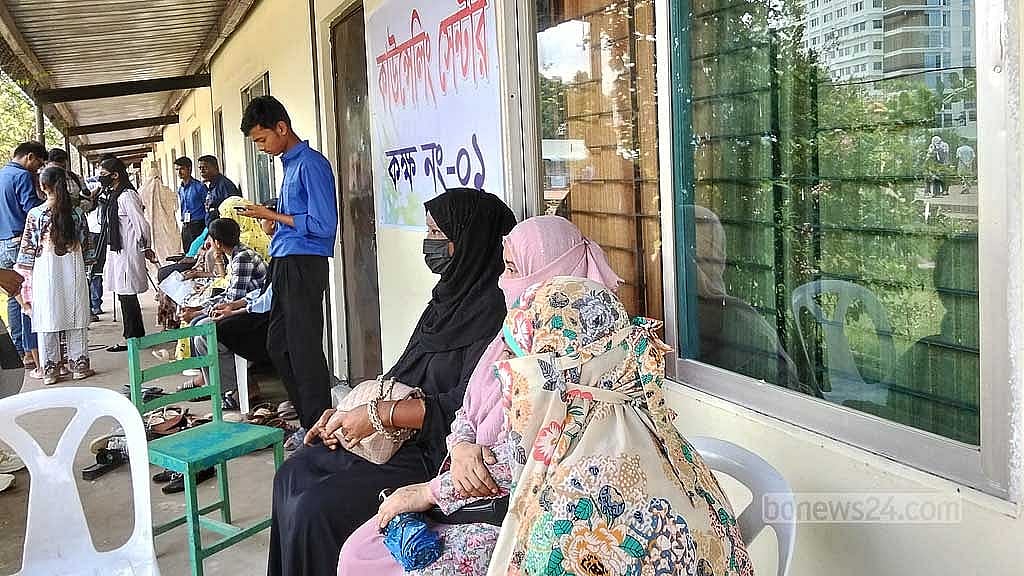
MANY TURNING TO MENTAL HEALTH PROFESSIONALS
Mental health expert Prof Helal Uddin Ahmed told bdnews24.com that trauma affects not only children, but also teachers and parents who witness such horrifying events.
“Experiencing mental trauma is entirely natural in such situations,” he said. “Anyone with basic human empathy will be affected.”
In the short term, he said, affected individuals may show symptoms like sleep disturbances, loss of concentration, disinterest in study, or irritability.
“In the long term, they could develop post-traumatic stress disorder (PTSD), depression, or other psychological conditions,” he warned. “Not everyone will face long-term issues, but some will. Most will gradually heal through a natural process.”
For those at risk of lasting harm, signs may include reluctance to return to school, increased temper, and declining academic performance. In such cases, professional psychiatric care may be needed, he noted.
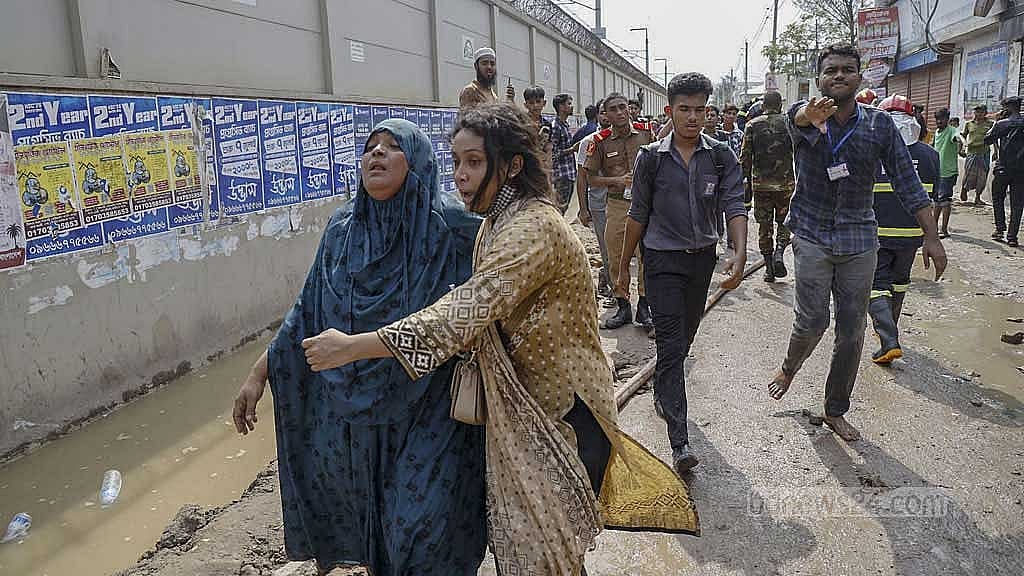
BACK ON CAMPUS, BUT HAUNTED BY MEMORIES
Eight days after the crash, Neela returned to the campus with her three daughters, Lamha (Grade 1), Tanha (Grade 8), and Nabila (Grade 10), to participate in the school's counselling sessions, even though classes were still suspended. Many other parents also brought their children for the same reason.
Tanha lost several classmates in the crash. The jet struck the building just minutes after she had stepped out of her classroom.
“When we walked past the building, she clung to me and said ‘Mum, please get me out of here’,” Neela said.
“She keeps saying ‘When they call the roll in class, some names will no longer be answered. They’ve left our lives forever’.”
Every day, Neela used to wait outside the Haidar Ali Building with Lamha until her older daughters finished class. On the day of the incident, she was not at the school; her elder daughter had returned home after a test, and her youngest had already been picked up. Tanha had left the building moments before the crash. All three children were physically unharmed.
But the trauma left its mark on the whole family.
Pointing to a swing near the building, Neela said: “That’s where Lamha used to play while I waited. I could’ve been here that day. My husband said afterwards ‘We could’ve lost everything’.”
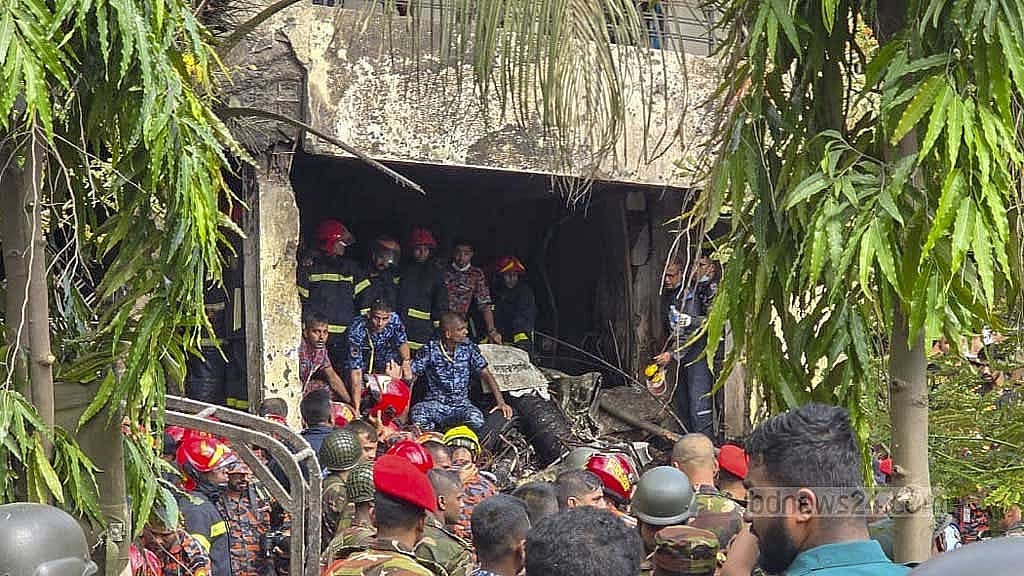
‘MY TEACHER WAS BURNING IN FRONT OF ME’
On the day of the crash, Grade 5 students Tabassum and Riyana were both on campus. Tabassum had gone to wash her hands before lunch; Riyana had been moved to another classroom for detention. While they narrowly escaped injury, their building was the one struck by the plane.
They saw one of their teachers burning alive. Some classmates are still hospitalised, bandaged head to toe.
Every night, the two girls relive what they saw. The sound of an aircraft flying overhead now terrifies them.
Jesmin Nahar brought her daughter Juwairiyah, a Grade 10 student, back to the school for counselling.
“Her teachers checked in regularly after the incident, asking about her mental state. They told me to bring her in,” Jesmin said.
“She was walking past the building when the plane exploded. She turned around and saw smoke everywhere. She fainted a few steps later. Someone called us from another phone—we rushed over and brought her home.
“She’s been crying since. She keeps saying, ‘Mum, I’ve never seen anything like that. My teachers were lying on the ground, and the school was on fire.’”
Babli, mother of Grade 9 student Tanisa Islam, said her daughter had left early on the day of the crash after an exam. “Otherwise, she would’ve been right in front of the building. That’s where she and her friends hang out,” she said.
“We live nearby, so we rushed over when we heard the news. She’s always been a bit anxious, but now she’s terrified. She saw so many children burned, some of them close friends. She can’t sleep. Whenever a plane flies over, she panics.”
Tanisa says she has heard updates about some friends but cannot reach others online, which worries her even more.
‘RIJU, MY BODY IS BURNING’: A FRIEND'S LAST HUG
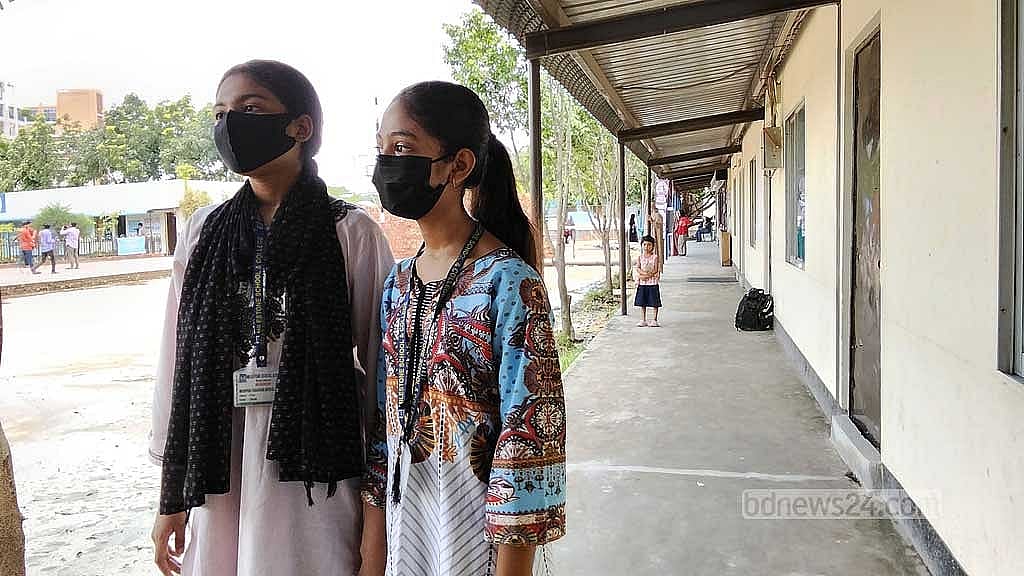
Nurunnahar Ruma brought her two eldest children, Riwan and Rizwa -- both in Grade 8 -- to the school’s counselling room and waited outside with her youngest, Grade 1 student Nailat. All of the students were identified with a single name.
“Both of their friends died in the crash,” she said. “My daughter didn’t eat for days. She said ‘Mum, if my friends can’t eat, how can I? Don’t you realise they’re starving?’ I cried too, we all cried together.”
Ruma used to wait outside the Haidar Ali Building for her children after class. That day, she was not feeling well and stayed home. Riwan also skipped school. She shudders to think what might have happened otherwise.
“I was sitting right there the day before,” she said. “I’ve seen the videos, everything’s torn apart. If I’d been there, my youngest would’ve been too.”
Rizwa was in the school during the crash. Just two minutes earlier, she had left the Haidar Ali Building to speak to a teacher about a dance routine for an upcoming cultural event. The plane hit while she was still with the teacher.
She ran back toward the building, where her burned friend Tasnia clung to her and said, “Riju, my body is burning.” Tasnia is now in the ICU. Their other friend, Maya, died.
Ruma said, “She had so many plans with those girls. Now one is gone and the other is fighting for her life. That’s why my daughter has sunk into deep depression.”
EMERGENCY COUNSELLING CAMP AT MILESTONE
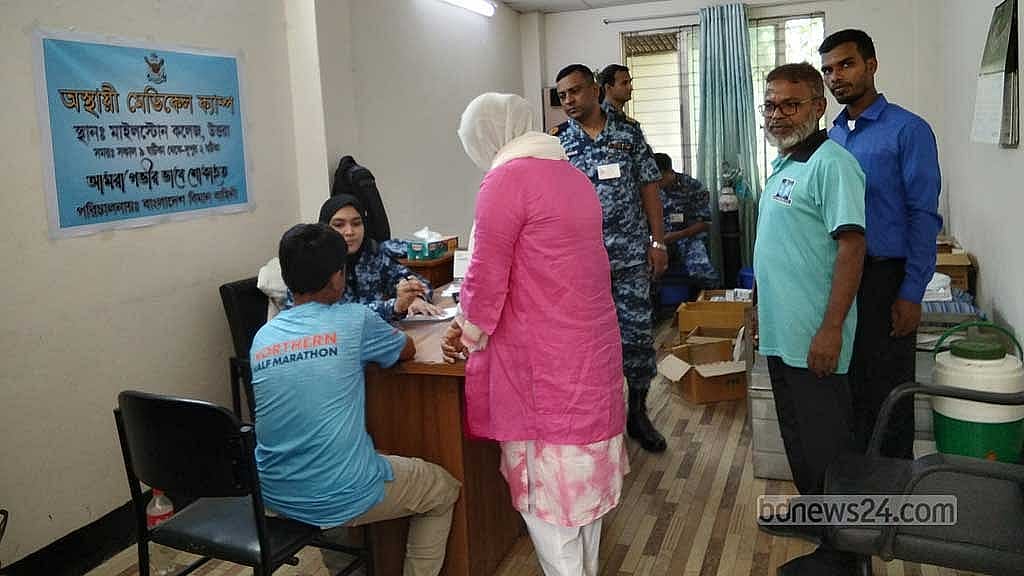
To address the widespread trauma, the Bangladesh Air Force has established a temporary medical and counselling camp at Milestone school. The initiative covers students, parents, teachers, and school staff.
In the first two days alone, more than 300 individuals received counselling and medical services, said Squadron Leader Waliullah Khan, who is leading the effort.
“Everyone who comes is registered for follow-up care,” he told bdnews24.com on Tuesday. “We’ve informed the school authorities, who have been encouraging students and parents to participate. The programme will run for at least seven days.”
A 17-strong team, including psychologists and medical specialists from the Air Force, is conducting the sessions.
HOW OTHER COUNTRIES RESPONDED TO SCHOOL TRAGEDIES
Tragic incidents involving schoolchildren have occurred in many parts of the world. Each has prompted its own kind of response to support the mental well-being of survivors.
In 2004, 334 people, 186 of them children, were killed in a siege by Chechen militants at a school in Beslan, Russia.
In 2009, a former student opened fire in a school in Winnenden, Germany, killing 15 before taking his own life.
In 2012, a gunman killed 26 people -- 20 of them children -- at Sandy Hook Elementary School in the United States.
In 2014, the Pakistani Taliban attacked a school in Peshawar, killing at least 149 people, including 132 children.
In 2017, a school employee in Brazil set fire to a building, killing nine people, five of whom were children.
And in May 2022, 21 people, 19 of them children, were killed in a mass shooting at Robb Elementary School in Uvalde, Texas.
Following the Uvalde massacre, several initiatives were launched to support traumatised families.
As part of mental health support, grief counselling and counselling events are arranged. A trauma-responsive system is also introduced.
As part of legal and institutional reforms, the school formerly known as Robb Elementary is renamed Legacy Elementary.
In addition, various training programmes of different durations are organised in Uvalde under the “Strong Act”.
WHAT MILESTONE NEEDS NOW: EXPERT ADVICE
Professor Helal Uddin Ahmed, a leading psychiatrist, says the counselling currently being provided at Milestone is a form of Psychological First Aid (PFA), which is essential for everyone.
“This kind of early intervention helps most people resume normal activities within a couple of weeks,” he said. “But some will still need long-term psychiatric care, counselling, and possibly medication.”
If children continue to display signs of distress, such as abnormal behaviour or social withdrawal, after the PFA phase, they must be referred to specialists, he advised.
“Not every child will need long-term treatment, but every child does need short-term psychological support,” he said.
He urged school authorities to monitor students closely and provide referrals where necessary. “They must return to class eventually, but there should be no rush. Reintegration must be gradual.”
He also recommended that students be encouraged to participate in extra-curricular activities, and be given structured opportunities to grieve.
“They’ve lost their peers,” he said. “We must help them express that grief, through remembrance, prayers, or other culturally appropriate rituals. These events cannot be ignored or erased.”
Prof Ahmed also emphasised the importance of protecting children from disturbing images or graphic footage.
“Parents and schools alike must be vigilant,” he said. “Even if a child seems outwardly fine, subtle symptoms may develop later.”
Professor MMA Shalahuddin Qusar, chairman of psychiatry at the Bangabandhu Sheikh Mujib Medical University, warned that overly intrusive approaches can backfire.
“First, the victims must not be disturbed, whether in the name of journalism, treatment, or research,” he said. “They must be allowed time and space to heal in their own way.”
He also insisted that only qualified experts should be involved in post-trauma interventions, and that such work must be authorised by the school or legal authorities.
“Random individuals should not be approaching the victims one by one,” he warned.
HOTLINE, OUTREACH LAUNCHED
The National Institute of Mental Health and Hospital has initiated an emergency mental health response for victims of the Milestone tragedy.
The measures include:
• A 24-hour mental health hotline
• Special outdoor psychiatric services
• Reserved inpatient beds
• A mobile outreach team
• Collaboration with the Bangladesh Association of Psychiatrists
A coordination meeting was held on Monday at the Shaheed Abu Sayeed Convention Centre to bring together health ministry officials, secretaries from health services and education, mental health experts, and school administrators. A joint strategy was agreed upon to offer continued psychological and psychosocial support to all affected.
Hotline numbers by time slot:
• 10am–2pm: 01835 154341, 01835 155521
• 2pm–6pm: 01835 153262, 01835 154340
• 6pm–10pm: 01835 153005, 01835 156262
The institute encourages anyone in crisis to also seek in-person support at their facility at any time.
NO NATIONAL EDUCATION RESPONSE YET
Despite these efforts, a key gap remains.
Md Abdul Majid, the district education officer for Dhaka, told bdnews24.com: “I visited the school twice, but recently I haven’t been able to because of the July Uprising commemorations. However, our sub-district education officer is in regular contact.”
He acknowledged that the Directorate of Secondary and Higher Education has not initiated any counselling support for students.
“To be honest, it’s not just the students; parents and teachers also need counselling. But we have no psychologists at the secondary level. That’s why no formal action has been taken.”