Published : 03 Aug 2025, 07:51 AM
Updated : 21 Aug 2026, 01:36 PM


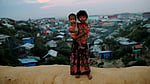
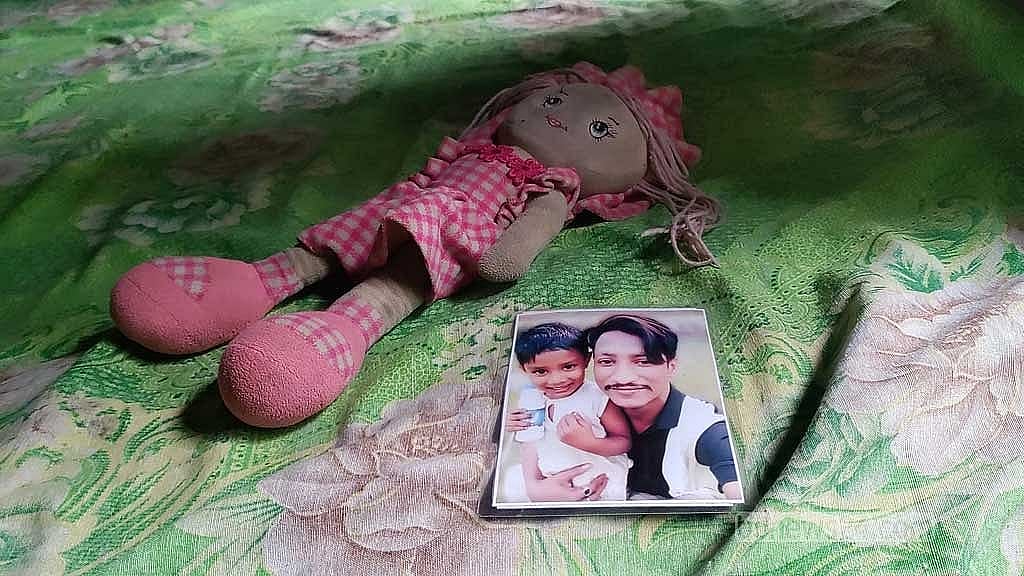
Little Iqra clutches a doll in her tiny hand. Beside her sits a framed photo of her father.
Between bursts of play, she pushes the photo forward and murmurs: “Dad went to bring ‘fun stuff’, never came back.”
Her father, Rajib Hossain, used to drive a CNG-run autorickshaw in Dhaka.
The family lived near Kadamtali Police Station.
On the night of Jul 19 last year -- when the nation roiled with protests over the quota system -- Rajib’s lifeless body was found on a nearby street.
His wife, Mosammat Champa, told bdnews24.com that Rajib had stepped out just before the Isha prayer. He never returned.
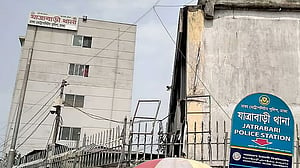
Around 1:30am, his body was discovered on the footpath beside the police station.
While the July movement was visibly led by students, many now believe it was the working class who bore its heaviest toll, yet no complete record of the dead has ever been made public.
From the Language Movement of 1952 to the Six-Point Movement, the 1969 uprising, the Liberation War of 1971 and the fall of the dictatorship in the 1990s -- labourers have fallen in every struggle.
But their names, more often than not, have disappeared from the nation’s telling of its history.
Successive regimes have ascended to power over the blood of the working class.
But once in office, they have quickly turned away.
As it stands, the erasure of workers from the narrative of national struggle seems poised to continue.
“Unless the working class builds its own political force, their rights will never materialise,” said Anu Muhammad, former professor at Jahangirnagar University.
“The current political forces serve the elite -- the upper class, business lobbies and bureaucrats. Workers have no one speaking for them.”
STRUGGLE
Rajib’s ancestral home lies in Chhatiani, under Kaneshar union of Shariatpur’s Damudya Upazila.
His wife and two young children now live close by at her parents’ house.
Waiting at a bus stop near Tinkhamba-Pulkarpara in Damudya, Rajib’s father Tofazzal Hossain, a mason by profession, guided the correspondent to their modest tin-roofed home.
“My son is gone,” he said, his voice flat. “Now my grandchildren’s future is lost in the dark.”
The path to their village winds through rough terrain -- first by autorickshaw, then a mile-long stretch on foot along a soggy, unpaved track.
By the time the family home appears near the Sikdar household in Khaigo Mouza, the surrounding fields are flooded deep.
Rajib’s father-in-law Abdur Rashid Sikdar helped navigate the final distance.
Wading through knee-deep water, they reached the doorway, only to find the rising tide already brushing its edge.
Inside the worn, tin-walled house, Champa sits quietly as her children, Iqra and Alif, play nearby -- unaware of the gravity that has reshaped their lives.
“Rajib hadn’t even taken the autorickshaw out in the last three days. He saw the tension in the streets and stayed inside. He wasn’t part of any politics,” said Champa. “So why did they kill him?”
The water creeping in through the yard did not seem to faze the children, who splashed at the doorstep, giggling.
Rajib’s father-in-law tried to calm them, even as the weight of unspoken worry filled the room.
“He’s gone,” Champa repeated. “Now what happens to my children? I have no idea.”
Neighbours in Chhatiania -- tea vendors, auto drivers, day labourers -- spoke with quiet worry.
Everyone seemed to echo the same thought: what will become of Rajib’s children?
“They lost their father so young,” said Al Amin, a tea stall owner. “Your heart aches when you see them.”
Champa pleaded for justice. “Let the government investigate who killed my husband, so that this never happens again.”
With floodwaters high, Rajib’s father-in-law took the correspondent back to the road by boat.
“I came from Barguna and built a life here over the past 10–12 years,” he said. “Only Allah knows what lies ahead for my grandchildren.”
GOVT SUPPORT
The interim government recently released a gazette listing 844 “martyrs” of the July Uprising. Rajib’s name is listed at 198.
Rajib’s father said the government gave a savings certificate worth Tk 1 million, from which the family receives monthly payouts.
The July Martyrs Memorial Foundation added Tk 500,000, divided between wife, children and parents.
Another Tk 200,000 was given by the district council, which remains in the bank.
Several local residents, speaking to bdnews24.com, urged the government to consider long-term support for Rajib’s two children, so their education is not disrupted.
WORKER DEATHS
The first gazette named 834 people; another 10 were added later.
A report by the Bangladesh Institute of Labour Studies (BILS) said at least 114 workers were killed between Jul 16 and Aug 4, based on media reports from the period.
According to BILS, the victims included 24 shop employees, 10 garment workers, 27 transport workers, 10 construction workers and 43 others.
BILS Executive Director Syed Sultan Uddin Ahmmed said the list is still being updated and cannot yet be considered complete.
He also heads the Labour Reform Commission.
Although BILS recorded 10 garment worker deaths, Taslima Akhter, president of Garment Workers Solidarity and a member of the commission, claimed the number is at least 26.
She said their findings are being updated and will be published soon.
Shamsur Rahman Shimul Biswas, chief coordinator of the Bangladesh Jatiotabadi Sramik Dal, said around 97 of those killed were activists of the party or members of its allied labour platform.
He added that a list of the victims had been submitted in June to Anisuzzaman Chowdhury, special assistant to the chief advisor overseeing the planning ministry.
FORGOTTEN NAMES
The working class has long been left out of the national conversation, said political analyst and researcher Mohiuddin Ahmed.
Referring to the Six-Point Movement, he noted that during the hartal on Jun 7, 1966, at least 11 workers were believed to have been killed. “But how many of their names do we know beyond Monu Miah and Mujibullah?” he asked. “Even the media rarely mentions the others.”
He added, “In the 1952 Language Movement, as far as I know, only one person killed was a student -- the rest were not. But the role of the working class is almost never discussed, because they are not in the discussion themselves.
“They depend entirely on the media and politicians.”
Speaking about the July Uprising, he said: “We’ve seen photos showing transport workers and rickshaw-pullers joining the protests.
“Many were injured or killed. But after the Uprising, all credit went straight to student leaders and politicians.”
Asked how much responsibility researchers bear in preserving the history of working people, Mohiuddin said, “Researchers can only work if they get access to information.
“Right now, even when a worker dies, newspapers don’t publish their names.”
He criticised the lack of access to police records. “Police reports are never made public, and are often destroyed. If researchers had those reports, they could extract valuable information.
“What we need first is a full list of the dead. Not just names, but their age, occupation, where they died, how they died. Only then can proper research be done.”
Mohiuddin also spoke of the mindset that contributes to this neglect. “We have an intellectuals’ graveyard. We observe Martyred Intellectuals Day. But there is no day for martyred workers.”
“In past struggles too, most of those killed were working-class people,” he added. “But this remains buried in our national psyche. Noor Hossain is a rare exception; people talk about him. But hardly anyone remembers the rest.”
SAME OLD SYSTEM
The system that continues to sideline working-class people has remained unchanged, according to Dhaka University Professor Emeritus Serajul Islam Choudhury.
He said the issue stretches far beyond the July Uprising. “Even during British rule, common people rose up, hoping for freedom from landlords. They joined the Liberation War thinking they’d escape Pakistan’s exploitation.
“But it didn’t happen. The system hasn’t changed,” he added.
Serajul added that the public had taken to the streets in July to challenge this very structure. “Common people came out. A large portion of them were workers and labouring people.
“But now, people are already starting to forget them.”
“Workers joined all our major movements,” he said. “Even the Language Movement saw labourers taking part. In every struggle that followed, the working class played a major role.
“In the Liberation War, too, workers, farmers and the middle class made up the majority. Once again, people came out with hopes of change. The labouring class joined with the belief that this would bring them freedom.
“That freedom never came. Their neglect is built into the system, which is a capitalist one.”
Anu said workers’ contribution must be recognised. “The government needs to focus on employment, wages and safety. Workers must be able to live with dignity.
“If the problems of the working class are solved, the entire country’s problems will begin to resolve. But those in power forget the workers once they are in office.”
Taslima, president of Garment Workers Solidarity, said it was the working class who gave the July movement the shape of an uprising. “They joined because they wanted to live with respect. Garment workers, rickshaw drivers, transport workers -- many took part, many gave their lives.
“The workers who died must be recognised.”
She added that as a museum and monuments are being built to honour the uprising, workers must also be remembered. “The museum should preserve the story of their sacrifice.
“Alongside fair wages and job opportunities, they deserve respectful recognition. Our mindset toward workers must change.”
Labour Reform Commission’s chief Syed Sultan said those workers who died in July must be recognised. “A person gave their life for their rights, but has not received any recognition.
“They were not recognised in 1952 or in 1971. This culture must change.”
He noted that some reports point to workers having the highest number of deaths in the Uprising, but said the focus should not be on figures.
“Even if one person dies, their entire family loses everything. That person might have been the only support. One death can undo an entire home.”
Sultan said recognition must be followed by action.
“There has to be long-term planning for the families left behind. That begins with a complete, accurate list of the dead and injured,” he added.
[Writing in English by Sheikh Fariha Bristy]