Home
+
Published : 03 Nov 2025, 02:10 PM
There’s a quaint superstition in newsrooms that anniversary pieces should be lighter than the rest—cake, candles, a few misty-eyed lines about “our journey”, then back to the grind. Forgive me for breaking tradition.
At 19, bdnews24.com has earned more than a slice of sentiment. It deserves an honest reckoning with what it takes to keep the lights on, the pages loading, and the truth—warts, footnotes and all—reaching your screen.
Bangladesh’s last two years have served up more story than most countries can digest in a decade: a student-led upheaval, cyclical internet blackouts, Sheikh Hasina’s fall in August 2024, an interim government under Nobel laureate Muhammad Yunus, and a flourishing black market in disinformation.
In other words, perfect weather for journalism—and terrible weather for journalists.
THE SOCIAL-TO-NEWSROOM PIPELINE
We used to worry about rumours that began in teashops and ended up in living rooms. Now, they start on anonymous feeds and end up on primetime. Across the internet, doctored clips and AI-confected “confessions” sprint from Facebook, YouTube to studios in an afternoon—complete with martial graphics and drum solos to lend authority.
Bangladesh felt the full force of this during the turbulence of 2024: posts mislabelling victims, recutting context, massaging numbers until fiction felt inevitable. By the time corrections arrive, the viral has already done its work. Fact laces up its boots; fable wins the ratings.
The answer isn’t to sneer at social media—it’s to treat it as a crime scene. What’s the source? Where was the video shot? What do the shadows say about the time of day? The public doesn’t just need the facts—it needs to see how the sausage is made. “How we know” should be a standing feature, not a once-a-year ethics seminar.
MONEY, MEDDLING AND OWNERS' INTERESTS
If you want to understand the pressures on a newsroom, don’t ask about the splash; ask about Thursday at 11am—the moment the ad inventory looks thin, the payroll looks thick, and the phone rings with a “friendly” word about an inconvenient story. Most outlets are nudged into obedience by a thousand tiny financial contingencies.
In Bangladesh, the news business is fragile. Big platforms swallow most ad money, leaving government and corporate ads as lifelines. Subscriptions are hard to sell. That mix makes newsrooms easy to pressure. Even routine renewals and audits—portal registration, broadcast permissions, import clearances, tax checks—can be used as levers. You don’t need a raid to change coverage, a delayed stamp will do.
Many outlets also sit inside large business groups—banks, telecoms, real estate, energy, imports—whose fortunes depend on regulatory goodwill. When a newsroom’s public-interest mandate collides with a parent company’s commercial or political calculus, journalism often loses.
This conflict deepens when a company’s regulatory exposure or pending litigation becomes a pressure point, or when investors are scared off by the risk of retaliatory suits, leaving editorial teams more dependent on politically exposed funding.
WHEN INVESTMENT MEETS THE MACHINERY
Censorship has been modernised. Bans are outdated. The new method is a buffer—slow the site, throttle the traffic, bury the signal. Bangladesh’s media have long worked under the shadow of punitive and ambiguous cyber laws, and administrative levers that chill reporting without a single newsroom raid.
In October 2023, this outlet reported precisely that kind of “choking and access throttling”: a dramatic blackout that starved the newsroom of audience and ad revenue, even without formal blocking.
Pair that with strategic litigation and investigations built on flimsy or inflated charges—designed to freeze investment and frighten backers—and you have a ruthlessly efficient system.
Think back to 2019: bdnews24.com disclosed a proposed investment to fund automation and creative expansion. The guardians of propriety promptly pressed pause on the deal. The aim was clear: tie up the top man and bind the newsroom in legal rigmarole rather than resort to open censorship. A bid to upgrade a newsroom thus morphed, overnight, into a case study in how regulatory muscle can choke ambition long before a single new server is switched on.
The goal isn’t victory—it is to keep editors in court. Time is the new truncheon.
Corporate interference is subtler but pervasive: advertiser vetoes, soft blacklists, event sponsorships with editorial strings, and “off-the-record” calls before a critical story runs. None of this leaves fingerprints, but everyone in the trade feels the grip.
As some outlets fell silent—out of fear or calculation—social feeds became the only live wire. The state’s answer were days-long internet shutdowns. Information didn’t stop, it splintered and rumours rushed in.
WHEN THE MASK SLIPPED
Let’s be frank. Over the Awami League’s 15-year rule, a slice of the media either relinquished—or was made to relinquish— its public-interest brief and its duty of candour. Government failures were airbrushed into “challenges”, opposition voices were besmirched, anti-people measures disappeared from front pages while propaganda blared on loop under the guise of “achievements”. The quid pro quo was obvious: access, patronage and perks for owners and marquee names who played along.
Then came the three electric weeks of mid-July to early August 2024. The bargain was laid bare, the patina peeled. Patronage outlets dropped any pretence of objectivity, parroting the party line that pro-democracy youths were “thugs”.
Field reporters at those organisations often filed accurate copy from the ground; editors in air-conditioned newsrooms—loyal to the government or under orders from proprietors—killed the stories.
Protesters unable to see the kill-switch then jeered the wrong people: the reporters on the byline who never chose the headline or the blackout. The smearing orders didn’t come from the field, they came from the top.
A FREER AIR, A FRESH HAZARD
The regime’s fall brought a gust of freedom inside newsrooms. But another hazard seized the feed and the airwaves: rumour-merchants with ring lights and monetised outrage. Their blend of truths, half-truths, and outright fakes is engineered to outperform nuance, deepening public confusion.
It is precise because social media is so loud that an independent, accountable press is more—not less—essential. The faster the feed, the more you need a fact-check. And the pressure has not vanished—it has merely changed style. Rights groups have tallied a cascade of cases against journalists following last year’s unrest, with several colleagues already behind bars and many more in legal limbo. The message is old, the font is new.
WHAT RESILIENCE LOOKS LIKE
The structural rot persists. Draconian speech laws remain on the books. The networks that weaponised journalism haven’t vanished, they’ve rebranded. The government- appointed Media Reform Commission has tabled proposals—amending the Cyber Security Act, capping any one company to a single outlet, and creating a standards regulator with teeth. Whether those reforms see daylight—and in what form—remains to be seen. Until they do, the incentives to muzzle, sue and throttle will outlast any single government.
Journalism is not a faith—it’s a craft. And readers, too, have work to do: pay, if not with cash, then with attention to outlets that show their homework. Reward corrections, not just scoops. Share the piece that changed your mind, not merely the one that confirmed your biases. Democracy is not only a ballot, it's a muscle that must be exercised.
BDNEWS24.COM AT 19
Anniversaries tempt flattery. Instead, let me offer gratitude. This newsroom has lived through throttling, blackouts, smears, and the constant hum of "toe the line" politics instead of answering to its readers—Bangladesh’s tens of millions. It has also lived through the quieter, deadlier threat that haunts every independent outlet: becoming predictable.
The cure has been the oldest one: report, verify, correct, repeat.
When the powers-that-be and their thuggish appendages try to dominate the information space to steer narratives toward narrow partisan ends, the only sustainable answer is daylight: facts assembled with care, methods explained with clarity, and a public record that survives the week.
Bangladesh can lead by example. If its newsrooms bake verification into workflow, disclose their conflicts and correct their mistakes fast, and design business models that reward patience over virality, audiences will follow. The alternative is an information market where the loudest wins and the public loses.
Nineteen is an awkward age—old enough to know better, young enough to still annoy the right people. Keep annoying them. Keep explaining how you know what you know. Keep telling your audience when you got it wrong and what you have done to make it right. And keep your distribution as redundant as an airline cockpit: if one switch fails, the plane still lands.
The prize is not a perfect media. It is a society less vulnerable to panic, prejudice, and the profitable lie. On that score, the work has barely begun.
Happy nineteenth, bdnews24.com. Now, back to Thursday at 11am -- where the real test is always waiting.
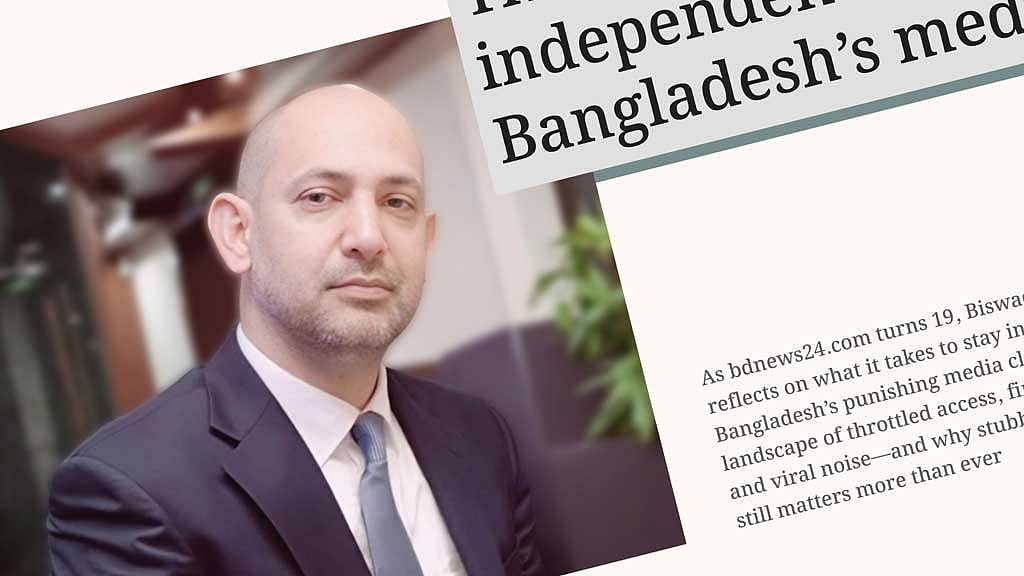
[Biswadip Das is a senior editor at bdnews24.com]