Home
+
Published : 06 Aug 2025, 10:17 AM
THE SEA THAT SWALLOWED GRIEF
The sea does not judge, it just accepts everything, good or bad. Ten years after the atomic bomb erased his family, an old man walked into the waters near Miyajima, a note in his pocket: “I go to find them.”
The sea took what the bomb could not—the last man who remembered his daughters’ laughter. He is one of the countless hibakusha (survivors of the atomic bomb) who could not bear the pain —not just physical, but also shame, loneliness, guilt for having survived; they threw themselves into the Setonaikai (Seto Inland Sea).
Psychiatrist Dr Robert Jay Lifton, in his seminal study of Hibakusha, “Death in Life” wrote: “The contending symbols within and around hibakusha are those which affirm life and those which subvert it; the polarity is that of reintegration versus residual distrust.”
AUG 6, AND AUG 9, 1945: THE DAYS THE SKY BURNED
The uranium-enriched atomic bomb, “Little Bot” was dropped on Hiroshima on Aug 6, 1945. It was followed by the plutonium-enriched atomic bomb “Fat Man” on Nagasaki on Aug 9.
Before the bombing, Hiroshima had an estimated population of 360,000. The bombing killed 140,000 (38 percent) and injured 80,000 (22 percent). Nagasaki had an estimated population of 250,000, and the atomic bombing killed 70,000 (28 percent) and injured 80,000 (32 percent) as of Dec 31, 1945).
According to the Red Cross, 90 percent of Hiroshima's doctors and nurses were killed or disabled within hours. Dr Michihiko Hachiya was one of the few Hibakusha doctors who survived. In a moving book titled “Hiroshima Diary: The Journal of a Japanese Physician, August 6 - September 30, 1945”, he writes: “I saw a man with his eyeballs hanging down under his cheek. A woman clutched her burned child, her skin peeling off like a glove.”
Red Cross hospital nurse Toshiko Saeki said, “A boy grabbed my wrist and begged, ‘Sister, cut off my hand – the pain is eating me alive.’ But I had no morphine or the ultimate painkiller. I gave him a wooden stick to bite on.”
That stick was just one example of 42,000 recorded non-drug pain treatments in the first month of Hiroshima. The Red Cross called it “the greatest overwhelming pain crisis in modern medicine”. That diary, that stick, is preserved in the Hiroshima Peace Memorial Museum.
SCIENCE AS WITNESS: THE LIFE SPAN STUDY
The Atomic Bomb Casualty Commission (ABCCC) was established in November 1947, funded by the National Academy of Sciences through the US Atomic Energy Commission (AEC), to study the health effects of the atomic bombings of Hiroshima and Nagasaki. It was run by the US Occupation Authority (1945–1952). But it was not supported by any Japanese law. Critics called it a 'research colony', as the survivors (Hibakusha) were subjected to intensive research, but there was no medical support programme for them.
According to the testimony of a Hibakusha preserved in the Hiroshima Peace Memorial Museum, “The ABCC was studying us like laboratory rats. Only after the RERF (Research and Development Agency) came that we became human beings.”
The Hibakusha and Japanese scientists had been demanding joint control. In 1975, ABCC was reorganised as the Radiation Effects Research Foundation (RERF) through joint US-Japanese funding under the Japanese Civil Code.
The bombs dropped on the two cities were detonated in the air. The point in the air where the explosion occurred is known as the “epicentre”, while the “hypocentre: is the point on the ground directly below the explosion in the air. This is very important because it marks “ground zero”, the point of greatest direct impact, heat, shockwave, and primary radiation exposure for those on the ground. The fatality rate within 500 metres of the hypocenter was nearly 100 percent. Within 1,000 metres it was about 90 percent.
The causes of death of those killed within seconds in Hiroshima and Nagasaki were:
1. Blast (50 percent) (In Hiroshima, distance from hypocenter: 4 km; In Nagasaki: 5 km)
2. Heat (35 percent) (In Hiroshima, distance from hypocenter: 3.3 km; In Nagasaki: 4 km)
3. Radiation (15 percent), gamma rays, neutrons (In Hiroshima, distance from hypocenter: 2 km; In Nagasaki: 2.5 km)
The blast was a supersonic shockwave (velocity about 1,000 km/h), which flattened buildings, threw debris in all directions, turned trees into spears, threw people, especially children, into the air, and dismembered their bodies. By the end of 1945, 38,000 of the dead were children.
A notable demographic pattern of the Hibakusha (and clearly the primary casualties) is that there were fewer men in their 20s and 30s in the cities at the time of the bombing. This is often attributed to their absence on military duty or wartime work. This means that, proportionally, a larger proportion of the civilian casualties in the cities were women, children and elderly men.
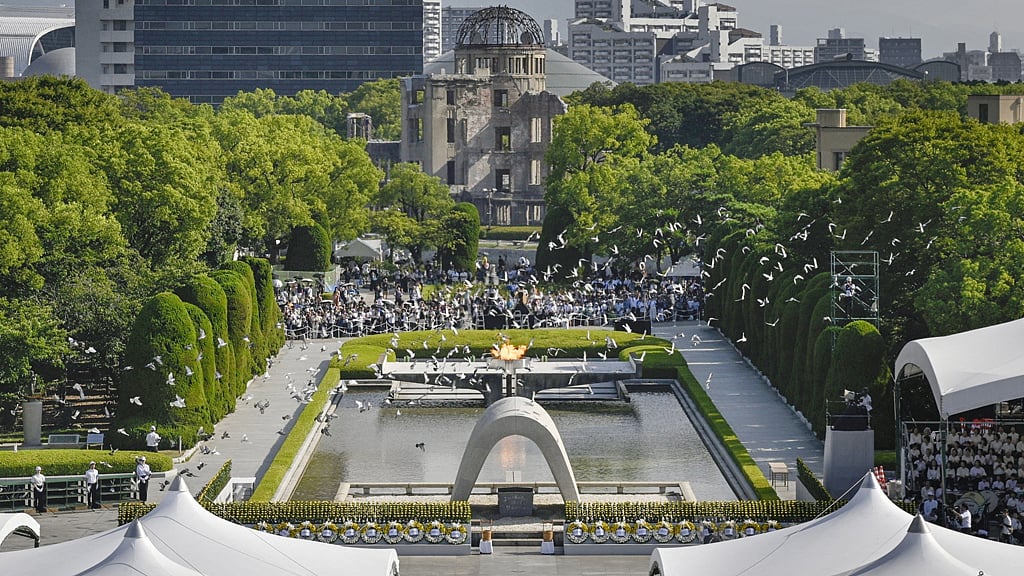
Child Hibakusha Sadako Sasaki was only two and a half years old at the time. At the age of twelve, she was diagnosed with leukaemia, and a roommate in the hospital told her the Japanese legend that whoever made 1,000 paper cranes would have their wish granted. Sadako sat in her hospital bed, making paper cranes relentlessly, hoping to recover from her illness. She died after making thousands of cranes. Her story resonated deeply around the world. Today, people still place paper cranes at the Hiroshima memorial as a symbol of hope and remembrance.
A major component of the ABCC and RERF research programme was the collection of data on individuals over their entire lives. Radiation was the cause of 15 percent of immediate deaths. The purpose of the LSS was to examine the “long-term” health consequences of exposure to radiation from the atomic bomb. All Hibakushas who were within an estimated 10 kilometres of the hypocentre of Hiroshima and Nagasaki at the time of the explosion were considered as the research sample - 284,000 individuals. Of these, those whose physical distance from the hypocentre was confirmed by records and whose radiation dose could be estimated/measured according to shielding. Shielding affects radiation dose. For example, a survivor inside a concrete building 1 km away will receive approximately 50 percent less radiation dose than a survivor outside at the same distance. The calculation is as follows:
Indoors: concrete building (50% dose reduction), wooden building (20% reduction).
Outdoors: no shielding (100% exposure).
Body posture: standing vs. hunched over (more consistent dose).
The LSS cohort (student) was created as a subset of the master sample. This cohort consisted of 120,000 individuals. Within this cohort were 2 subgroups:
1. Exposed group (86,000 individuals): those within 10 km or less who were exposed to a radiation dose of 0.005 Gy (Gray) or more (taking shielding into account).
2. Control group (34,000 people): Those located 3 km or more away who were exposed to radiation doses of less than 0.005 Gy (Gray) or who entered late (i.e. those who received little or no radiation dose).
An X-ray can be used as an example to understand the intensity of the radiation dose, A chest X-ray uses 0.02-0.1 milli-Gy per image. A single round-trip flight from Tokyo to New York would expose a passenger to a radiation dose of 0.1-0.2 milli-Gy. In contrast, the Hibakusha living 1 km away were exposed to a radiation dose 20,000 times higher than that from an X-ray. The important findings of the LSS study are as follows:
1. Increased risk of solid cancers: Radiation significantly increases the risk of solid cancers (e.g., lung, breast, stomach). Every 1 Gy of radiation exposure produces a 10 percent “excess relative risk” (ERR).
2. Leukaemia (blood cancer) spike (early and late onset): The highest risk of malignant leukaemia, peaking 5-15 years after exposure. For those under 20, every 1 Gy of radiation exposure produces a 4.5 percent “excess relative risk” (ERR).
3. Dose-response relationship: Research has shown that even small amounts of radiation increase the risk of cancer - there is no “safe” level and the risk increases steadily with higher exposures, even at doses of 0.1-0.5 Gy. Exposure of 0.5 Gy increases the lifetime risk of solid cancer by 5 percent.
4. Increased risk of heart disease: Radiation accelerates atherosclerosis (obstructed blood flow in blood vessels) and heart disease. Every 1 Gy of radiation exposure creates a 0.12 percent “excess relative risk” (ERR) of stroke/heart failure.
5. Transgenerational effects (lack of genetic mutations): No significant genetic mutations are inherited in offspring. That is, the effects of radiation are not transmitted to subsequent generations.
LSS has proven that the cruelty of radiation is measurable; every 0.1 Gy of radiation consumes 1 percent of the health of a living person, not only through tumours, but also through heart failure and the spread of social prejudice.
LSS continues to make important contributions to understanding the delayed effects of radiation and to formulating public health policies related to protection from radiation. In addition to the LSS, RERF conducted other studies on independent sample populations, showing that many of the approximately 9,500 victims of the “black rain” who fell on villages outside Hiroshima after the explosion developed leukaemia, thyroid cancer, and rare genetic disorders decades later.
Hibakusha families were considered stigmatised - no one wanted to marry them for fear of “contamination”. On the other hand, pregnant Hibakusha later gave birth to children who had no eyes, no limbs or brains, or whose brains had not yet developed. Many were abandoned. Others were hidden, their parents ashamed to admit their existence. As a result, Hibakusha also had to bear the heavy burden of social discrimination. They were often viewed with a mixture of pity and fear, seen as carriers of an invisible contagion. This made their suffering a lonely journey, often endured in silence, their physical ailments compounded by a pervasive sense of isolation.
HIBAKUSHA REACHES OUT TO HIBAKUSHA
Out of this unspoken pain, the “Nihon Hidankyo” (Japan Confederation of Atomic and Hydrogen Bomb Victims' Associations) was born in 1956. It is a national, non-governmental organisation founded by the Hibakusha themselves. Its primary mission is to advocate for the rights and support of atomic bomb survivors and to work tirelessly for the global abolition of nuclear weapons. Through it, one Hibakusha reaches out to another Hibakusha, clasping their wounded hands in solidarity. They are the architects of their own support, turning personal suffering into a collective force.
Tado’s collection is a vast treasure trove of personal testimonies, collected like precious fragments from a shattered world. Inspired by the testimonies of the Hibakusha, the UN Treaty on the Prohibition of Nuclear Weapons was signed in 2017. The treaty (ratified by 93 countries) bans nuclear weapons, but the nuclear powers (the United States, Russia, etc.) boycott it. Hidankyo’s lawyer Setsuko Thurlow, herself a Hibakusha, caused a stir by showing pictures of her burned relatives during the treaty’s negotiations at the UN.
Dr Shuntaro Hida, 28 at the time, treated hundreds of patients after the explosion, while his own body betrayed him. The radiation was eating him alive. But he kept working. In his historic diary, “The Atomic Bomb and My Enduring Body,” he writes:
“August 7, 1945. The hospital is gone, the whole city. My hands are shaking. I write by the light of a lantern, people still burning around me. I am a doctor. I should know how to save them. But today, for the first time in my life... I don’t understand.”
He survived – but spent the next 60 years battling leukaemia, tumours and unbearable pain. In 2004, he wrote:
“The leukaemia has returned. But today a young worker asked me, ‘What’s the point of living like this?’ I told him: ‘Yes, it is. Because you’re listening.”
The keloid scars on the skin of Hibakusha became a symbol of nuclear violence. In 1952, Life magazine published graphic photographs of the charred bodies of Hibakusha, shocking the world. In 1945, 13-year-old Shigeko Sasamori rolled up her sleeves at a 1955 press conference to reveal her keloid scars, which she called “my body’s protest.” She later became a nurse, whispering to bomb victims, “Your scars prove that the world must change.”
THE NOBEL’S UNFINISHED BATTLE
The Nobel Committee honoured the Hibakusha with the 2024 Nobel Peace Prize on behalf of their organisation, Nihon Hidankyo.
“We are not victims,” said Setsuko Thurlow, the organisation’s lawyer, in her acceptance speech. “We are witnessing something that mankind will never repeat.” This was not a victory lap; it was a courtroom, and the evidence was written on Tadeo’s body and in documents.
The father of the atomic bomb was American physicist J Robert Oppenheimer. Hibakusha Akihiro Takahashi (then 14 years old) confronted Oppenheimer at a 1951 Tokyo conference.
“I showed him my scarred hand and asked, ‘Why did you make this?’ He looked at my burned hand, then whispered, ‘To end the war.’”
However, Dwight D Eisenhower, the supreme commander of the Allied Expeditionary Forces in Europe, said, “I was against it for two reasons. First, the Japanese were ready to surrender, and there was no need to hit them with that terrible thing. Secondly, I was disgusted to see our country use such weapons for the first time.”
Albert Einstein said, ‘If I had predicted Hiroshima and Nagasaki, I would have torn up my formula in 1905. I would have been better off as a watchmaker.”
Oppenheimer never formally apologised. But “Oppenheimer”, a heroic account of his complex feelings on the bomb, won many awards, including Best Picture at the 2024 Oscars. No one has ever been formally tried or punished under international law for the atomic bombings of Hiroshima and Nagasaki. Nobel Laureate Kenzaburo Oe said, “Hiroshima is an unpunished crime.” However, Japanese war criminals were tried through the “Tokyo Trials”. Out of the 11 jurors, Indian Bengali jurist Radhabinod Pal was the only judge who sided with the Japanese war criminals. He criticised the trial as a “victors’ trial”. A monument to Radhabinod Pal stands at the Yasukuni Shrine.
The atomic bomb transformed the bodies of the Hibakusha into a painful archive, from which their minds desperately sought to escape, but flesh and blood never truly allowed them to forget. Let us not only remember the explosion, but feel the echo of that moment in the bodies of the Hibakusha. This demands our unwavering commitment to a world where such terrible memories will never haunt us again. The Hibakusha’s Nobel Prize is not an endpoint—it’s a demand: their bodies bore the evidence; now the world must act.
Baizid Khoorshid Riaz is a public health and hospital administration expert, lyricist and essayist.