Published : 01 Sep 2025, 09:14 AM
Updated : 28 Aug 2026, 01:25 AM


As Dhaka University prepares for the long-awaited elections of its Central Students’ Union (DUCSU), candidates are flooding the campus with bold promises.
Some pledge to end the chronic housing crisis. Others vow to make administration “paperless”. Still others promise safer campuses and faculty recruitment free from political influence.
For students, the campaign has become a kaleidoscope of aspirations. Yet many question how much of it can actually be delivered.
Under the DUCSU constitution, the union’s responsibilities are narrowly defined -- focused on education, co-curricular activities, and coordination with other universities -- leaving sweeping institutional reforms outside its jurisdiction.
Former DUCSU general secretary Mushtaq Hossain sees the gap differently.
In his view, promises are less about direct execution than about building pressure. “They are not the authorities,” he told bdnews24.com.
“But as recognised representatives, they can place demands, negotiate with the university or even with the government. That’s what unions do: collective bargaining.”
Mushtaq argued that such advocacy is not only possible but necessary. “Students identify with these issues. Whoever wins the mandate must push the administration. They may not deliver the solutions themselves, but they can compel those in power to act.”
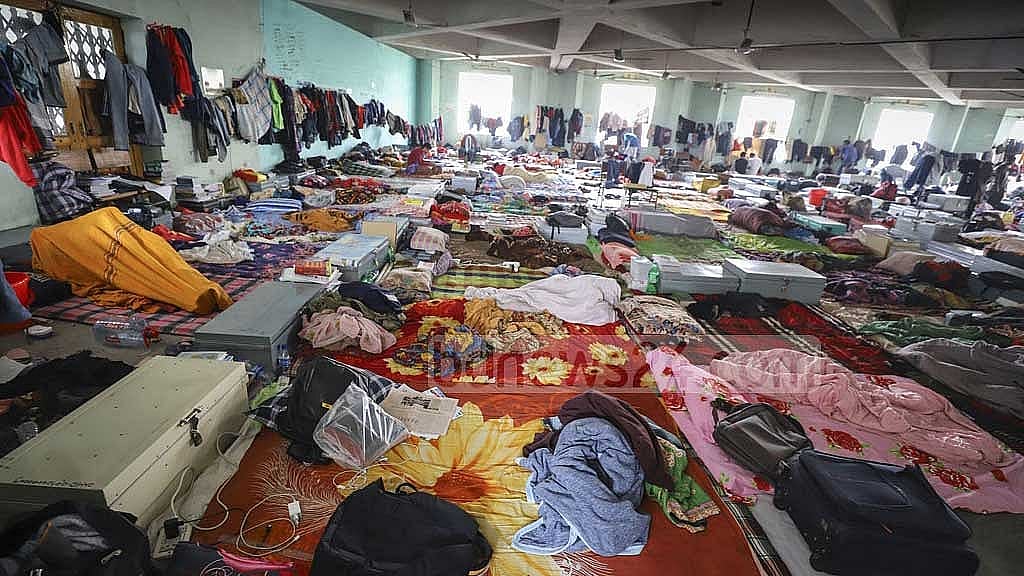
Hossain, who served as GS in 1989-90, said if authorities seek cooperation, DUCSU and hall unions can jointly negotiate with the government. Winning panels, he suggested, should seek consensus with all student organisations to tackle broader issues.
He explained why the union does not use the phrase “collective bargaining agent”.
“Students don’t frame it that way. DUCSU’s role has often exceeded daily grievances, stepping in when national political parties were paralysed. In those moments, it unlocked doors of change.”
But routine responsibilities, he said, cannot be ignored: “Daily social, cultural, and educational problems of students must remain at the heart of its work.”
Some students remain doubtful.
Riaz Ullah, from the Department of Mass Communication and Journalism, told bdnews24.com, “First, they have no legal basis or capacity to fulfill these promises. Second, why wait until elected? Why not act now?”
He cited examples: “Food quality could be improved today. Housing shortages remain unresolved. If they can’t address it now, what will change later?”
Tanvirul Islam, a marketing student, was even blunter: “These promises are castles in the sky. We had high hopes after the July Uprising, but what happened? Even those we trusted didn’t deliver. Maybe they’ll win votes this way, but real change? I doubt it.”
For the first time in more than six years, Dhaka University will hold both central and hall union elections on Sept 9. Voting will be conducted simultaneously in 18 residential halls.
This year, 471 students are contesting 28 DUCSU positions. 45 candidates are vying for vice-president, 19 for general secretary, and 25 for assistant general secretary. In the last election in 2019, only 229 contested.
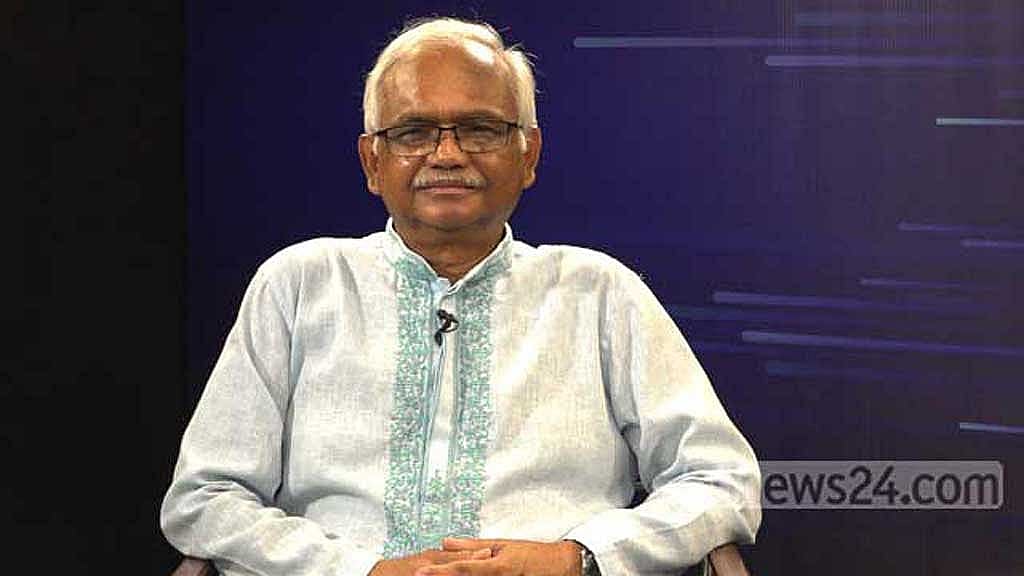
Campaigning runs from Aug 26 to Sept 7, with candidates reaching voters both on campus and online.
There are 39,874 eligible voters across the 18 halls, including 18,959 women from five halls.
Ahead of the election, the administration has also introduced amendments to the DUCSU Constitution.
FUNCTIONS OF DUCSU
The statute lists nine core functions:
• Protecting and safeguarding the rights of Dhaka University students
• Supervising common rooms for members, and providing indoor games, daily newspapers, and journals
• Publishing at least one journal annually, and, with approval, other bulletins, magazines, or papers
• Organising debates, cultural events, lectures on public issues, and social gatherings
• Hosting annual competitions in speech, debate, recitation, essay writing, and indoor games, open to students from other universities as well
• Sending representatives, if possible, to inter-university debates and educational conferences
• Inviting or sending representatives to debates, conferences, and similar programmes
• Encouraging social service, arranging welfare lectures, meetings, and exhibitions, and conducting such activities in schools when possible
• Undertaking other activities with approval of the president and executive committee
GOALS AND OBJECTIVES
The Constitution also outlines DUCSU’s broader goals:
• Upholding and nurturing the spirit of the independence struggle and the 1971 Liberation War
• Preserving the ideals of the 2024 July Uprising against inequality and fascism, and all democratic movements in Bangladesh’s history
• Advancing students’ academic and co-curricular activities to the highest level
• Promoting cultural and intellectual cooperation among students of different halls
• Developing true citizenship and leadership among students
• Fostering cultural and intellectual cooperation with affiliated colleges and institutions at home and abroad
VC: THE ‘ALL-POWERFUL AUTHORITY’
Leaders of several student groups argue that although DUCSU is meant to serve as a platform for student welfare and to press demands on the university administration, in practice the vice-chancellor -- by virtue of being its president -- holds absolute authority.
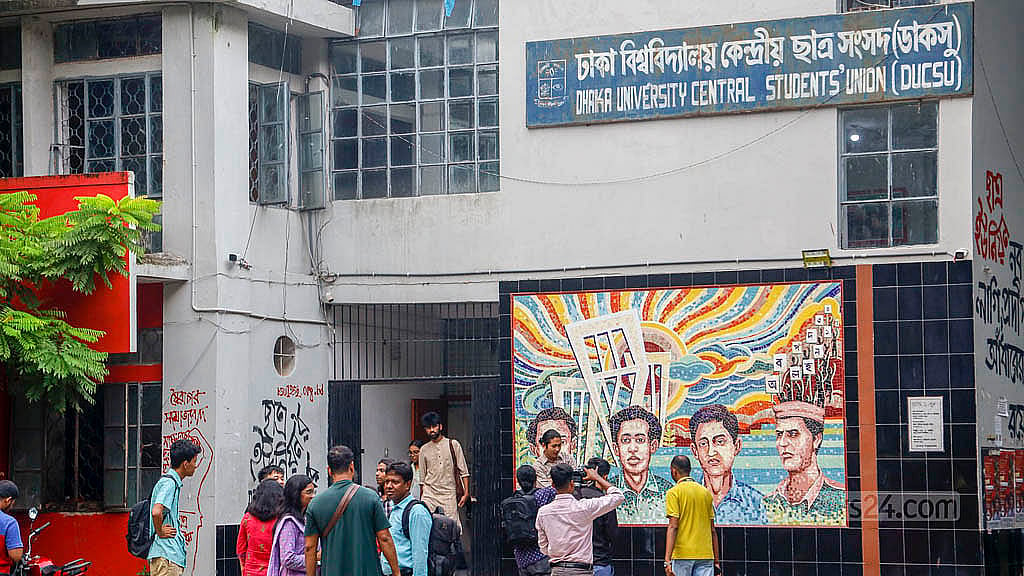
Some leaders have therefore called for amending the Constitution so that the president’s position is filled by a student, making DUCSU a truly student-run body.
In its proposal for constitutional reform this year, the Students’ Union suggested that the DUCSU president, not the vice-president (VP), should be the chief executive. The president would preside over all central executive sessions, take part in deliberations, and cast a single decisive vote.
“The president shall be directly elected by DU students. Any member of the parliament will be considered eligible for the position. The VP will no longer be treated as chief executive. Instead, the VP will assist the president in daily functions and act as president in his or her absence.”
The proposal also called for curbing the president’s powers. Currently, the Constitution grants the president the authority to dismiss any officer or even dissolve the entire parliament -- powers that critics describe as “wholly authoritarian”. The Students’ Union insisted these provisions must be scrapped altogether.
PRESIDENT’S RESPONSIBILITIES
According to DUCSU’s Constitution:
- The vice-chancellor automatically serves as president, with authority to preside over all executive committee meetings. The responsibilities include:
• Ensuring the parliament operates in line with established rules;
• Taking necessary measures during emergencies, deadlock, or constitutional violations to maintain smooth functioning;
- Any officer or committee member if deemed necessary, or dissolving the executive committee altogether and calling new elections. Taking any action deemed suitable to keep hall councils functional
- Suspending DUCSU for any period with approval of the university syndicate;
Also, only the university syndicate holds the power to amend the Constitution governing DUCSU and the hall councils.
The VP, on the other hand, is designated as chief executive, presiding over all meetings in the absence of the president and treasurer.
COMPETING PROMISES
Among the panels, the Jatiyatabadi Chhatra Dal has released a 10-point manifesto. Other groups, including the left-wing alliance “Protirodh Parshad”, the Independent Students Unity, the Bangladesh Democratic Students’ Council (BAGCHAS), and Islami Chhatra Shibir, are yet to announce theirs. Still, candidates continue making various promises on the campaign trail.
Chhatra Dal’s commitments include:
• Improving curriculum, infrastructure, and research quality; forming a cybersecurity cell to prevent cyberbullying; making the campus environmentally sustainable; and institutionalising regular DUCSU elections.
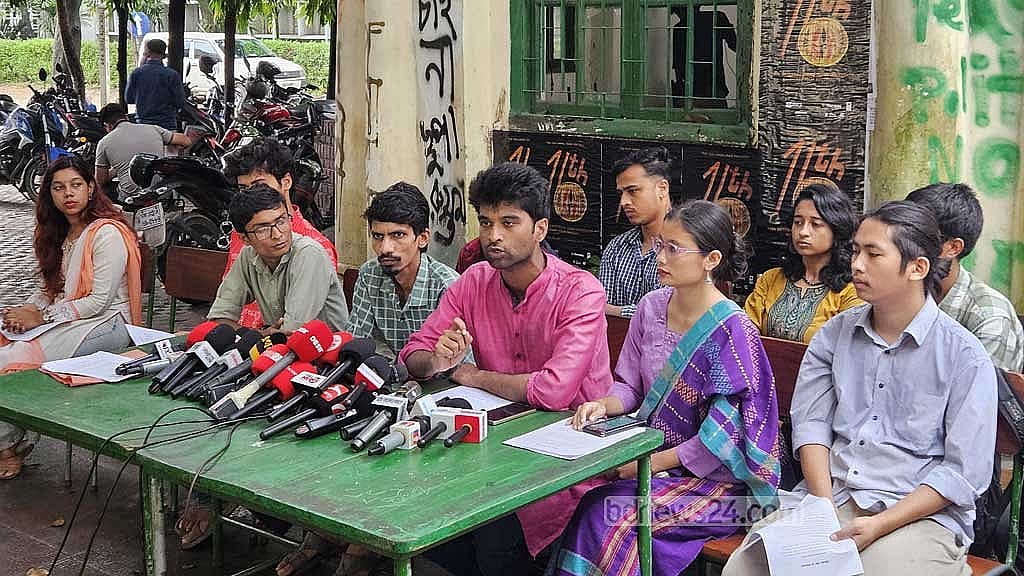
• Ending guestroom and mass-room culture, and halting political repression; placing the entire campus under CCTV surveillance; restricting entry of outsiders; establishing an independent “Student Protection Cell”, a “Cyber Security Cell”, 24-hour helplines, medical corners in dorms, and a “Mental Wellbeing Center” at TSC.
• Expanding infrastructure to address classroom shortages; reviewing curricula with input from students, faculty, and experts; creating credit-transfer opportunities; adopting mechanisms against favoritism and bias by teachers or administrators; ending politically motivated faculty recruitment; and ensuring exams, results, and classes follow the academic calendar.
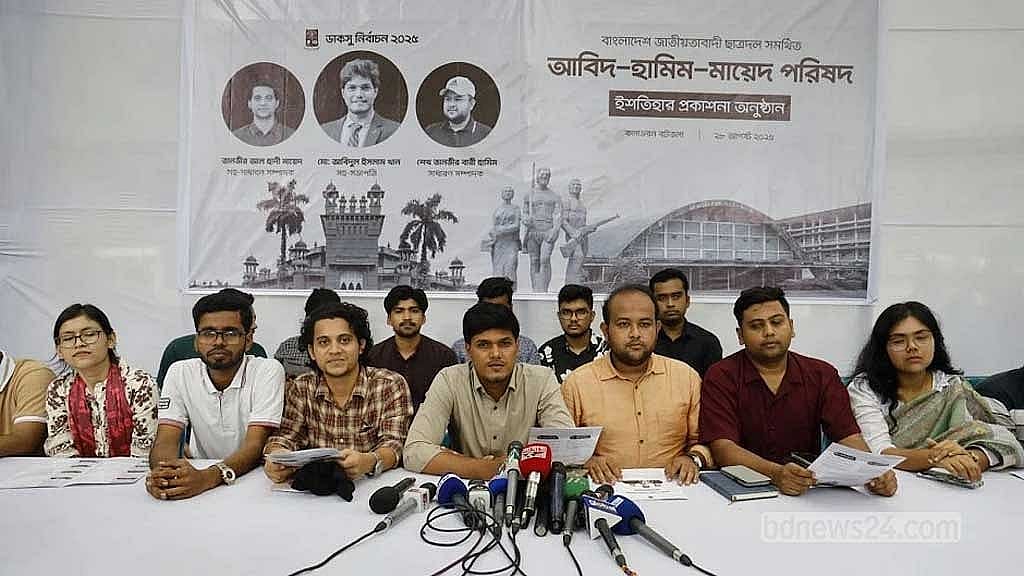
• Guaranteeing freedom of dress for female students; installing subsidised sanitary vending machines in dorms; extending women’s hall entry hours; allowing non-residents to stay with permission; ensuring every student has one seat and study desk; increasing subsidies on cafeteria meals; forming teams with nutritionists to ensure food quality and nutrition; building new canteens at faculty and departmental areas; and introducing sufficient battery-run shuttle services across campus.
Democratic Student Union promises:
• Ensure regular DUCSU elections according to the academic calendar, and put an end to partisan political structures within halls and academic spaces.
• Undertake democratic reforms to make the 1973 Ordinance on autonomy meaningful, including initiatives to end the university’s “administrative authoritarianism” by introducing a transparent policy for appointing the vice-chancellor, pro-vice-chancellor, provosts and other administrative posts.
• Bring the entire university area under high-speed internet coverage through Starlink.
• Introduce a “One Card, All Services” system, ensuring access to the library, healthcare, transport, canteen facilities, and hall entry.
Chhatra Shibir-backed panel:
• Transform Dhaka University from a “political institution” into an “educational institution”.
• Establish a “paperless registrar building”.
• Create a daycare centre for female students, introduce a guardian lounge, ensure night-time healthcare for women and recruit female doctors.
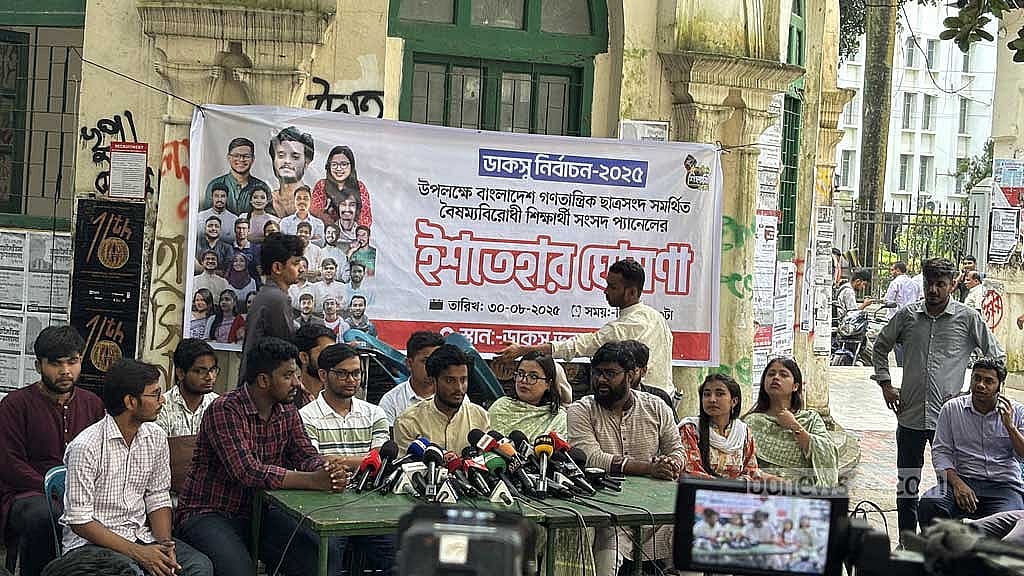
Protirodh Parshad:
• Ensure equal opportunities in accommodation, transport, education and research from the first year.
• Publish a campus charter banning mass rooms, guest rooms, and the ragging culture.
• Guarantee rights and safety for marginalised groups within the university, including women, indigenous students and persons with disabilities.
• Prohibit commercialisation, privatisation and downsizing of education at Dhaka University. Cancel the UGC’s policy paper drafted on IMF and World Bank advice.
• Allocate at least 10 percent of the university budget to research. Modernise every laboratory in consultation with teachers and students.
• Replace privately run hall canteens with cafeterias operated under university administration.
• Upgrade the Shahid Buddhijibe Dr Muhammad Mortaza Medical Centre into a modern facility with a minimum of 100 beds.
[Writing in English by Syed Mahmud Onindo]