Published : 08 Oct 2025, 02:38 AM
Updated : 28 Aug 2026, 01:28 AM


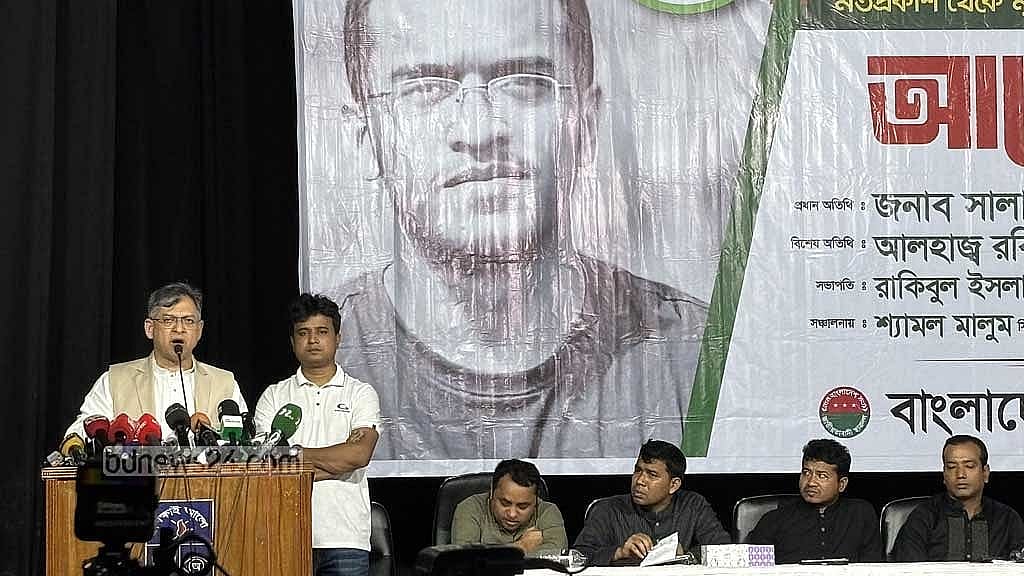
BNP’s senior leader Salahuddin Ahmed has said the sacrifice of BUET student Abrar Fahad laid the foundation for the July Uprising.
Speaking at a discussion organised by Jatiyatabadi Chhatra Dal at Dhaka University’s TSC on Tuesday, the Standing Committee member reflected on Bangladesh’s political history and the evolution of “fascism”.
Salahuddin traced Bangladesh’s political history from British rule, the 1947–1971 period, and the liberation war, noting that struggles and sacrifices of different movements shaped the nation.
He said the 2024 Uprising’s steps were “constructed” on the sacrifices of martyrs like Abrar and the victims of the 2018 Shapla Chattar killings.
The BNP leader said Abrar’s killing must be analysed “historically and theoretically”, rather than reduced to a matter of regional hegemony or simple aggression.
He said British exploitation had intensified after the 1905 Partition of Bengal, which had offered brief hope but was reversed in 1911.
Referring to the 1940 Lahore Resolution, he said it planted the seeds of a new form of domination under the two-state model.
The division between East and West enabled a pathway for post-British control through indirect dominance, he claimed.

Salahuddin said the political history between 1971 and 2024 shows a pattern of “foreign interference”.
He accused ousted prime minister Sheikh Hasina of facilitating this trend, calling her leadership an extension of external power structures within Bangladesh.
He claimed powerful neighbours seek to expand influence by creating ruling elites aligned with their own mindset.
This control, he said, is exerted through education systems, cultural distortion, and ideological shifts that reshape local values.
According to him, the current regime in Bangladesh is a product of this strategy. He alleged that a foreign-backed leadership has “successfully established” political dominance by replicating colonial-style governance.
Salahuddin said the political culture in the country has “declined”, and the only way to remove what he called “bad politics” is by replacing it with principled, democratic values.
Without this, he warned, “fascism” would eventually return.
Abrar, a resident of BUET’s Sher-e-Bangla Hall, was beaten to death on Oct 6, 2019. His killing sparked nationwide outrage and led to a ban on student politics at BUET.