Home
+
Published : 28 Nov 2024, 03:30 AM
"They stormed into our college and attacked us indiscriminately. They were armed with iron rods, machetes, and local weapons. They mistreated our teachers and harassed the female students. They were saying that if we dispersed, they would attack again and set fire to the place. How can college students carry out such terrorist activities?"
These were the words of Nahid Hasan, a student, following the vandalism at Government Shaheed Suhrawardy College and Dhaka National Medical College on Nov 24.
The attack involved students from several colleges in Dhaka, including Dr Mahbubur Rahman Mollah College in Demra.
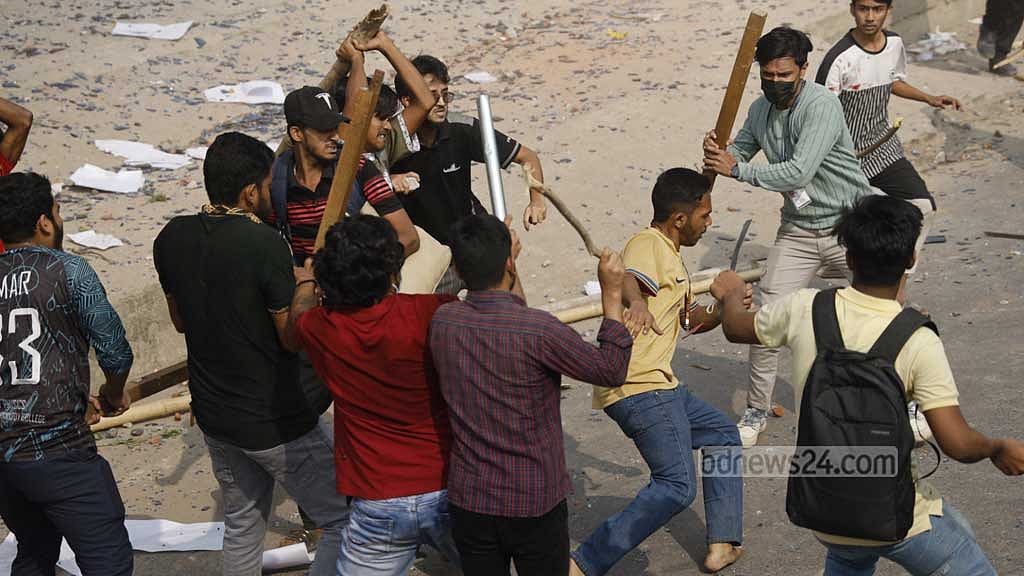
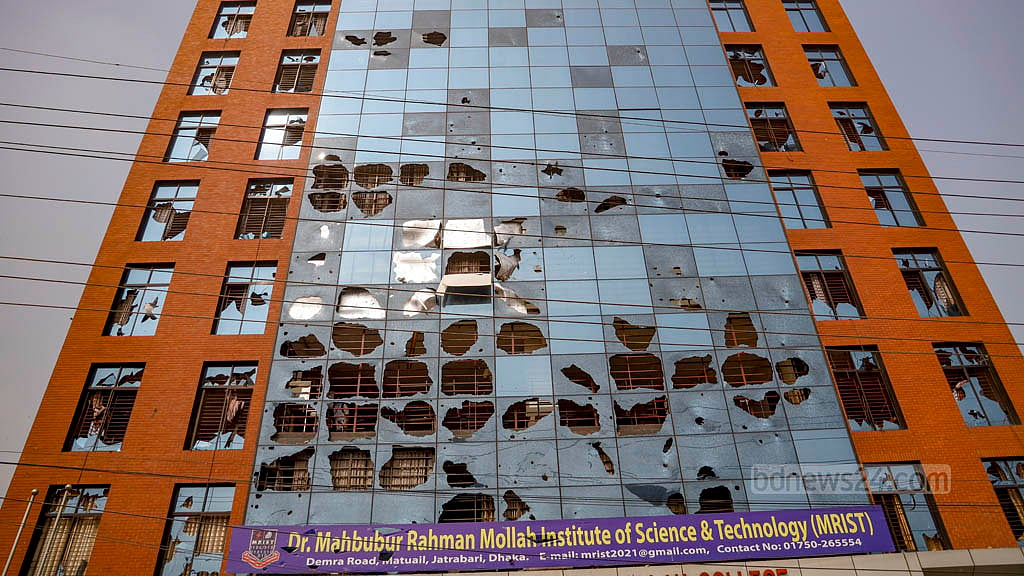
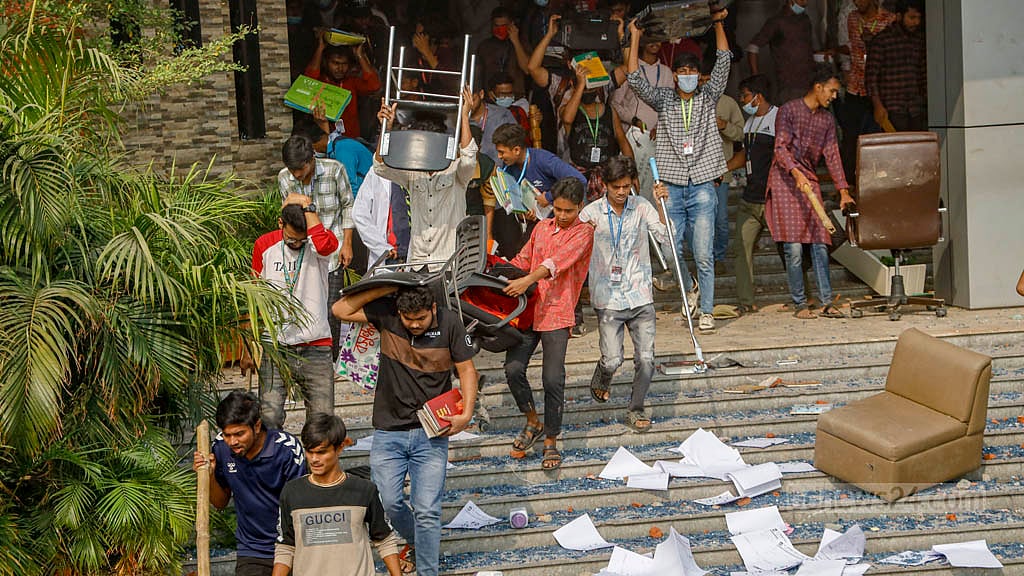
The next day, students from Suhrawardy College and the nearby Kabi Nazrul Government College went to Mollah College in retaliation. There, they carried out widespread vandalism and looting. The sight of injured students lying on the road, being beaten with sticks and bamboo by the opposing students, would make any sane person shudder.
Students from different institutions in Dhaka are getting involved in violence over trivial incidents, such as arguments over boarding a bus or students from one institution having tea outside another institution's campus.
Despite students engaging in clashes openly with prior “announcements”, law enforcing agencies are failing to prevent them.
The government has suggested exercising “flexibility” in law enforcement about students.
However, criminologists believe that applying the law with a “class-based” approach will only fuel a greater “urge” for violence within those specific groups.
Police have yet to confirm any political involvement in the incidents.
However, leaders of the Anti-discrimination Student Movement, which led the July-August uprising, believe the violence may be fueled by the influence of those recently ousted from power.
Psychologists have identified signs of post-uprising instability among students, and educators are urging swift measures to address this.
They have called on the interim government to take steps to resolve minor issues through dialogue, to prevent further disruption.
One of the recent student actions that has sparked intense discussion and criticism was the rail and road blockade on Nov 18.
During the protest in Mohakhali by students from Government Titumir College, who were demanding their institution's conversion into a university, stones were thrown at a passing train.
The incident left several people, including a child, injured.
Some students were later seen protesting against the incident.
The next day, tension flared at the college due to the large presence of police, but the situation has remained calm since then.
On Nov 20, from noon to evening, clashes broke out multiple times between students of Dhaka College and Dhaka City College over a dispute that started with a scuffle and led to bus vandalism, leaving more than 150 students injured.
On the night of Nov 24, a clash broke out between students of Dhaka Polytechnic Institute and Bangladesh University of Textiles, or BUTEX, in Tejgaon after an argument at a tea stall.
Over 50 students were injured in the incident.
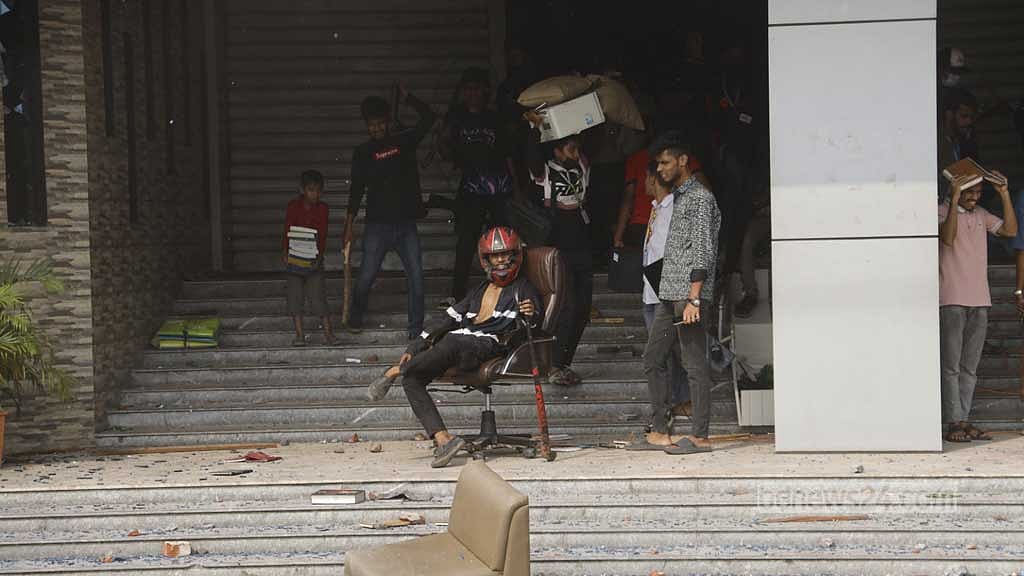
On the afternoon of that day, under the banner of the "Super Sunday" programme, students from Mollah College and several other colleges carried out extensive vandalism at Dhaka National Medical College and the nearby Suhrawardy College.
Students of Mollah College alleged that they were beaten up by students of those colleges on Nov 21 while protesting against “medical negligence” after the death of their classmate Abhijit Howlader, who was suffering from dengue.
The following day, a counter-demonstration dubbed “Mega Monday” was organised by students from Suhrawardy and Kabi Nazrul Colleges.
The fighting lasted for two hours, leaving over a hundred students injured, with vandalism and looting taking place at Mollah College during the conflict.
PERSPECTIVES ON GROWING VIOLENCE
The Anti-Discrimination Student Movement sees the ousted Awami League and its allies as responsible for fuelling these incidents.
Tariqul Islam, the central coordinator of the platform, told bdnews24.com: "The fascist Awami League's allies are instigating these incidents. They are turning small matters into controversies in an attempt to create a national issue.”
"Their main goal is to discredit the students. They want to present the students as criminals before the people of Bangladesh. They are desperate to undermine the mass uprising and portray it as a terrorist activity," he added.
Criminologist Tawohidul Haque described the student violence stemming from arguments or disagreements as "unwanted and unexpected”.
Tawohidul, who is also an associate professor at Dhaka University’s Institute of Social Welfare and Research, believes that when divisions arise over law enforcement, it fuels a sense of violence among others with similar tendencies.
"We think students are making mistakes, and nothing can be said. Some government officials are saying that violence will increase if forceful control is exerted. A question is emerging in law enforcement—students contributed to the July Uprising. Capitalising on this notion, law-enforcing agencies are adopting a more tolerant approach towards students," he said.
Tawohidul advises law enforcing agencies to ensure the prevention of all forms of violence, rather than adopting an 'active in some places, silent in others' approach.
Prof Helal Uddin Ahmed, of the child adolescent and family psychiatry department at the National Institute of Mental Health, or NIMH, said: “There has been a societal shift in the last two months. Post-uprising instability is evident everywhere, even among young people.”
“They have gone through two to three months of trauma and witnessed many incidents. This has caused intense psychological pressure, but we have not taken any steps to address this mental stress,” he added.
To overcome this pressure, the psychiatrist emphasised the ‘crucial role of families and teachers’ in supporting students.
Prof Mohammad Ali Zinnah of Dhaka University’s Institute of Education and Research believes that the instability in educational institutions is negatively affecting students’ academic lives.
"After the July-August uprising, appropriate steps were not taken to maintain law and order. The law enforcement agencies need to be in a position where they can take proper action without resorting to 'repression'. It is the responsibility of the current government officials to ensure this," he told bdnews24.com
“Similarly, students must play a responsible and conscious role. They need to ensure that their freedom doesn’t turn into arbitrariness,” he added.
Professor Zinnah said, “Educational institutions must take the initiative to resolve minor issues through dialogue with other institutions. Instead of creating hostility, there should be efforts to foster friendly relationships between students of different institutions.”
LAW-ENFORCING AGENCIES ROLE IN MANAGING RECENT UNREST
On August 5, the day of the ouster of the Awami League government, police across the country, including nearly all police stations in the capital, were attacked.
Despite attempts to restructure the force, its ability to control law and order has not yet been restored.
In the midst of this, the growing trend of “mob justice” has led to police playing a passive role in many instances.
After a day-long blockade on Nov 18, the students of Titumir College called off their programme at 4pm, citing discussions with the Ministry of Education.
However, they resumed the blockade at 6pm, after talks failed to yield results.
The ensuing disruption caused severe traffic congestion, particularly on the Mohakhali-Gulshan road.
On that day, the law-enforcing agencies played a passive role. However, the following day, a large number of police personnel were stationed outside the college, as well as on the roads around Amtali and nearby areas.
Police forces were also seen stationed along the railway lines.
The same day, Banani Police Station chief Russell Sarwar said: "We have deployed sufficient forces. Under no circumstances will they be allowed to take to the streets. If an attempt is made to block the roads, police will take action."
The OC added that this measure was taken to prevent public inconvenience.
After repeated clashes between students of Dhaka College and City College on Nov 20, the situation required the intervention of the army alongside police to bring it under control.
As a result of the violence, the academic activities at both colleges were later suspended.
On the day of the incident, the Deputy Commissioner of Dhaka Metropolitan Police's Ramna Division Masud Alam said: "Initially, police tried to peacefully remove them from the road. However, the situation became so confrontational that there was a risk of students being injured. In this situation, police used stun grenades and tear gas shells to control the situation."
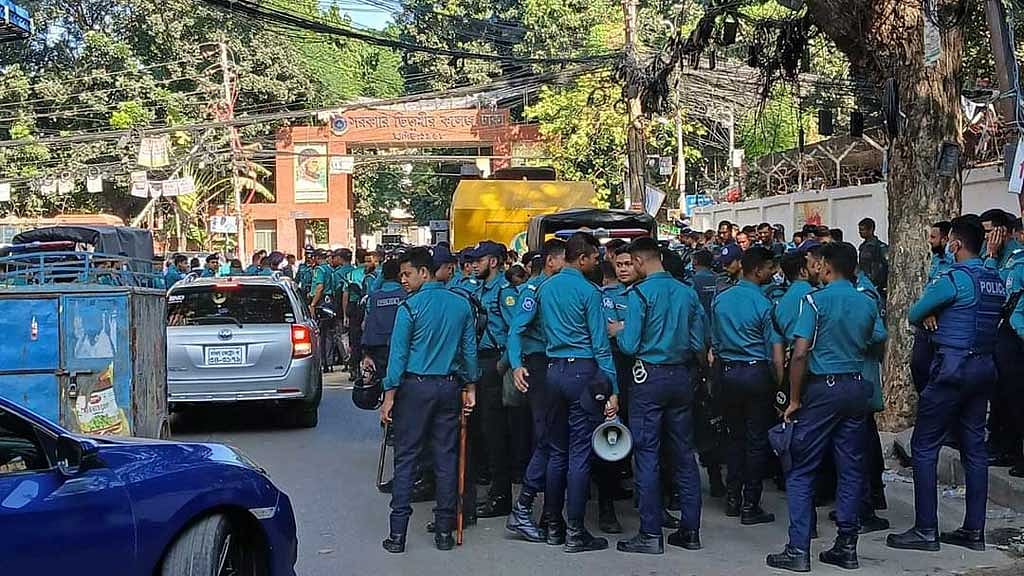
On the night of Nov 24, a group of students from Dhaka Polytechnic Institute and BUTEX clashed in Tejgaon. Although the incident occurred near the Tejgaon Industrial Area Police Station, police were unable to respond immediately due to a lack of capacity. Later, police, along with the military, brought the situation under control after nearly two hours.
A police officer said, "On that day, four students from Dhaka Polytechnic were sitting at a tea shop outside the Shahid Aziz Hall of BUTEX, drinking tea and smoking cigarettes. When they were behaving in an inappropriate manner, students from Aziz Hall asked them to leave. This led to an argument, and a minor scuffle occurred between two or three people."
The officer continued, "Afterwards, the four students from Dhaka Polytechnic left the area and informed other students from their nearby halls, including Latif Hall. In response, students from Dhaka Polytechnic went to Aziz Hall at BUTEX, where they started attacking and beating the students while also vandalising the property."
"Initially, the students of Aziz Hall, who were attacked, informed students from their other halls, and when they arrived at the scene together, a running battle ensued between the two groups, which eventually turned into a clash," the officer said.
When asked about a political connection to the clash, he said: "There was no indication of any political involvement; the clash arose from a trivial matter."
On Nov 24, during the "Super Sunday" programme, students from Mollah College and several other colleges carried out widespread vandalism at Dhaka National Medical College and the adjacent Suhrawardy College.
In retaliation, students from Suhrawardy College attacked St. Gregory's High School and College, accusing them of being involved in the attack.
The institution was subsequently closed.
The following day, students from Suhrawardy College and Kabi Nazrul College initiated the "Mega Monday" programme.
DMP’s Wari Division Deputy Commissioner Saleh Uddin said, “Several thousands of students from some colleges, armed with sticks, were advancing toward Mollah College as per their pre-declared programme. With limited forces, we attempted to intercept them at Jatrabari but failed. They overpowered us and proceeded to the college.”
He added, “According to our intelligence, it appears that a vested group mingled with the students to execute this destruction and attack on the college for their own motives.”
When asked why the police could not stop the attack despite having prior intelligence, the police official said: "Our police force was limited, while their numbers ranged from 15,000 to 20,000. Many of them were disguised as students and ordinary people."
In response to allegations from students that police assistance was unavailable, he said: “The events of the 5th of August caused significant damage to police, particularly in the Wari Division and Jatrabari area. We face several constraints. Deploying all forces to one location creates vulnerabilities elsewhere in Dhaka city.”
The Dhaka Metropolitan Police said in a press release that a Facebook group named United College of Bangladesh, or UCB, comprising students from 35 colleges, was involved in the incidents.
A coalition exists comprising students from seven colleges: Dhaka College, Eden Mohila College, Suhrawardy College, Titumir College, Begum Badrunnesa College, Mirpur Bangla College, and Kabi Nazrul College.
Police claimed, based on analysis of various video footage, that students from multiple institutions affiliated with the coalition participated in the attacks on both consecutive days, alongside those from the directly involved colleges.
WHAT IS PATH TO RESOLUTION?
Regarding the failure to prevent conflict during the recently held “Super Sunday” and “Mega Monday” programmes, Tariqul said: “The fascist Awami League government has reshaped the police force over the past 16 years in such a way that restoring balance will take time.”
He added, "It is easy to remove a few high-ranking officers, but in such a large force, thousands of police officers cannot simply be replaced."
The movement leader said, “Both law enforcing agencies and the education advisor have failed to prevent such incidents. We will soon meet the advisor to discuss the matter."
He continued, “We need to resolve issues to restore peace. It’s the government's responsibility to compensate for the damage done to each campus. Above all, if we can create unity within the student community, these isolated incidents will decrease, and the educational environment will be restored.”
Prof Helal said, “When violence occurs in only a few individuals or a small group, it can be considered a disorder.”
“But what is happening now is a result of social influences, where individuals may be encouraged to engage in destructive behaviour by observing others. It must be tackled on a societal level,” he added.
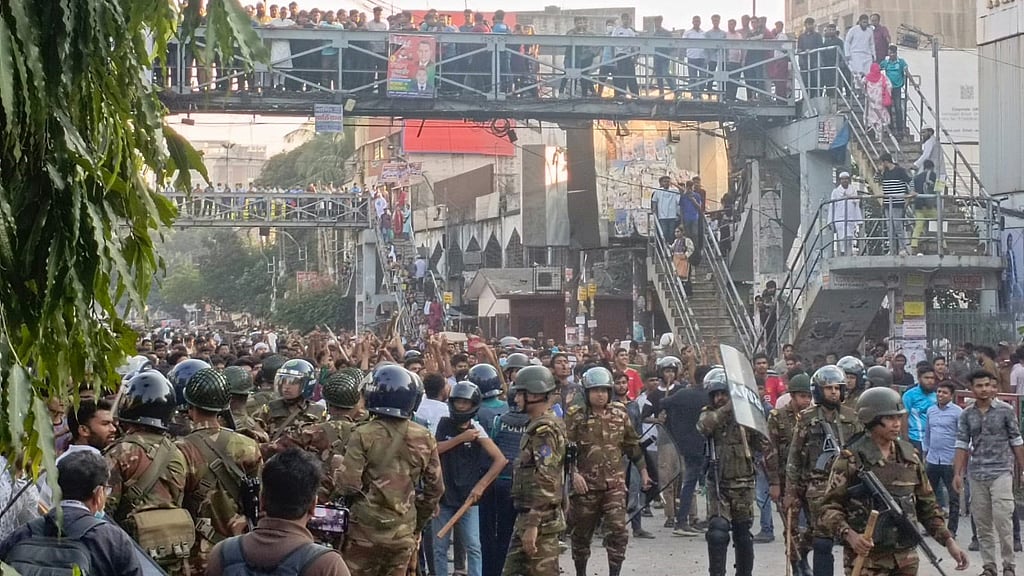
He remarked that this violence is creating safety concerns among others, saying: “Parents, teachers, and the administration must play a stronger role. Similar incidents have occurred in various colleges in the past, but there was no strong response in those cases.
“If we fail to address past incidents, we must assume that similar or even worse incidents will occur again,” said Prof Helal.
He also advised strong law enforcement and recommended that educational institutions engage with parents to take measures.
Amid discussions about why violence persists despite the presence of committees in educational institutions, the Anti-Discrimination Student Movement announced the launch of the ‘National Student Solidarity Week’ programme starting Tuesday.
Abdul Kader, the coordinator of the movement, told bdews24.com: "When students were protesting the death of a fellow student at National Medical College, a misunderstanding arose. Later, students from Suhrawardy College attacked the medical college students. This is where the conflict started. We feel that a group is trying to create divisions among students. Their main goal is to divide the student community."
[Writing in English by Sheikh Fariha Bristy]